Meet the Everyday Heroes - The Voters of 2014
Ink on their fingers
Hope in their eyes
The PowerOf49
Exercise their Rights.
The biggest election in the world, General Elections 2014 are on and people from across the country are celebrating the rights democracy bestows upon them; the right to vote.
Bangalore so far has reported the lowest voter turnout of about 54%. Yet there were a few voters who did step out to vote.
Jaagore asked some of these people what made them vote in Elections 2014.
Akarshitha Nagraj, 24, student

I voted for safety of women commuters, especially at nights. I voted for the educated politicians.
Arshiya Tabassum, 36, software engineer

There is acute water shortage in our area. I have voted so politicians have an answer for this.
Sujita Raj, 39, homemaker

I voted for better roads - so politicians clear up the unfinished roads works that cause immense trouble to commuters daily.
Ammu R, 24, cook

I'm a first time voter.
I voted because I'm sick of garbage strewn across the city haphazardly. I voted so we have a clean city to live in.
Usha, 35, maid

Water from my taps have worms in it. I had complained before, now I voted for clean drinking water.
Prajini, 35, homemaker

I voted for an affordable city. Cost of living is very high here.
Malvika Gupta, 23, software engineer

I'm a first-time voter.
I voted for safety for women in the streets. I also voted for a traffic-free commute in Bangalore.
Anuj Kabadi, 21, content strategist

I voted for empowerment of women through education and employment. I voted for a better country for women.
Naveed Mulki, 28 , media professional

I feel men don't stand up for women enough... there's more harassment than we men acknowledge. I voted this year for safety and empowerment of women.
Share this story on

What voters in Bihar need to know
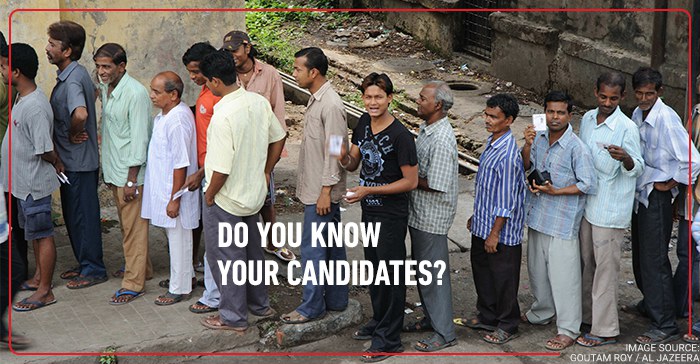
As the date for Bihar’s elections to take off approaches, we wanted to take a look at the issues that Bihar’s voters want resolved.
Bihar’s urban voters have identified subsidized food distribution, better schools, better education and eradication of corruption as their top 4 needs. On the other hand, the top 4 needs of rural voters are the fundamental basics that are yet to be provided: better electric supply, better roads, better hospitals and clean drinking water.
It’s easy to see that the people of Bihar still struggle with basic necessities. This predicament should influence every Bihar voter to be well informed about the candidates they elect to preside over the state’s governance.
The following candidates and MPs/MLAs were analyzed since the 2004 elections:
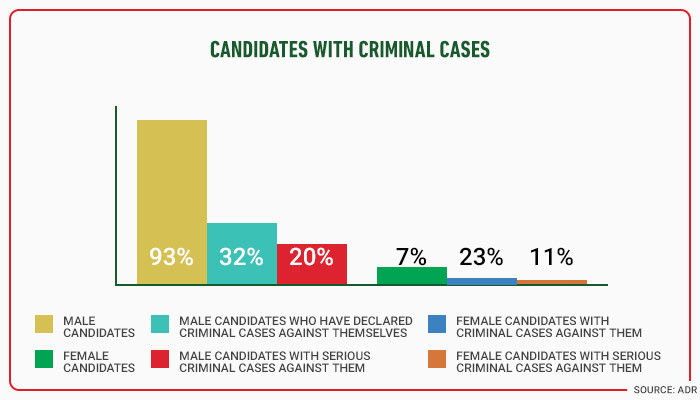
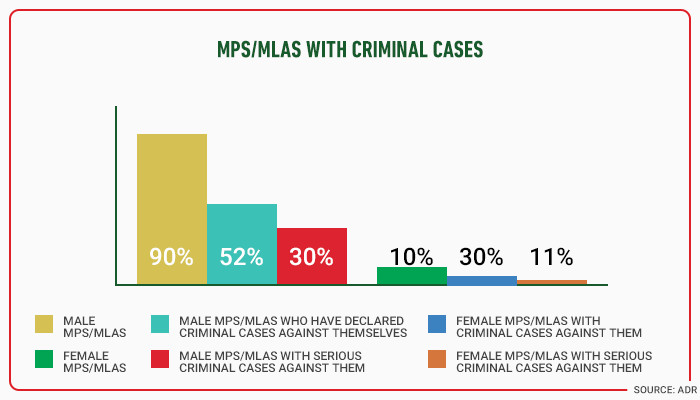
We condemn crime but a significant number of candidates and MPs/MLAs who have been elected or are standing for elections have criminal cases against them.
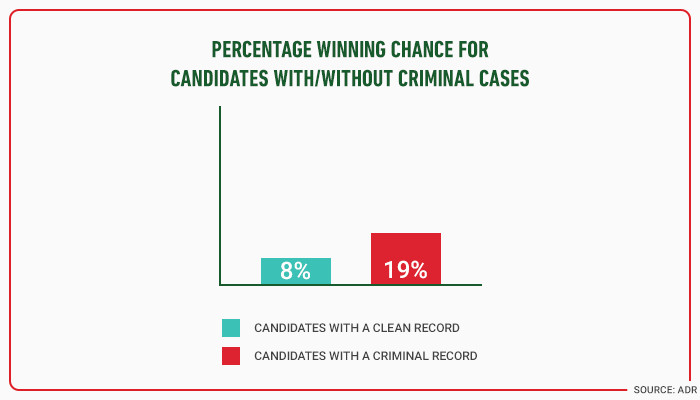
Candidates with criminal cases against them have more chances of winning elections.

Bihar has one of the lowest GDPs per person in the country but the state also has alarming disparity among its population. The above data highlights this as well.
Candidates with criminal cases and some with even serious cases against them have been elected to power by Bihar’s citizens, over the past decade. Being aware of the candidates who are contesting will empower the voters to hold them accountable even after the elections are over.
If you have any comments or views please write to us at jaagore@gmail.com or tweet to us at @jaagore.
Sources:
ADR
Wikipedia
Share this story on
How one state’s election could impact the entire country
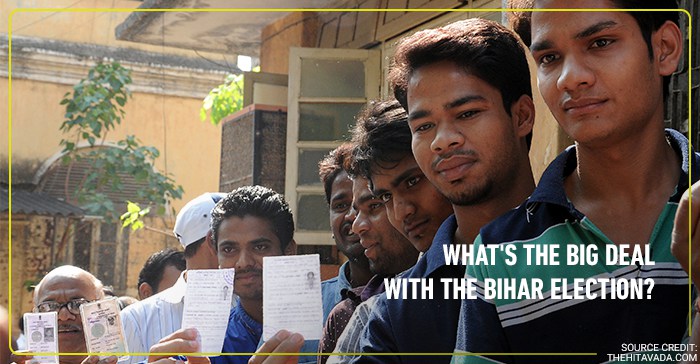
Will the 2015 Bihar election be instrumental in constructing a better India? The Bihar assembly election has caught national attention for several reasons. One one hand we have the people in Bihar choosing its representatives who would hopefully work towards Bihar’s improvement, and on the other hand we have the ways in which Bihar elections will affect the centre.
We asked expert Richard Rego (scroll down for Richard’s bio) about why he thinks Bihar election is important and how it will influence India, and here’s what he had to say:
1. What are the most important concerns that people in Bihar need to demand from its leaders this election?
Accountability and transparency from its leaders. A strong and independent Lokayukta along the lines proposed by Anna Hazare. If the elected leaders are made accountable, a lot of things will fall in place.
Second, creation of jobs for its youth. Problems of crime and violence could be attributed to unemployment and lack of opportunities. These are two major areas that the electorate must demand to be addressed on a war-footing.
2. How is Bihar election a matter of national interest in terms of the impact it will have on the nation?
The on-going elections point to the development-potential of the country. For a long time, the rest of the country did not think of Bihar in compassionate terms, but the current crop of voters have proved how a thinking electorate can change the fortunes of a party on development-plank. If, for example, a dependable / 'meritorious' party is voted to power, there is the promise of development; the nearly 20% increase in women's literacy rate in the last five years is testimony enough.
Also, in the recent years, Bihar has shaken off its unenviable 'bimaru' tag. This bodes well for the country and fills the electorate with hope of development, elsewhere too.
On the flip-side, there is fear of other states which benefited out of Bihar's poverty! A developed Bihar will not have to depend on other states, like it had to all along. This may eat into the cheap work-force (construction, driving) and educational (students) migration to other states. Till it rains, everybody loves a good drought!
3. How will development in Bihar affect India’s overall development?
In spite of its rich natural resources, Bihar is one of the least developed states of India (with a poor 0.3 on Human Development Index against the national figure of nearly 0.5). For now, India's progress has been highly skewed because of Bihar's (and a few Northern and North Eastern states’) underdevelopment. A well-developed Bihar can add noticeably to India's employment, education, production, and GDP.
4. Migration is a major issue in Bihar. How do you think should this concern be addressed in this election?
The major reason for migration in Bihar is lack of educational and job opportunities in the state. If the authorities work towards job creation, better educational environment, and a fear-free society, migration will reduce; people feeding on the state's resources will also feed the state with their constructive output. Electors and the contestants should have this firmly etched in their minds. No-work = No-votes should be the mantra.
5. What is the significant role women voters play in this election?
Women voters constitute almost 47-48% of the electorate. It is a huge population to swing the tide in favour or against any party. They are the ones who are exposed most of the election campaigning at home directed through various media. It means, they are also aware of the candidate-profile. If women demand better living conditions, better job opportunities for their children, and disruption-free education, services and production, the "best promising party" will win, and we can hope for better delivery. In addition, alert and conscious women can influence the men-folk and their candidate-choice.
6. What is the significance of women politicians in Bihar elections?
Bihar has not been known for its women politicians. Probably, not many women are given an opportunity or permitted political consciousness to test waters. Consequently, men have continued to rule by proxy, even when the mandate was for women to govern.
There is an exception though: At a press conference in late 1990s, one of the former CMs, Rabri Devi (not in the limelight till she assumed office as CM), asked her husband to 'let her talk'! It means, if a woman is empowered, there is a chance for other women and oppressed groups to get out of the shadows of their political masters.
For now, the picture is a bit bleak: Of the 456 candidates in the fray in the second phase, only 32 are women, and of the 583 candidates in the fray in the first phase, only 54 were women, contesting 49 seats. This comes to a meagre 8.27% of women contesting in the first two phases, out of the 1039 total contestants in 76 Assembly constituencies; of these fewer are likely to win, bringing down the women-leaders' number.
It is like current Lok Sabha which has just 61 women in the 534 seats. Nothing much has happened at the national level; and nothing different may happen at the regional level, either. But the scope for hope is galore, given the transformation women can work out for themselves and households.
7. How important is the participation of the youth in Bihar election?
Youth form a huge chunk of the electorate, like in any other Indian state. The importance of youth participation has to be understood in the context of their exposure to social media. Politicians employing social media for campaign, stand to gain big time by luring the youth. So, if a party has something substantial to offer the youth in terms of quality education, good job opportunities, freedom of movement, and a safe and better society, it stands to gain from the youth votes.
Bihar can make a significant contribution to national development if the elected government is able to tackle the various issues affecting the state, and channel its resources to judicious use. The power to make a difference ultimately lies with us. We need to exercise our voting rights to choose a responsible government, and then also follow up with the government to ensure that it functions as it should.
To know more about voting-related issues and information, check out our Elections Section. You can also write to us at jaagorein@gmail.com, and on our Facebook page, or tweet to us at @JaagoRe
More about the Experts:

Share this story on
Register to Vote in 3 Easy Steps!
Women make up 49% of the voting population, yet a large number of women are not even registered voters. This year it's time to change that! With the 1st phase of the election starting soon, ensure that you register to vote now. Follow this easy process to create your Voter ID :
.jpg)
1. Fill in the Form 6
The first step to registering for your Voter Card is filling in Form 6 - http://www.jaagore.com/vote/register-to-vote
2. Organize your Documents
There are some basic documents you need to submit with your Form 6. These documents need to be attested or certified before you submit them.
ID proof: Everyone needs to submit ID proof: Any government recognized photo identification will suffice. For instance:
- Passport
- Driving License
- Pan Card
- Student Identification Card
Address Proof: You need to submit a proof of residence. You need to have lived at that address for 6 months to register to vote at that address. Any of this documentation will serve as address proof:
- Bank / Kisan / Post Office current Pass Book
- Ration Card
- Passport
- Driving License
- Income Tax Assessment Order
- Latest rental agreement
- Latest Water / Telephone / Electricity / Gas Connection Bill for that address, either in the name of the applicant or that of his / her immediate relation (parents) etc.
- Any post / letter / mail delivered through Indian Postal Department in the applicant’s name at the address of ordinary residence.
If these documents are not in your name and are in your landlord's name, she or he can sign an affidavit stating that you stay at the mentioned address. If your proof of address is in a family member's name, you need to prove the relationship; you will need a birth certificate to prove a relationship to your parents, and a marriage certificate if the address is registered in your spouse's name.
Age Proof: If you are between the ages of 18 - 22, you need to submit age verification. Any government recognized documents will suffice, such as the following:
- Birth certificate issued by Municipal Authority or district office of the Registrar of Births & Deaths or Baptism certificate
- Birth certificate from the school (Govt. / Recognised) last attended by the applicant or any other recognized educational institution
- If a person is class 10 pass (or above), he should give a copy of the marksheet of class 10, if it contains date of birth as a proof of date of birth
- Marksheet of class 8 or class 5 if it contains date of birth
- Passport
- PAN card
- Driving License
- Aadhar letter issued by UIDAI.
3. Submit your form 6
You need to submit your Form 6 and certified documents to your nearest ERO. You will receive a receipt on submitting your form; keep it handy as you might need it to trace your forms!
It should take about a month to 45 days for you to find out about the status of your voter ID. Either you will get a call or receive it in the mail. If you haven't received it, you could contact the ERO office where you submitted your form with the receipt you received upon submitting your form.
If Election Day arrives and you still don’t have a voter's ID card, you need not worry - as long as your name is on the election rolls, you will be allowed to vote. Just carry your photo id (DL, Pan Card, Passport etc.)
For more information, you can also visit http://www.jaagore.com/vote/faq/
Share this story on
5 reasons why we are such lazy voters
.jpg)
1. We hate standing in queues
Election day is a declared bank holiday. So why would we stand in long queues when we could be enjoying ourselves anywhere else?
We'd rather wait in a really long line to buy tickets to the latest blockbuster movie… but waiting in a line just to cast our votes? Nope, we'll pass.
2. We don’t like the effort that comes with it
The process of applying for a Voter ID is too tedious. Moreover, we don’t want to take the trouble of doing our homework in finding out our constituencies, our MPs or our polling booths. It’s too time consuming, and definitely not worth our effort.
We wouldn’t mind going on a hunt across the city to find the perfect pair of shoes – but when it comes to making a difference to the country…that can wait for later.
3. We don’t really care
It's not like we as citizens are directly affected by the person who comes to power, right? We can complain all we want, but to actually do something about the problem? Now that's pushing it!
4. We find it boring
Just to open the newspaper and read about election coverage is so boring, when we would rather be reading about pop culture.
But Politics? BORING!
5. "Things will never change anyway."
All the politicians are corrupt and one single vote is not going to make any difference. Like, Seriously!
We get what we deserve
These are the exact reasons why we live in such a troubled country – we deserve it. If we make excuses and do not wake up from our apathy, things will worsen for each one of us. Let’s learn to be responsible citizens to pass on a better India to our children.
The first step in being good citizens is in exercising our most basic right: the right to vote. We lose the right to demand a better city, a better state or a better country if we do not exercise our right to vote.
So don’t be lazy, own up to your country, go out and vote!
Share this story on
8 Ways To Become a Good Voter
Enough has been said about what politicians ‘do or don't’. We, the society, must learn to practice what we preach. Before we point fingers at anyone, we need to ensure that we have done our bit.
Before we get politicians to take their oath to office, let's take our Pledge to Vote!

Cast your Vote
I pledge to honour and respect my vote by casting it
People's Power
I pledge to make the leaders in power come to terms with the power of people - i.e. the power of our votes.
No more Complaints
I pledge to not complain about bad governance but to do something about it – by making an informed choice and holding the elected representatives accountable.
Educate Myself
I pledge to educate myself about my local constituency's MP and the parties contesting, so that I can make an informed choice.
Promote Informed Voting
I pledge to educate myself and others on the procedures to vote, and encourage others to vote.
No to Petty Politics
I pledge to not be influenced by religion, caste, race, community or language, when voting.
Vote to Change
I pledge to understand that my vote is my chance to bring about the desired changes in my country, and I pledge to not waste this chance!
Vote Wisely
I am a voter, and I will vote wisely!
Share this story on
Highlights of Budget 2016-17
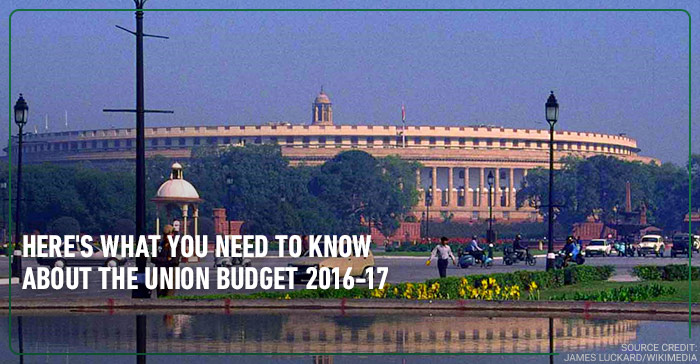
Every year, on the last working of February, the Finance Minister of India announces the Union Budget Plan for the next financial year. The Budget for the financial year 2016-17 was announced on 29 February 2016. What are the highlights of the new budget 2016-17, and how will the changes in the union budget influence our lives in the coming financial year? Here are a few points explaining it:
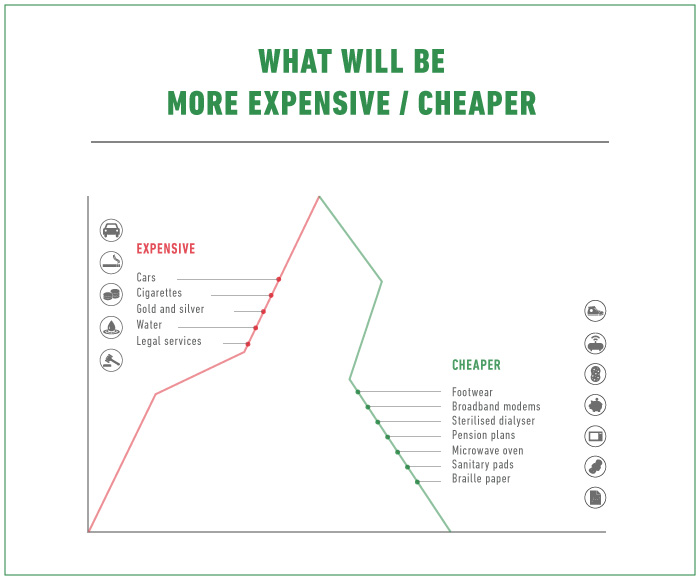
Changes in taxes
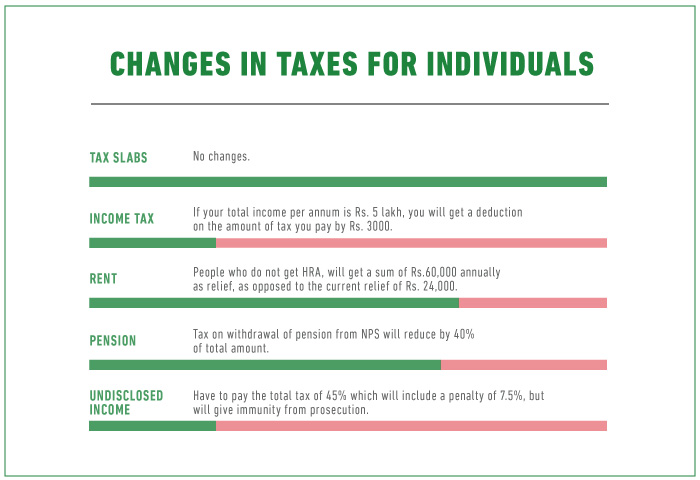
No Change in Tax Slabs: There is no change in the income tax slabs, existing slabs to continue.
Income tax: Under the new Budget plan, the deduction limit of the Income tax for people earning less than Rs. 5 lakh per annum has been increased to Rs. 5000, from the existing Rs. 2000. This means that if your total income per annum is Rs. 5 lakh, you will get a deduction on the amount of tax you pay by Rs. 3000.
Rent: The taxpayers who do not own a house and do not receive House Rent Allowance (HRA) from their employers, will get a sum of Rs.60,000 annually as relief, as opposed to the current relief of Rs. 24,000.
Pension: The National Pension System (NPS) is reducing the tax on withdrawals by 40% of the total amount accumulated, i.e. you will pay 40% less tax on your pension under the NPS. This will make the National Pension Scheme more competent against other pension products like Public Provident Fund & Employees’ Provident Fund, where the withdrawal is tax -free.
Undisclosed income: If you declare undisclosed income you, will have to pay the total tax of 45% which will comprise of 30% Income Tax, 7.5% surcharge and penalty of 7.5 of the undisclosed income. This will give you immunity from the prosecution.
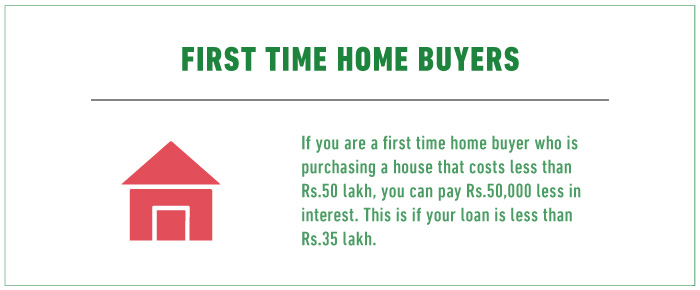
Impact on start-ups
.jpg)
Profit tax deduction: Start-ups to get 100% deduction for their profits for the first 3 out of 5 years, it has to be set up during April, 2016 to March, 2019 but MAT will apply in such cases.
Funding: Funds for SC/ST & women Entrepreneurs: Stand-Up India scheme will allocate Rs.500 crore for the SC/ST & women entrepreneurs.
Impact on companies
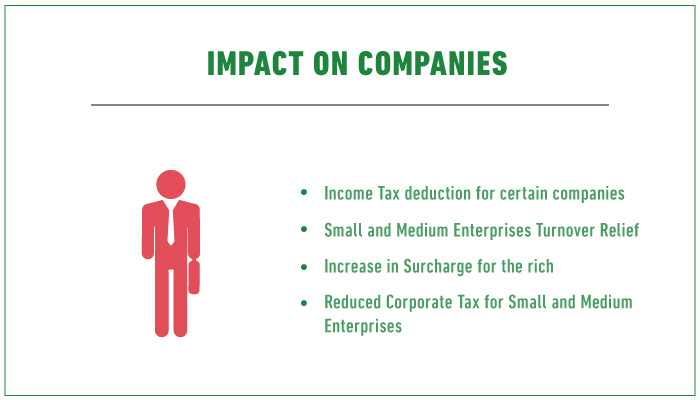
80JJAA deduction for companies: Companies that are subject to statutory audit and are undertaking certain industrial projects, will get deductions in income tax.
Micro, Small and Medium Enterprises Turnover Limit: The tax deduction limit for MSMEs (Micro, Small and Medium Enterprises will be raised to 2 Crores, from the existing 1 Crore. This will be a huge relief for small enterprises.Individual Professionals too can avail of this scheme. Their profits will be deemed to be at 50% with gross receipts up to Rs.50 lakhs.
Increase in Surcharge for the rich: The upper class will have to pay more income tax due to increase in the surcharge rate from the existing 10% to 15% , this applies to the individuals whose earnings are more than Rs 1 crore.
Corporate Tax for Small and Medium Enterprises (SMEs): Corporate tax rate for the relatively small enterprises i.e companies with sales not exceeding Rs. 5 crores (in the financial year ending March 2015) is reduced to 29% plus surcharge & cess.
These are a few highlights from the Budget 2016-17. If you have any specific questions or suggestions, do write to us on Facebook and Twitter pages, or email us at jaagorein@gmail.com.
Source of Information: Rishabh Parakh (CA)
About the Expert:

The Hindu
Indian Express
Share this story on
What is India's Union Budget?
The Annual Financial statement of India, or the Union Budget is announced every year on the last working day of February. This year, the new Budget came into effect from the 1st of April 2016. We wanted to understand the meaning of the Union Budget, and how it is divided among the different ministries of the government.
Here's a short video explaining the Union Budget of India:
To know how the Union Budget 2016 will affect you, watch this video on impacts of Budget 2016.
Do you want to know more about the way the budget is allocated in a financial year? Write to us on our Facebook and Twitter pages.
We sincerely thank CA Rishabh Parakh for his valuable inputs.
Share this story on
6 questions we need to ask before financial planning
.jpg)
What is the best way to ensure financial stability? The answer is simple - by planning. A few financial resolutions and goals can help sort out a person’s financial year, and one’s life. As we begin a new financial year, here are some important questions to ask, and some tips and tricks to set your financial figures right.
Q1. What is the purpose of financial planning?
There should be only one purpose to plan your finances - to achieve ultimate “Financial Freedom”. It means attaining that situation in life wherein one can do whatever one wants to do. For e.g. what will you do if you get Rs. 100 crores in your bank account today? Will you still do the same work what you are doing today? Probably Not! Then what will you do, help you set the foundation for real financial planning.
Also, in case a person is no longer able to earn and support the family, like in case of ill-health, accidents, or untimely deaths, planning will ensure that financial settling with family members and dependants is sorted.
Find out the highlights of India’s Budget 2016-17 HERE.
Q2. Why should I invest?
This is a basic but very important question that people fail to ask. One needs to decide if the planning is for retirement, or for children’s education or house or a Car, etcetera. This will help in setting targets.
Q.3 What will happen if I lose my job?
It is essential to have a contingency tentative plan for what to do if suddenly there is no steady income & job. One needs to take steps to improve your financial situation and build on cash reserves while still investing for achieving other goals. This cash reserves should be easily accessible whenever the need arises, as withdrawing money out of other funds like PF/FDs/MFs would be detrimental to overall financial life.
Q4. When do I want to retire and how do I plan to spend my retirement years?
One’s plan should not just be about earning till retirement, but also about how one wants to spend life after retirement. This is key to setting goals and planning one’s finances.
Q5. Which Financial Products should I invest in?
You need to plan your investments carefully amongst the numerous financial products available in the market ranging from Mutual Funds/Equities/ PPF/ FDs/ Bonds/Gold/Silver/Real Estate and a term insurance for securing your life.
Q6. How was my financial performance in the previous financial year?
It is good to do some self-appraisal by asking the following questions:-
Did I accomplish my financial objectives last year?
What was my income & Total Expenses both expected & unexpected?
Did I pay my EMIs/Dues in time or any Late payments; if any?
How much returns I made on my investments; did I exceed my target?
Did I have any surplus money which was lying dead in account only?
Did I touch my emergency fund or didn’t even create the one?
Did I borrow any money and if yes then for what purpose?
Doing this self-examination will open up the ways to set new year targets for accomplishing Financial objectives.
Savings and smart investments are simple steps to create long term wealth & assets for securing your future so make your yearly finance plan today and be stress free & welcome financial year 2016.
If you have any queries about financial reforms and planning, you can ask expert Rishabh Parakh by commenting on our Facebook and Twitter pages.
More about the Experts:
Share this story on
The impacts of Budget 2016-17
The Budget plan for the financial year 2016-17 came into effect from the 1st of April. To understand how this new budget will affect the lives of common people, we spoke to financial expert CA Rishabh Parakh, and created this video based on his inputs.
Watch this video to know how Budget 2016-17 will have an impact on your life:
To know more about the Budget 2016-17, click here.
Share your views on Budget 2016-17 on our Facebook and Twitter pages, or email us at jaagorein@gmail.com.
Share this story on