Why we should not forget the reason women are mistreated today
In the previous article, Macho Kumar was confronted with the reality of the gender police and the fear, ostracisation and conditioning that has gone into framing our gender identities.
In this article, feminist scholar and activist Ashwin Mohan seeks to address his doubts and helps clarify them.

Macho Kumar was struggling with the idea that behaviour does not make him a man and that he didn't have to earn his gender identity in any way. I could see his neurons fire as his eyes darted struggling from one inconsistent thought to another until he summarised his learning, "I've been wasting so much time."
I smiled.
Me: How Macho?
Macho Kumar: I have a script. I believed: If I didn't live according to that script I wouldn't be a man and my world will collapse, and people would laugh at me. I was afraid that they would call me 'homo' and 'faggot' because they thought I wasn't brave; like a man.
Me: I want you to think of bravery Macho. Don't you think homosexuals are brave to come out as gay? When they know the gender police will never accept them? They have to be prepared to fight physically as well when they announce that they are gay. What's braver? Them or the people that follow gender roles imposed on them from the past?
Macho Kumar: Are you saying that homos are more of men than macho men?
Me: Macho, gender is not a choice, you either identify as a man or a woman or you can be a switch between the two depending on who you are with. It is never a choice. Secondly, bravery is a human quality; not an exclusive male quality. Now answer your own question.
Macho Kumar: Heh. I see the difficulty I have in accepting that gender is not determined by actions, it's time to tell me about the monkeys. Also, I'm glad to report that I'm not feeling frightened anymore about anyone questioning my masculinity... temporarily. I say temporarily because I'm certain I'll go back to the old way of thinking once you're gone... does your monkey story have something to do with why we're all so inconsistent?
Me: Well, not all of us are inconsistent. But most of us are and yes, the monkey story gives you a solid clue as to why. Then you can tell me what you learned from it. Cool?
Macho Kumar (enthusiastically): Cool!

Me: This actually happened. I might be wrong about some facts, but rest assured I haven't mangled any important parts of the story. So these researchers, who were studying primate behaviour, particularly social behavior, rules and how they are formed, got hold of a large set of monkeys. They put 4 monkeys into a cage. Right in the middle of the cage, a large bunch of bananas were suspended.
Macho Kumar: Bananas are very tempting for a monkey.
Me: Haha, really? I thought that was a stereotype. Anyway, in the story they were more than tempting, they were irresistible. The monkeys allowed their leader to go first. As soon as the leader touched the bunch of bananas, they sprayed all the 4 monkeys with a jet of water from a powerful hose. All of them got drenched and miserable. The leader tried once more, and the others let him because he was the leader. Consistently the monkeys were drenched when they reached for the bananas, and in an hour they had learned that the bananas in this cage were bad news: if you touched them you got drenched and thrown with force against the cage, dripping wet. The researchers had created a new social order by being consistent in drenching them. And the monkeys learned: don't touch bananas.
Macho Kumar: Why didn't they learn that touching bananas can get you drenched only in this cage and nowhere else?
Me: Because that's how mammal brains work. On heuristics, ‘heuristics’ are methods to make storing information least costly for the brain, using lesser brain cells and lesser energy. Heuristics make you forget everything except what is perceived to be of value. It's easier to remember, 'don't touch bananas' rather than the reason for not touching bananas.
Macho Kumar: 'Hew-rustiks'. You know many fancy words.
Me (smiling): Yeah, does it make me more of a man?
Macho Kumar: Stop mocking me man. What happened next?
Me (grinning): Ok. Moving on. The researchers replaced one monkey in the cage with a monkey that had never been drenched. Guess what the new monkey did?
Macho Kumar: Went straight for the bananas of course.
Me: Yup. And the other three...
Macho Kumar(interrupting): Beat him up?
Me: Yes indeed, they used their fists to hammer his head.
Macho Kumar: Did they hose them down again?
Me: No. The water spraying devices were sent home. Their use was over. And guess what, one by one all the monkeys were replaced until there were no more monkeys in the cage that had been hosed by water jets. Still, not one of them was allowed to eat the bananas by others in the cage.
Macho Kumar: Astounding
Me: Nothing astounding. That's how the gender police works. Imagine the cage was India and the monkeys were us. And the freedom to eat bananas was gender freedom.
Macho Kumar: So you're saying we have forgotten the reason women are not given freedom?
Me: Yes. That has happened. There is no reason offered to a girl why she can't do things that a boy is allowed to do other than, "you're a girl".
Macho Kumar: Yeah that's what I tell my daughter. I also tell her "you'll get raped".
Me: Interesting. Do you know why men rape?
Macho Kumar (upset): Why will I know, I've never raped anyone!
Me: I know Macho. I believe you. Other than a rapist, do you know who else should know why men rape?
Macho Kumar: Who? Who?
Me: People who want to stop rape in this country.
Macho Kumar (meekly): Oh... Ok. So, why do men rape?
To be continued in episode 3. Why men rape.
More on the writer:

Disclaimer:
Views expressed here are of the author alone and do not necessarily represent that of the brand.
Share this story on

Freedom at midnight

We have just seen a play that spills over with laughter,
The actors are easy with their bodies and I am jealous,
I dream of a life where I can skip on the street.
Later in the taxi, it is 1 AM and I peer out the windows.
In these lengthening hours, my city is a city of men.
Men eating, men talking, men just lingering,
Men relaxed and easy–too easy–with their bodies.
The few women, they clench and steel themselves
They form tight little groups and walk quietly
They step aside, they jump back, they walk away.
Their bodies betray them as they navigate the night.
"There's so much sex there", an uncle said of Europe,
"People kiss and do all kinds of things on the streets."
— Oh uncle, but sex is here. It is here, it is here.
Come walk like a woman once in your India.
When I was 12, I was cycling home from school
A man followed me close, making kissing noises.
When my neighbor was 16, a man at the saree shop
Groped her as he spread sarees for her grandmother.
When my aunt was 40, a man unzipped, exposed himself,
In the lane just next to her daughter's school.
And I remember as clear as day, walking with my mother
And hearing a man singing dirty songs at her.
Once a man whispered to me, "Read Kamasutra?"
I was 19, on a train, with my father next to me
"But he's an executive!", my father said when I told him,
My face burned with a shame that I cannot explain.
Talk is cheap for those who say, "She wears short skirts"
I was in my school uniform, my neighbor in her salwar
My aunt and my mother were in sarees with flowers.
"Oh, it's just hormones. Let boys be boys!"
Those men were 16, and 25, and 45, and 60.
One was a 14-year old whistling at the bride,
Learning even then that music was a weapon.
"This is what happens in Westernised cities.
These things happen in India, not in Bharat."
– It happened in Madras, and it happened in Bombay,
It happened to my cousin in a little town,
At our village, it happened in the temple street.
And these are only the stories I remember.
It happened so often that we forgot to keep count.
So many men on the bus with their fingers poised
Too many men with their erections poised.
Men taunt us on the streets open and unashamed
Like we are dogs straying into sacred places.
1947, you say? "India awoke to life and freedom."
Indian women are wide-eyed, awake, and still waiting.
More on the author/poet:

Disclaimer:
Views expressed here are of the author alone and do not necessarily represent that of the brand.
Share this story on

Voices of Men: American activist challenges reactions to abuse in India

Ben Zeman at a gender sensitisation workshop in Vijayawada, Andhra Pradesh held last week
When Ben Zeman was in college, his girlfriend told him that she was once raped. Other women he met told him that they had been harassed on the street, harassed at work, listened to less than their male counterparts.
Learning about this, Ben took it upon himself to be the change he wanted to see. Over the past 30 years, Ben has worked with domestic violence programs and rape crisis centres as a prevention educator. His play, Voice of Men has been performed in the US and 10 other countries and it addresses sexual and domestic violence using humour to reduce audience defensiveness.
Ben identifies himself as a "recovering sexist" and believes every man must challenge violence and sexism in the world and in themselves.
He is now on a tour of India appointed by the Consulate of India and the US Government to raise awareness about crimes against women.
Jaago Re spoke to Ben Zeman on important facets of women's issues. Here's what he said:
Most common myths/knee-jerk reactions to violence against women
"Violence/abuse is physical"
Abuse is not just physical. Telling a woman what she should be wearing is abuse. When she says 'No'; trying to change her mind is abuse. Calling someone fat or ugly is abuse.
"Rapists are two-dimensional and inhuman"
The reality is that these men are friends, brothers, fathers. Some of them are respected and powerful men in society.
"Alcohol/dressing causes rape"
Blaming alcohol is the same as blaming the victim. It's another excuse; the same as, "I raped her because I lost my job, I raped her because of the way she walked." There's never really an excuse for sexual violence or domestic violence. Stop avoiding responsibility.
Being violent is a choice. If we're held accountable, we won't do it. It's time we held each other accountable.
"Only women are victims"
Men are also victims of sexual violence, and I am concerned about them. Very often, the culprits are heterosexual men. This is because sex crimes are not about sex, but about power.
"Women are framing men in false cases"
A vast majority of victims are not lying. Most victims of violence are women and children, and they are telling the truth. Women don’t lie about rape and violence.
"Not all men are the same"
A lot of men feel defensive when such discussions take place. Men don’t have to claim that we are all horrible people. Yes not all men are the same, but majority of men are silent on these issues. Men need to stop being silent. By telling a woman "not all men are the same" when she speaks of violence, it's like telling her to shut up. Instead of being defensive, we need to listen.
In Nepal, I met girls as young as 10 years old trafficked to Mumbai. Most never returned. The ones that did manage to escape and come back had HIV. Men need to hear these stories! People should get busy supporting women's groups.

What I want to tell the criminals who indulge in such acts
I want to tell the culprits they think they have the right to control women: their days are numbered. Women and their male allies are changing the world. If they resist, they will face prison, and if they come along with us they get a chance to lead respectful and happy lives with the women in their lives.
What I want to tell the victims
It's not your fault
Many times victims blame themselves or get blamed by others.
You're not alone
Sometimes the victims don’t tell anyone about the abuse. I would advise them to tell someone safe – someone close to them. All the NGOs and support systems are built for them.
Help is available
There are plenty of helplines which are trained to deal with these issues. Make use of them.
That I believe them
There's an incorrect notion that women and girls are lying about sexual abuse or violence, and that they "asked for it". Women and girls are not liars. They lie by omission, based on how they are treated. I believe in her.
Robbing our societies of women
He also spoke on the recent Baduan rape in UP where two minor girls were gangraped and hung on a tree. “It’s heartbreaking. These two girls could have been the next Einstein or Marie Curie. The intelligence, creativity, beauty of these two souls is just gone. Criminals are robbing our families and societies of women everyday.
We cannot survive as a human race if crimes against women continue
Each act of violence is not just a crime against woman, but a crime against all of us. We cannot survive as a human race if crimes against women continue.
I want to encourage Indian men to work together to stop crimes against women. I want to urge men to listen to women and learn from them. I want to invite everyone to join hands for this important cause.
Schedule for India tour
Do make sure to catch him live in action. Here's his full schedule in India.
August 19-23 Kolkata
August 24-25 Chennai
August 26-27 Coimbatore
August 28-31 Delhi
If you want to report cases of harassment, do push the pin here
Share this story on

Will more toilets help solve India's rape problem?
Chennai Corporation, the local municipality body will introduce 1000 She-toilets soon. Is there a connect between lack of toilets and attacks on women?

Seen here, a woman checking the e-toilet in Kerala House.
Of late, reports of rapes (especially of minors) coming in from the heartland, have seen an unprecedented rise. Many of these girls have been raped on their way to fields they use to relieve themselves.
This has brought to attention the lack of public toilets for women. Half the population in India doesn't have a toilet in their homes.
Has lack of toilets left the women more vulnerable to attacks? It has been widely debated upon even in international media. However, there has been a consensus that citizens' right to public spaces is of paramount importance now.
Al Jazeera reports: The point really is that women should have access to public spaces even after dark without fear, whether they’re toilets in tiny villages or streets in big cities. What’s more, going to the fields provides women with a space to chat and hang out among themselves. The presence of private toilets may well erode women’s capacity to loiter in this fashion.
Chennai Corporation to build 2000 toilets
Perhaps one positive move in the wake of such reports would be Chennai Corporation's commendable decision to construct around 2000 toilets in the next one year.
Around 2000 e-toilets will be introduced in places like bus stands, market places and other open spaces.
The news comes as a great relief for women who work outdoors and spend many hours of the day outside of home. There are plenty of women (labourers, hawkers etc. ) who work on the streets and cannot afford a toilet in their homes.
"This is the first time Chennai Corporation has done a detailed survey and mapping of places where public toilets are required and where the public oppose it," said a senior corporation official.
He further stated, "The survey has identified need for both male and female public toilets. Based on the survey, 2,000 units of toilets i.e. 1000 for men, and 1000 for women will be constructed across 348 locations in the city."
What's more, it's an e-toilet.
Reportedly, e-toilets will be fully automatic with auto-flush, auto-cleanup and auto-fans and lights which turn on/off when person enters/leaves.
State governments are increasingly opting for e-toilets in their buildings as they have the advantage of power flushing, automatic cleaning and sterilization.
E-toilets gaining popularity with State Governments?
She-toilet system was in news earlier when this was implemented in Kochi. Many units have been installed all over Kerala in public places like museums, bus stands, road side, tourist spots, schools, etc. They are funded by the municipalities, panchayats, district collectors, MPs through their specific funds. Kerala Government gives a 50 per cent subsidy to local self-governments to install these e-toilets.
Some units have been operational in Tamil Nadu, Maharashtra, and North India as well.
TOI reports that Chennai currently has a little over 900 public toilets, inadequate for its 65 lakh population.
Powerof49 wants 1 crore toilets for women in 1 year
The Powerof49 Manifesto has stated that over 1 crore toilets have to be built in one year. This manifesto was presented to the leading party and it was accepted by them. Chennai is one small step in that direction.
Read it here: Power of 49 Complete Manifesto
Share this story on
The Power of A Mother-Daughter Team

I sit, across a cup of coffee from Elaine Ghosh , a passionately formidable woman and the founder of the Parinaam Foundation. It was scheduled to be a quick interview but we’re running on three hours and counting, every minute of which has had me riveted. In between talking about the work that Parinaam does, I’ve received life lessons about love and compromise, a recipe or two and anecdotes of hope and transformation from the urban slums where Parinaam endeavors to make a difference.
Parinaam was founded in 2006 to cater to the educational and healthcare needs of urban poor women. Understanding that providing financial support alone is not enough to help the poor; Parinaam tackles the larger indexes of poverty by providing services in the areas of healthcare, education, livelihood, community development initiatives and social support as well. Parinaam provides these services through their strategic partnership with Ujjivan, a highly respected and regarded micro-finance institution.

We are joined by Mallika, Elaine’s daughter who gave up a cushy advertising job one morning and decided to do so much more by joining Parinaam. The Ghosh mother-daughter team is a hurricane of differing opinions, strong personalities and verve that is infectious. Mallika begins telling me about their Urban Ultra Poor Program (UUPP) and suddenly their focuses, sentiments and passions merge seamlessly. “There are enough NGO’s and government initiatives that target the rural poor, but what about the urban poor? The migrant laborers who live in slums that we turn a blind eye to as we drive through our cities” says Mallika. Elaine adds “These women, the ones we classify as the ‘ultra poor’ have to deal with much more than their rural counterparts. The city provides gambling and easy access to liquor to the husbands. Municipal representatives and the law harass them and their ‘homes’ which is often not more than a few concrete bricks and a blue tarp are displaced every time the land their slum is on comes under litigation.”
“We had to find a solution to what could be done to help these women and their families that goes just beyond the financial hurdle. That’s how the Urban Ultra Poor Program was born. It’s a tailored one, we operate in just eight slums across Bangalore and are currently helping around 470 families, but right now, this narrowness help us to be deeply focused” says Elaine. The UUPP is dedicated to the four areas of : employment opportunities, financial literacy, health and childcare. “These four things are linked and only once we tackle all of them will there be any hope of breaking the cycle of poverty” adds Mallika.
The Ghosh mother-daughter team are an inspiring example of women coming together to work for change. Their direct impact on the lives of women who live their lives below the poverty line is inherent to the power of 49.
http://parinaam.org/
Share this story on

A Story They Don't Want You to Hear: The Western Woman in India

"Being in denial, never solved any problem, for anyone, anywhere."
As a white, British woman living, studying and working in India over the last seven years it cannot be denied that I benefited from white and economic privilege there. As this First Post article correctly points out:
The reality is that the average Indian woman -- many of whom are poor, lower caste or rural — is far more unsafe in India than any white person.
Much has been written about the South Asian obsession with pale skin already and I will not explore that here. I am also not going to discuss the derogatory, sexist and racist stereotyping of white women and western culture in India either; Hollywood should Feel Offended by Bollywood does a very good job of dealing with those issues.
What I am going to raise here is the oft repeated claim of moral equivalence, that India is somehow 'the same' as (or worse than) developed, western countries in terms of how it treats females. Study after study, millions of 'disappeared' females, the legality of marital rape, the incessant attacks on young girls and women of all ages so on and so forth confirm that India is one of the worst places for females (let alone LGBT) to live. Yet, many Indian nationalists, religious fundamentalists, patriarchs, and even 'liberal', educated types go into full denial mode when these disparities are mentioned. One story in particular appears to unite all these people in their Occidentalist scorn, the personal testimony of white women in India.
First, let me make one thing clear, I love India. The amazing food, music, spiritual philosophies, mountains, beaches, yoga, ethnic and religious diversity and all the other reasons tourists flock there, make India a place worthy of visiting again and again. But for a woman it is often dangerous and restrictive. My life in Europe is a hundred times freer, safer, healthier, anonymous and happier than living in India. If you don't believe me, here are just a few of the things I experienced in India that I never experienced in Europe:
- Being followed, stared at, verbally abused and commented on wherever I went, alone or with my young son
- Being in Jammu, where there were hardly any females out in public day or night, and having policemen knock on my hotel door late at night demanding to see marriage papers for the man I was with
- Being required to give only my father's name and never my mother's name on official forms
- Being blamed for male harassment and inappropriate behaviour towards me
- Being told not to go out late (after 8pm) on my own
- Having racist, sexist and ageist abuse shouted at me in the street by a woman for being in an interracial relationship
- Being aggressively sexually propositioned twice, by supposedly educated and intelligent men, who refused to take my first, second and several 'No's for an answer
- Being unable to sit or go alone anywhere without attracting male stares or comments
- Sitting on night buses worried that the man next to me would molest me in my sleep
- Sitting in women-only carriages due to concerns for safety and privacy
- Meeting a woman who had been married off by her family to a complete stranger who treated her like a slave
- Seeing brave, intelligent women alienated and hounded out of their communities for daring to writing about sexism and injustice towards women
- Reading a women's NGO research report in which one field staff member blamed a woman for staying in an abusive relationship.
And NO, Europe is not perfect and YES, misogyny and sexism exists there too. BUT I have yet to experience any of these things personally there. It is no conspiracy or mistake that European nations are consistently rated the best countries in the world for females.
Why have I written this? I was asked to do so, several times. By an Indian woman who is tired of the lies, denial and fantasies of Indian nationalists, post-colonialists and patriarchs. Who knows the reality of living in India. Who is alienated by white Liberal 'friends' propping up her oppressors and deniers with long words and sophisticated political theories making claims of moral equivalence where there is none. I write it in solidarity with Rose Chasm(Michaela Cross), Ophelia Balan, Sarah Webb and others who have spoken out about their experiences in India and faced not only a deafening silence from white women but also a hateful backlash from those who take any opportunity to attack white women, especially 'feminists'. I write in solidarity with Japleen Pasricha who bravely wrote about her brief taste of freedom after five months living in Germany and with Swati Parashar, who rightly says 'It's time more western feminists spoke up against the violence women in countries like India face repeatedly and every day.'
Women's personal testimonies and 'lived' experiences should never be silenced or belittled based on their skin colour or nationality. Basic human rights are women's rights and no amount of cultural relativism, 'victim mentality', post colonialism or hysterical cries of 'white imperialism' will ever change the truth of that.
More on the author:
Disclaimer:
Views expressed here are of the author alone and do not necessarily represent that of the brand.
Share this story on

How families bias against the women in their midst
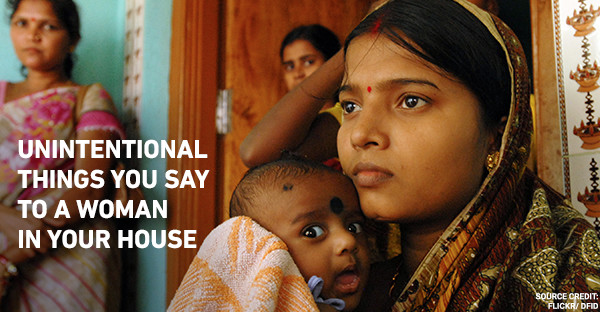
Have we ever stopped to think why India is more often not, dubbed as a patriarchal society? With women always being kept on the back burner, we are a country that is still trying to find a balance to give equal opportunities to our women and reduce crimes against them. However, to enable such a change, we need to take a step back and understand how we have contributed to the country acquiring such a label.
The late Dr. Abdul Kalam had once quoted, “Empowerment of women leads to development of a good family, good society and, ultimately, a good nation. When the woman is happy, the home is happy. When the home is happy, the society is happy and when the society is happy the state is happy and when the state is happy there will be peace in the country and it will develop at greater pace.”
We couldn’t agree more - for greater change to occur in society, change needs to begin at home.
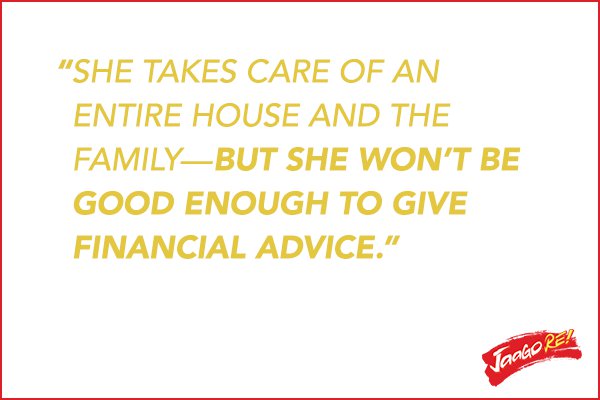
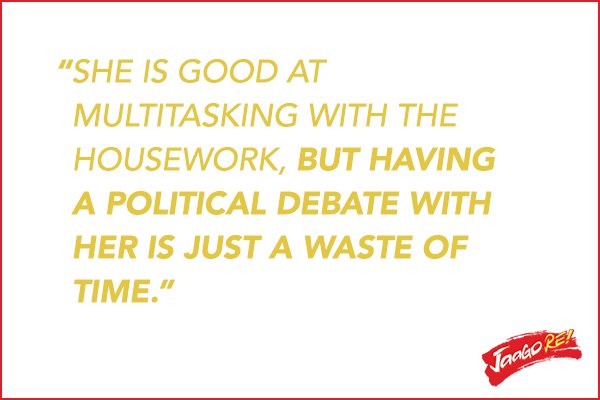
Even within the family, we tend to bias against the women we know, from our mothers, to wives to sisters and daughters. Here’s how we unintentionally put down women in our families:
.jpg)
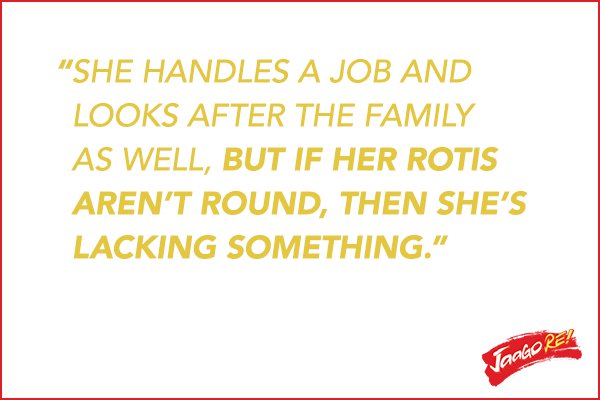
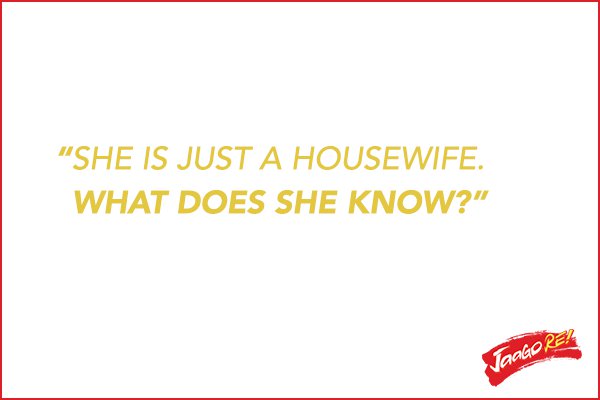
Even though our mothers/wives/daughters do a lot for us, we hardly appreciate them for the work they do. Some manage full time jobs and take care of the household whereas others sacrifice their dreams and careers to look after their families and we still do not look at them as people worthy of how much they do for us. Even though they spend all their lives looking after us , we still see it as something they are supposed to do.
What are the unintentional phrases you might have said about or to your wife, mother or daughter or sister? Share them with us by posting your comment below or tweeting to us at @jaagore. You can also mail us at jaagorein@gmail.com
Share this story on

Change Through Chai & Conversations

Lakshmi Rebecca is the brains behind and the face of India’s first online chat show ‘Chai With Lakshmi’. Now in its fourth season the show has been online since 2011 with over 120 webisodes and a staggering 2 million views.
Driven by inspiring stories and ordinary people who do incredible things, Lakshmi’s show is a beautiful collection of interviews and features of people who are making a difference in small ways. The first season of the show featured positive stories of people, NGO’s and facilities that cared for the terminally ill primarily from in and around Bangalore. Some feel-good lighthearted content on cooking and relationships also found its way into the season. She moved onto a larger scale and diversified topics for her second season that covered Indian’s who have achieved and conversations on empowerment, information and the Indian society. Indian athletes took center stage in the show’s third season. Now in its fourth season, Chai with Lakshmi is focused on individuals and organizations who are working for and contributing to creating social change.
Lakshmi’s focus on positive stories and sensible conversations makes her show crisp and entertaining. Testament to that is the large fan base she has across her social media profiles and the sheer number of views her online chat show get. She chooses the people who she has on her show on the basis of how they are making a difference to the way the rest of us live and what they are doing to help shape this country’s future. Understanding that not every episode can be too serious, Lakshmi throws in a few on the history and traditions of tea from other parts of the world and some on life and success.
Lakshmi Rebecca is a perfect example of the kind of influence a woman can have in society. Her passion and belief that lives can be enriched and attitudes can be changed by inspiration taken from positive stories is in itself a lesson that change can be initiated by one woman, a cup of tea and conversation. http://chaiwithlakshmi.in/
Share this story on

Woman of the River

Can a single woman turn the tide… literally?
When the water levels of Kosi River in Uttarakhand began to decrease, the villagers that depended on the river bore the direct brunt of it. The problem would have been fatal had it not been for the relentless efforts of one woman - Basanti.
Basanti in 2003 had read about how deforestation in the Kosi region could eventually lead to the river drying up by 2010. She researched more and found out that forest fires and cutting of trees was affecting the balance of the eco-system of the river. This alarming find was what spurred her into action. She began following the women of the village as they would go down to the forest to cut wood, show them the article and tried to talk them out of unprecedented wood cutting.
Eventually, she succeeded in educating the women about the importance of conserving the forest to help conserve the river. She requested them to form small groups and look after the forest. She also managed to convince the women to refrain from cutting live wood, particularly oakwood. While she and the groups of women did face some opposition from other villagers in the initial phases, eventually, the process streamlined to such an extent that the forest officials also decided to lend their support as both parties were fighting for the same cause.
The villagers, under Basanti’s guidance, were helping protect the forest from fire and had ceased to cut live wood as well. As a result of her efforts, the forest began to yield healthier pine trees and new springs have begun to sprout, which serve a perennial source of water.
One lady convinced other women to join her and save the river. One lady took the responsibility, and in no time, she had other women following her footsteps. This inspiring story only proves that there is immense strength in numbers; that together, women can shake mountains or in this case, turn the tide!
If a woman can get a river to begin flowing again, what’s to stop women who constitute 49% of the vote bloc from transforming this country? #PowerOf49
Share this story on

Things Women Do Together

Isn’t it about time that you, as a woman in this country, start looking at voting in a new light? Why should voting be any less cooler than any other activity that you do? Especially when your vote, along with the votes of the millions of women in the country who constitute 49% of the voting bloc has the potential to create a government that is more attentive to the female population.
You and your group of girlfriends; or you and your mother along with many other moms and daughters; or you and all the women in your office – all of you are part of the power of 49.
As a collective, women can actually achieve something when you all vote as a bloc. It’s time to wake up and take an interest in the government and the policies that could really affect every day change in your life and in the lives of all the women you know.
Share this story on
