What We can Learn from NorthEast India about Sports
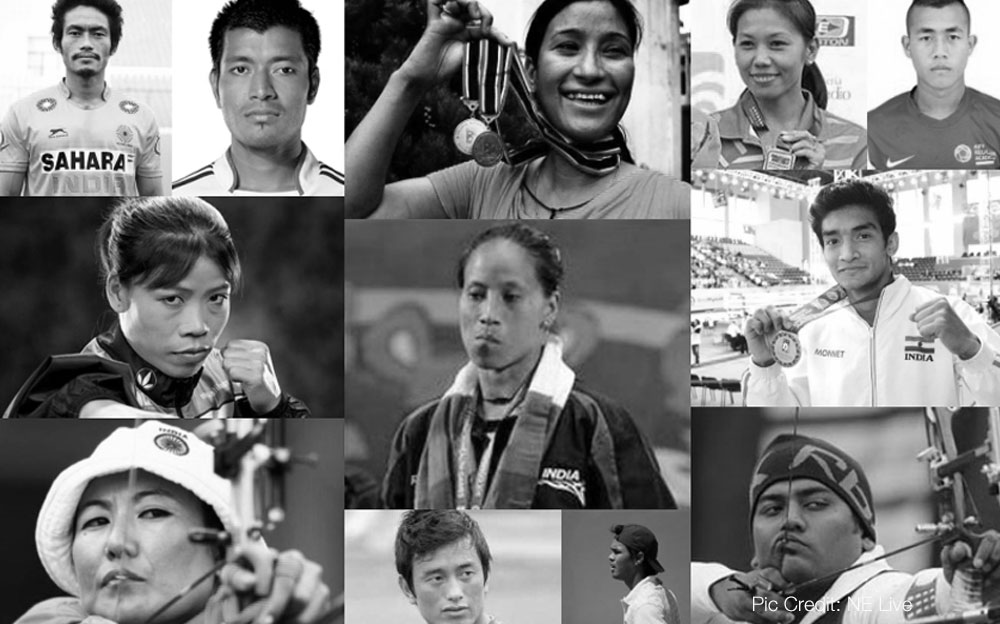
The North-Eastern states in India are home to some of India’s most recognised international players. Just to name a few, M.C. Mary Kom - 2012 Olympics bronze medallist and a five-time world amateur-boxing champion, footballer Baichung Bhutia, boxer L. Sarita Devi, silver medallist at the 2014 Glasgow Commonwealth Games, Jayanta Talukdar, Gold Medalist and Arjuna Award winner, weightlifter K. Sanjita Chanu, who won gold at the 2014 Glasgow Commonwealth Games, etc.
While Northeast India constitutes only about 3.7% of the total Indian population, the youth out there are well-known for their inclination towards sports, especially Manipur. Out of the entire 2016 Rio Olympics contingent, 6.72% of them belonged to the NE.
Why is Northeast India repeatedly at the forefront of sports news? Is a culture of sports the reason behind their thriving sports scene? Let’s look at some numbers.
Sports Culture & Infrastructure in the Region
As of 9th March 2017, 13,684 talented sportspersons are being trained under Sports Authority of India (SAI) Schemes throughout the country, out of which 9653 are boys and 4031 are girls.
22.3% (901 out of 4031) of girl trainees at SAI centres are trained in the North-Eastern States of Arunachal Pradesh, Manipur, Meghalaya, Mizoram, Nagaland, Sikkim and Tripura. They are provided with regular sports training in 27 sports disciplines on residential and non-residential basis in 290 SAI sports centres.
One of the fourteen SAI Regional Football Academies in the country is in Imphal. Out of the five proposed NSAs, the government plans to set up an SAI National Archery Academy in Guwhati.
According to a 2016 study by Dr Anil Mili (published by the International Education and Research Journal), Assam and Manipur have synthetic athletic tracks for all-weather competitions. These states “have good number of sponsorships from corporate giants and other public sector-undertakings which help in promoting physical education and sports” in the region.
Children are motivated to participate in sports from a young age and the general opinion of the people in Northeast India is that physical education should be implemented as a compulsory part of school and college curriculums. They believe that sports leads to the overall development of their youth, unlike other states in the country where sports and games are thought to be a waste of time and a distraction from studies.
Dr Mili’s study also revealed that 82.77% of the respondents from Arunachal Pradesh, Assam, Manipur and Nagaland opined that “physical education and sports may be helpful in curbing the menace of drug addiction, HIV, alcoholism, terrorism etc.” amongst the youth.
Sportspersons have given back to their communities by supporting and guiding young athletes from their native lands. Mary Kom Regional Boxing Foundation is a great example of this. The foundation provides free coaching to students with free lodging and food and covers additional expenses involved during competitions.
Another such example is the chain of Bhaichung Bhutia Football Schools that were set up in Mumbai and Delhi, by Bhutia after his international success.
Support from the Centre and State
When it comes to generating funds and using them for sports, the North-Eastern states stand apart. 8.78% of the National demand for funds to develop sports infrastructure and conduct sports competitions under a new central scheme implemented in the FY 2016-17 called, Khelo India Scheme came from the North-Eastern states. This Scheme provides for conducting sports competitions in two age groups of under 14 and under 17 all over India to encourage mass participation of both boys and girls in Sports and creation of sports infrastructure facilities.
Even in the past, out of the Rs. 191.25 crore spent from 2014- 2016, under the Rajiv Gandhi Khel Abhiyan (RGKA) and the Urban Sports Infrastructure Scheme (USIS), 17.2% of the national demand came from the Northeast. In 2016-17, Assam’s state expenditure on Education and Sports at 35% is significantly higher than the national average of 15.6%.
Can the rest of the country follow the example of the Northeast?
Physical education is important in a secondary school levels to inculcate confidence, competitiveness and team-spirit in the minds of the youth. Incorporating sports into a child’s education adds to his/her holistic growth and personality development. They have also been very enthusiastic in demanding better sports infrastructure and facilities in their regions. Hence more states in the country should follow the example of the North-Eastern states, not just to produce better sportspersons representing the country, but also to help build a better society for the future generations.
Tata Tea’s Jaago Re has started a movement to make sports a compulsory subject in schools by bringing together the community to sign a petition. Such initiatives and better implementation of the Central schemes aimed towards sports infrastructure development could eventually help us reach our full sporting potential as a country.
Do your bit and join the movement today. Click on Link or call 7815966666 (toll free) to sign the petition to the HRD Ministry, to work with the sports ministry and implement sports as a compulsory subject in schools, and advise state governments to implement this across all educational institutions.
Alarm Bajne Se Pehle Jaago Re!
More on the Author:
Share this story on

10 ways we discourage our children from playing sports

Come Olympic Games, Commonwealth Games and other World Championships, India is suddenly gripped in a mad frenzy and what follows is an eager wait for the medals. More often than not, we struggle on the world stage and celebrate single digit wins - although, we have the talent with immense potential. While we all want India to win more laurels at such international sporting events, this won’t be possible unless we change our mindset about sports. Sports is an integral part of education and till it is treated at par with 'academics', we cannot expect to improve the dismal scenario. If a child is goaded into concentrating only on studies instead of 'wasting time' on sports, then how can we expect to emerge as a great sporting nation?
The onus to nurture India's next great sports person lies on each and everyone of us. If we wish to elevate India's ranking, we have to actively build a culture of sports. And for that to happen, we have to fight the existing prejudice against sports. The latter is often manifested in a few statements which children are used to hearing from their elders.
Here are some of the most common ones here:
- Sport is such a waste of time.
- Sport has no future. Concentrate on your studies if want a successful career!
- Sport aren't meant for girls. You'll get tanned and look masculine.
- What if you get a scar while playing sports? Who will marry you then?
- Thoda khel kya liya, khud ko khiladi samajhne lage!
- Sport is just a hobby - a distraction from studies.
- You need to focus on your exams - sports won’t help you score marks.
- What will you do after you get married? Sports won’t feed your family.
- Aise hi koi bhi Sachin thode hi bann jaata hain!
- Our hard earned money is to ensure that you have good education - not to play sports.
It is this thought process which deprives our children of the opportunity to discover their passion and hone their talent for a particular sport. At some level, we, the adults, believe that sports as a field is not as rewarding or as respectful as that of a doctor, an engineer or a MBA graduate. Who knows, we may have lost out on numerous would-have-been champions, owing to this flawed thinking!
It’s time to bring about a radical shift in our attitudes. Join our movement to change this mindset and petition the HRD Ministry to make sports a part of educational curriculum.
Sign the petition launched by Tata Tea to make sports a compulsory subject in schools across India. Sign the petition here
Alarm Bajne Se Pehle Jaago Re!
Share this story on
Why I started the World 10K Run: Piyush Sachdeva
Former national level cricketer, sports advisor and sports enthusiast, Piyush Sachdeva talks about his visions of a platform bringing people together from all races, castes, age groups all on one ground. Keeping this in mind, he started World 10K Run in Haryana, one of India’s most recognised city runs. He goes on to emphasise how World 10K Run is also building and promoting a sports culture in his home state, Haryana. He talks about the challenges he’s faced and met with while working on grassroots to make sports consequential in India.

‘Sports for all’: The beginnings of World 10 K Run
I am a former cricketer from Haryana. Being a sports person, I always learnt that sports is one avenue accessible and available for all kinds of people, never mind the background. When I founded World Sports Forum & India Road Runners in 2012, I thought of creating a platform that will truly justify ‘sports is for all’ with no preference to gender, age, background or hearsay. Where everyone can participate together and enjoy the benefits of being fit and healthy.
Eventually I realised running is the rare sport that needs no special training, no equipment, or no infrastructure. What’s more, you can run together with your friends, family, your acquaintances or even with those you do not know of.
The dream ‘World 10k run’ was born with the idea of creating a culture of being fit. When people from different castes, creed, colours, cultures, ages, cities, countries run together it definitely brings about national integration too.


World 10 k Run: Bringing the Joy of Running Together & Reviving a Sporting Culture
I primarily started this event so we can educate people about sports and revive a sports culture across our region, and the country at large.
Through this run, we also organise free physical training camps, sports seminars and sports meetings and workshops in schools and colleges to educate them about sport.
Our simple mission is to create and promote a s ports culture, fitness and health among the people and drive home the idea that 'Every Step Counts'.
Often we have renowned players like cricketer Mohit Sharma, Yuzvendra Chahal, Yogita Bali(Hockey) etc. from different sports participating in the World 10k run; discussing sports openly with the lay audience while running, which bridges the divide between the players and the general public and builds the general enthusiasm among the crowd about sports.
.JPG "Why I started the World 10K Run: Piyush Sachdeva")
Piyush Sachdeva, Founder of World 10 K Run
“If we wish for a sporting culture in India, we need education on sports…”
We need to focus on sports as a part of our education system very strongly. Physical education is an integral part of education, so we should follow and implement it. The biggest challenge is to work in the grassroots of our country, and to make sports an essential part of a child’s routine.
We should strictly follow the phrase, ‘Catch them young and train them young’. India is not only a transforming nation, but indeed ours is a nation where majority of the population are adolescents. If we wish for a strong sporting culture, we have to educate everyone in India on what sports really is.
Petition to make sports compulsory across schools in India
Only when sports is made compulsory in schools, will every child have access to sport. Our future generation can grow up on the concept of inclusiveness for all, we can reduce discrimination and prejudice through sports. What’s more we are only securing the health and fitness of the next generation by integrating sports into our education.
Tata Tea has recently launched a petition to make sports a compulsory subject in schools across India.
To make this change possible, I urge everyone to join the movement and sign the petition to make sports a compulsory subject in schools. Sign the petition here
Alarm Bajne Se Pehle Jaago Re!
More About The Writer
Share this story on
A powerhouse of talent for the future of Sports in India: Stairs
STAIRS is an NGO working towards sports, education and health of underprivileged children across various urban and rural areas of India. Since the year 2000, they have worked tirelessly to make sports accessible to children from all backgrounds across India. Thanks to their efforts, several children trained by them are now playing professionally at some of the biggest sporting events worldwide, even though many of these kids are from impoverished backgrounds. Not only has their sports programme helped develop and nourish the sporting talent among them, but also has greatly contributed to their cognitive and overall development.

Why sports education & prowess in sports is as good as, if not better than academic education
Shikha Gaur, Manager of Corporate Communications for Stairs, speaks to Jaago Re: “Once you look at the stories of several children under our wing, you can easily see the positive impact sports has had on many aspects of their lives. There are many such cases but the crux is that there is a positive association between physical activity and mental fitness and all those components also affect academic achievements. Young children involved in sports from an early age tend to show better academic performance; besides that, there’s lesser involvement in juvenile crimes and they tend to be less influenced towards substance abuse. Grassroot sports teaches the youth how to lead a healthy lifestyle early in their lives. Once it becomes a habit in their routines, they tend to continue participating in recreational sports activities throughout their lives. It is a way to incorporate physical activity and a healthy lifestyle right at the starting phase of life.
From the son of a rickshaw driver to representing India at the Asian Games worldwide: Sandeep Kumar
Sandeep Kumar, the son of an auto rickshaw driver was spotted by STAIRS during a talent hunt in Majnu Ka Tilla, Delhi in 2012, an area inhabited by families belonging to the disadvantaged section of the society. He has a family of three, where the monthly income is between Rs.8000-10000. He has been representing the Delhi state Sepak Takraw team in senior National Championship since 2002 and has won medals each year. He represented India in the 16th Asian Games in Guangzhou, China in 2010 and has been selected for the national coaching camp for 17th Asian Games held in Incheon, South Korea, 2014.
Stairs: A widespread reach for children to cross the socio-economic barriers in sports
Like Sandeep Kumar, Stairs has worked with thousands of children across the country. Here’s a quick look at the approximate numbers for their reach:
Over 300,000 children are playing on a daily basis at 400 sports centres across 4000 villages of rural and semi urban areas of India.
Over 45 different forms of sports are being played with equal focus on health and education of the children.
They provide training, scholarships, sports gear and platforms like cricket championships, volleyball championships, STAIRS School Football League (SSFL) for the youth to excel and choose sports as a career.
Today, SSFL is the world’s largest talent scouting and training program in football engaging 100,000 footballers across the country.
STAIRS Khelo programme, running in 7 states of India, has produced 8 international and 12 national level Sepak Takraw players and 5 national level volleyball players.

UFLEX STAIRS School Football League is an initiative by Society for Transformation, Inclusion and Recognition through Sports (STAIRS), a not for profit organisation. UFLEX SSFL is supposedly the world’s largest football talent scouting and training programme at the school level and being held in three states - Delhi, Gujarat and Uttar Pradesh this year. The mega sports event has reached out to 100,000 aspiring footballers so far.
Giving Sports its due importance will lead to exemplary results for India in the global sports arena
Shikha Gaur, further continues to stress on their belief on the importance of sports : “STAIRS is a recipient of the prestigious National Sports Award/ Rashtriya Khel Prothsahan Puraskar 2016. Many children trained by us are now representing India across the world. We are a talenthouse for the future of sports in India.
We attempt to channelize the energy of the youth for personal and economic growth through the medium of sports; by creating a holistic development of the youth of India. Since we believe in development of children through sports, we think it’s of utmost importance that sports should be made compulsory in schools. Only when it becomes a part of our educational curriculum, will the overall scenario of sports in India transform.
Adopting sports by schools can make a significant change in the Indian sporting field and like the countless academic legends that have emerged from India, sports legends can also be nurtured to help make India a sporting giant in the global sporting arena.”
Tata Tea has recently launched a petition to make sports a compulsory subject in schools across India.
To make this change possible, I urge everyone to join the movement and sign the petition to make sports a compulsory subject in schools. Sign the petition here
Alarm Bajne Se Pehle Jaago Re!
Share this story on
Nurturing Future Olympians of India: GoSports Foundation
Sporting champions are not born overnight. They have to be discovered, nurtured, trained and groomed. That can only happen when the right talent gets the right support at the right time.
In 2012, two GoSports athletes participated at the London Olympic and Paralympic Games, but the 2016 Rio Olympic and Paralympics Games saw participation from 15 of their athletes (4 in Olympic and 11 in Paralympic). In fact, half of the members of the Paralympic contingent were GoSports Foundation athletes and out of the 4 medals won by India at the Rio Paralympics, 3 of them belonged to athletes trained by the foundation.

Sportspersons like Kidambi Srikanth and Dipa Karmakar received support from GoSports which helped them do well in their respective disciplines
GoSports Foundation is a decade old non-profit organisation focused on supporting the country's most talented young athletes for the Olympics and the Paralympics. They provide scholarships and support to junior Indian athletes, in an attempt to professionalize sports in India. They believe that if India has to win at the international level, our society needs to first build a culture of sports that supports athletes, and encourages young talent to take sports more seriously.
Deepthi Bopaiah, Executive Director of GoSports spoke to Jaago Re on the need to build a culture of sports in India.

“Parents, schools & the larger society can be the pillar of support for rising sports stars.”
Sports, as we all know are quite beneficial for children. By playing sports, children develop physical skills, make new friends, have fun, learn about being a good team player, learn about fair play and the essence of winning and losing.
In my opinion, parents should let their kids participate in sports not for instant success, but rather from the perspective of keeping fit. As we are aware, children today are so engrossed with technology based gadgets, that sports and playing takes a backseat. Let the child first get used to sports and get to like it so it can become part of their daily lives.
Later if the child is found to be really talented, they should be allowed to consider sports as a career option. There might be a Devendra Jhajharia or a Dipa Karmakar in every household but are not able to come out of the closet due to the lack of support by parents.
Society also needs to evolve in their mindset regarding letting their children choose alternative career choices. They deem someone as 'lucky' or born with an 'extraordinary' talent when anyone excels in an alternative career choice. This can be very demotivating for children if they decide to pick up a sport as a career.
Why do we need to begin with our schools?
A lot of untapped sports talent in India is found in our schools.
For any sports to be developed, due importance should be given to a strong Grassroot Structure so that the sporting talents can be scouted and nurtured from an early age. Making sports a compulsory subject in schools can be one of the stepping stone towards that. Schools should also take responsibility in giving sports equal weightage as education. They can scrutinize the development of a child and hence if sports is made a compulsory subject in school with marks, children have to then take sports seriously. Furthermore, schools should also consider developing the sports environment so kids get the platform to pursue their passion in sports from school level.
Schools possess a unique combination of infrastructure with a structured group of children going through it. Although most schools have an open field; there are schools that do not have the infrastructure and would now be required to develop the same if sports is made a compulsory subject in schools.
There is a pool of untapped talent in schools; we just need to tap into it. To to this, we need quality coaches and teachers at the school level to empower the children who have the zest and zeal to excel in sports.
We can put India back on the world map, if the change begins from schools
I wholeheartedly feel that communities, schools and individuals should play their part in supporting sports for providing new avenues for young kids to explore other than basic education. Schools provide a platform where junior talent can be nurtured so that their transition becomes smoother to national and international levels wherein organizations like GoSports come into contention for providing the support and thus, improve the chances of bettering India’s world rankings in the field of sports.
In a field as vast as sports, it is impossible for a single entity to bring positive change unless there are collective efforts directed towards achievement of the common goals.
India undoubtedly has immense Sports talent at its disposal but these talents are still in need of professional support and resources to reach their potential. If the right platform is given to right talent at the right time, there is no doubt that we will improve our performances at the International events and be at par with our counterparts.
To make this possible, Tata Tea is petitioning the HRD Ministry to make sports a compulsory subject in schools across India. This will not only help children gain exposure to sports at a young age, it will enable a slow yet steady move towards a culture of sports in India.
I urge everyone to join this movement and help build a culture of sports for a better sporting future for India. Sign the petition here
Alarm Bajne Se Pehle Jaago Re!
More on the Expert:
Share this story on
Thanking Sports Teachers in India: Standing their Ground in a Society that Lacks a Sporting Culture
Even the best of sporting talent may fail if they do not have the right coach to guide them and help them in honing and perfecting their skills. However, sports teachers or coaches are seldom given as much importance as academic teachers.
This is ironical, as in our tradition, the gurukuls were centres of physical and mental growth, with equal importance to both. Despite this, we have sports teachers and coaches today, who keep at their thankless job to aid the overall development of the next generation.
On account of Teacher’s Day, we spoke to a few coaches to understand what motivates and drives them, their dreams and expectations and the ethics which they abide by in their profession.
Rohit D'Souza, Rugby Coach, Co-founder at Mumbai Strikers Sports Club, Former Mentor at Magic Bus

Picture Credit: Prajakt Patil
"I enjoy teaching because I enjoy playing it. It's not always about the money, it's about the joy of effort that goes into training for a sport."
Tanaz Mohammed
National Level Hockey Player, Hockey Coach for MMK College Girls Team, Grassroots Development Coordinator at Mumbai City Football Club

"I learnt some of my biggest life's lessons from sports, and now I'm sharing it through coaching others."
Raj Shekhar, Football Coach, Worked with Mumbai Football Club, and with the likes of former players from Premier league clubs like Chelsea, Arsenal and Liverpool.

"I play and coach football purely out of passion. Chase your passion and dreams, success will follow."
Raju Bhasvar, former Asian Games gold medallist, Arjuna Award winner, Kabbadi Coach

"I teach Kabbadi because this is the sport that has given me an identity. Coaching Kabbadi gives me immense satisfaction because I’m building a new healthy generation of India."
While we still struggle to understand the importance of sports, our coaches are struggling hard to nurture the best talent in the country. Their relentlessness and perseverance is inspiring, and Jaago Re salutes them for pre-acting towards building a sports culture in India.
Join them in elevating India’s world ranking in sports and ensure that every child gets the opportunity to identify their passion and talent in sports.
Sign the petition to make sports a compulsory subject in school curriculum by clicking on this link here
Alarm Bajne Se Pehle Jaago Re!
Share this story on
What happened to my father shouldn't happen to any other sportsperson in India: Suromitro Basu, sports journalist
Suromitro Basu, the youngest Indian journalist to cover the Olympics, has come a long way. His childhood experience with the difficulties sportspersons face (through his father’s story) led him to choose a career as a sports journalist, and also use his reach to pre-act towards building a better future for sports in India. He launched the "Chak de Barf Pe" campaign that helped India’s Ice Hockey team participate in the Asian championship.
Suromitro Das shares his journey as a pre-activist with Jaago Re:
“Even if I become India’s top table tennis star, I won’t earn a penny”: Suromitro’s father, who was forced to quit the sport at the peak of his career
Can you imagine a budding 18-year-old international level table tennis player being asked to quit the sport? My father was a promising table tennis player as a teenager, but he was discouraged by the society and the authorities from taking up the sport professionally. Because of the lack of encouragement for sports in our society, my father could not fulfil his dreams, and India lost a talented young sportsperson. It’s the same story for thousands of young sports talent in India.
The glaring lack of a sports culture in India
Suromitro Basu with gymnast Dipa Karmakar and badminton player Jwala Gutta at Rio Olympics 2016
Anyone who wants to be a cricketer in India has several avenues to do so, but what about other disciplines? What if I wanted to become a professional squash player or a professional ice hockey player, how do I progress? Where do I start?
The deeper I dug, the quicker I realized that not much has changed since my father's era, except for a handful of sports. When I first got in touch with the Indian Ice Hockey team, they didn't have a single rink to practice on, the only one that is located in Dehradun has been shut for the past five years because the Government didn’t have funds. The national team had qualified for the Asian Championship, but the Federation didn't have the money to send their players abroad. Many other sports face a similar, or worse situations in India.
Doing our bit - all of us have a role to play in building a sports culture in India
My meeting with the Ice Hockey team made me realise that if I didn’t help them, no one would. Hence, along with the Federation officials I launched a crowdfunding campaign titled, "Chak de Barf Pe". What ensued over the next 48 hours, is something that none of us were prepared for. Notable personalities such as Anand Mahindra and Gautam Gambhir, all came forward to support the cause, and the team eventually did book their flights for Kuwait. However, the most important aspect that emerged from this entire campaign was that India genuinely cared. It was us, the people of India that wanted to award the bravehearts who were giving it their all to represent their country abroad.
Since then, we (Sportskeeda) have sent junior sprinter Beant Singh to the World Championship and funded Shot Putter Inderjeet Singh's training - all this through crowdfunding.
However, it was important for the people of India to understand that it’s not just the established athletes that need money for infrastructure. For instance, till 2014, the Bengal junior Women's hockey team didn't have a ground to play on. They shared their ground with the cricket team, who used to essentially occupy the ground for the entire day. Hence, they practiced on the concrete often injuring themselves in the process.
Sportskeeda's reach helped me get such problems out onto the mainstream, which were then directly addressed by the local governing bodies. However, we as a society need to first understand that India's athletes are human beings with extremely realistic problems. The only solution is to have a culture of sports that is supportive of sports and sportspersons.
Can introducing sports from an early age to children make a difference to sports in India?
All our efforts are just small steps in the right direction. For uplifting the status of sports in India, change has to start right from the grassroots. I believe that if sports is made compulsory in schools, it is going to change the outlook and the direction of sports in the country.
Tata Tea has recently launched a petition to make sports a compulsory subject in schools across India. This will not only help children gain exposure to sports at a young age, it will enable a slow yet steady move towards a culture of sports in India.
To make this change possible, I urge the everyone to join the movement and sign the petition to make sports a compulsory subject in schools. Sign the petition here
Alarm Bajne Se Pehle Jaago Re!
More on the writer:
Share this story on
Every Indian plays a crucial role in improving India's World Ranking in Sports

During every World championship, a lot of questions are asked following the disappointing overall performance of India, and rightfully so. Our teams often come back to an angry and disheartened audience and we tend to express our disappointment even at our diligent players.
Let’s take a quick look at our world rankings to see where we stand:
- The Indian Tennis Team ranks 23rd in the world.
- The Indian Men’s Volleyball Team ranks 34th out of 127 nations.
- The Indian Women’s Volleyball team ranks 100th out of 113 playing countries.
- The Indian Basketball team is ranked 61st out of the 85 nations.
- In the latest FIBA ranking report our Rugby team is at the 74th position out of 102 playing nations.
(Source: SportsKeeda)
While every citizen of India has a right to question, we also need to collectively shoulder the responsibility of our current standing in sports . It is up to us to build a culture of sports in India and to uplift the fledgling sporting scenario of India, and the first step towards this is to change our perception about sports.
Here are a few simple ways in which each and every one of us can help build a culture of sports in India:
Encourage children to participate in sports
It is not necessary that every child has to become great sportsperson. Yet this will go a long way in creating a positive impression about sport in their minds, and they also get an opportunity to figure out if at all they are genuinely interested in pursuing sports. This is how children can identify their passion for a particular sport and hone their talent. An additional benefit, needless to add, is children adopting a healthy lifestyle.
Make Local Sporting Events More Accessible and Commonplace
Often there are several local sporting events held in our own neighbourhood and we don’t hear of it. Keep an eye out for them through your local newspapers, or the governing bodies or sports clubs in your neighbourhood. In case there’s a lack of these events, people can get together and organise more of such events to give a chance to more people to participate.
Position sports stars as role models
Every child idolises a pop star, a movie star or any other celebrity. However, not every kid grows up idolising sports stars as their role models. Expose children to more success stories of sports athletes and inspire them with their talent, dedication and their success.
Perceive and respect sports as a rewarding career option
A child or a teenager will be automatically motivated to better one’s game if they are nurtured with such positive thoughts about sports.
The status of sports in India will not change overnight. However, small steps taken by each of us will take us to a point where we finally start to see improvement. The onus is on each citizen to start moving in this direction. Within the family itself we can begin to introduce sports. Playing together as a family will be a child’s initiation into sport, which can further be carried into his/her growing up years and finally, adulthood.
While these are a few steps to start a change at a personal level, to build a culture of sports we need to also affect a change at a national level. We as the citizens must make sure that we have a system that supports sports, and what better way to do that than by making sports a compulsory subject in schools?
We believe that only when sports becomes a part of our school curriculum, will the status of sports be elevated in our society. If children were to take part in sport daily in their formative years, we are raising a generation of youth conscious, aware and naturally inclined to sports.
To make this change possible we are petitioning the HRD Ministry to make sports education a compulsory subject in schools.
Join the movement and sign the petition to help make this possible:
Alarm Bajne Se Pehle Jaago Re!
Share this story on
Tata Tea Jaago Re ties up with Haiyya: Organise for Action to tackle gender bias at the grassroots

It has been estimated that about 2.5 lakh girls are killed each year in India because of their sex (World Bank 2012 report on ‘Gender Equality and Development’). This holds true for both rural and urban areas, and in every strata of our society with even a lot of educated adults practising and passing on their gender biases to their children. The treatment of girls in one’s households moulds children’s psyche, who internalise preferential treatment of boys. Changing the mindsets of people and bringing about gender equality requires massive and sustained effort. Tata Tea Jaago Re's 'Deepa ho ya Deepak, Ek Samman, Ek Sa Hak' initiative in association with Haiyya: Organise for Action aims to do just that at the grassroots
Encouraging parents and children to question traditional gender roles
Are we guilty of knowingly or unknowingly perpetuating gender bias on our children? Let’s look at a few general comments and practices:
Expecting only the girls to learn household chores like cooking and cleaning,Spending more money on education for boys rather than for girls,Bringing up girls with the philosophy that however educated they may be, their priority in life should always be to get married and raise a family,Pushing girls to take up gender-appropriate jobs, like teaching and nursing etc.,Comments like ‘Aap larkein hoke larki se haar gaye‘ or ‘Larkein larkiyon jaise nahin rote‘ even when they are made in jest.
These are just a few examples of how traditional gender roles are ingrained in young children. Helping people identify gender biases in their daily lives and making them realise as to why they need to change their beliefs and actions are the initial steps towards achieving a society where boys and girls are given equal opportunities, rights and freedom.
Thus, this initiative helps both children and adults identify various scenarios where boys and girls are treated differently by society. It also helps in setting the context as to why there is an urgent need to break free of these biases.
Engaging with the masses through interactive activities
Over the past three months, we have conducted several workshops spanning over both, urban and rural areas in Punjab, Haryana, Delhi and UP. They follow a strategic method of organizing community engagement activities in the neighbourhoods with both, parents and children by identifying influencers in the communities, distributing pamphlets and finally assembling at the pre-decided venue.
The use of forms of mass entertainment like Nukkad Natak (street play) to ensure that the message reaches the grassroots, and is understood by everyone has proven to be quite successful. The change in the approach and attitude towards a boy and a girl has to start from their homes and to aid the same, a simple toolkit with specific messages have been designed and are distributed to all parents.
Here’s how this initiative has been successful in influencing parents in changing their opinions.
Help build a society where girls face no gender discrimination
While it is encouraging to witness parents realise how a society free of gender bias will make their children’s lives better, this is just the beginning! The message has to reach far and wide and the onus to bring about the change lies in each and everyone of us. Together, when we pledge to practice and teach gender sensitisation, we can pave the way for a better future for India.
Join us in our quest to realise a safe, equal society for all.
Read more about the petition initiated by Jaago Re and signed by more than a million Indians to make gender sensitisation compulsory in schools here
Alarm Bajne Se Pehle #JaagoRe
Share this story on
Why is Sports a Great New Year Resolution for Indians?
.jpg "Why is Sports a Great New Year Resolution for Indians?")
As the world prepares for 2018, checklists and new year resolutions are resurfacing. Our resolutions are usually reactions to fix things that have gone out of hand, like resolution to keep fit, focus more on one aspect of our life or another, learn something new, etc. But, why do we wait for things to go wrong? Is it not possible to resolve issues before it gets too late?
Luckily, for most of our goals for the year 2018, there is an all-in-one solution - Sports. Most of us don’t realise that playing a sport has much more to offer than the evident health benefits. While we are raising our voice to make sports a compulsory subject in schools, here are 5 reasons why we as pre-active members of the society need to resolve to take sports more seriously:
Stay Physically fit
Fitness resolutions are quite popular, and playing a sport is one way to make it fun. Our children and youngsters lack fitness, and it’s time we got them to adopt playing as a regular and serious activity. Not only does sports help children grow healthy, it also helps older adults maintain a healthy work-life balance.
Better Mental Health
According to the Department of Sport and Recreation (Government of Western Australia), being physically active protects against mental health issues, decreases depression in older adults, and is as effective as medication for mild to moderate depression. Sports also help improve self-esteem and cognitive function in youngsters.
Holistic Development
According to Dr. Richard Bailey (writer and researcher on Education and Sports), children who engage in regular sporting activities have better self-esteem and confidence. Sports also help teach children social skills, discipline, and coping with setbacks or defeats. Research also shows that children who grow up playing sports are better professionals than those who don’t, because sports helps develop strategic thinking, analytical thinking, leadership skills, goal setting and risk taking etc., among other qualities.
Coming together as a community
We all know how powerful sports can be in bringing together a community, a nation, and even the world. The solidarity between England and France during the terror attacks in either countries (2017 attacks in Paris, and 2017 attacks in London) showed that sports helps people stand together. Closer home, we have seen examples of the Hockey Village in Rajasthan, Janwaar Castle in Madhya Pradesh, Yuwa in Jharkhand, and the likes that prove the point the sports has the power to unite people against all odds. A new year resolution to play together could be the best way to unite the Indian society.
Make India a sporting powerhouse
With over a billion people, India has the potential to become a sporting powerhouse. While we as a community have petitioned for a policy-level change to introduce sports as a compulsory part of education in schools, we need to change things at the grassroots too. However, it is not as difficult as it sounds. People love playing, and if we as individuals decide to take sports seriously and dedicate some time daily, the younger generations will get exposed to sports, understand its value, and eventually make way for a sporting culture in India.
These are just a few reasons why sports is a great new year resolution, and even if we do not engage with sports directly, if we resolve to encourage local sporting activities and motivate children to take up sports seriously, it will help in creating a better future for sports in India. To reach there, we must pre-act today. So, are you ready to take up sports as your New Year resolution?
Alarm Bajne Se Pehle #JaagoRe
Sources:
Mirror
Department of Sport and Recreation, Government of Australia
Novak Djokovic Foundation
Psychology Today
NCBI
Share this story on