Monthly experiences that are too embarrassing to share
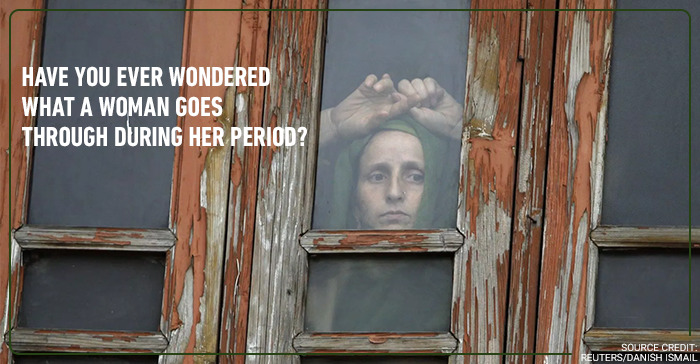
“Stop PMSing!”
“You and your mood swings!”
How many times have you said or heard these statements? Too often would be true. Our society tends to mask menstruation behind banal and trivial comments. Women on their period are stigmatised and are made to believe that talking about their menstrual cycles is embarrassing.
We collated a few comments often made with reference to menstrual cycle and asked women to respond with their monthly experiences and received comments that are usually not heard.
“The cramps can’t be that bad, you are just weak!”
Prachi, 25
As much as the process is natural and essential to a woman’s body, I find the pain part absolutely cruel and unnecessary. It’s extremely uncomfortable and my entire day is wasted as I isolate myself with hot water and force myself to sleep. The week preceding the onset of my period, I start to dread it which affects the efficiency of my work.
“Don’t talk about your period. It’s embarrassing!”
Nikita, 24
The first day is excruciating! I can't move, my back and hips hurt, I can’t sit or stand and all I want to do is lay down after taking pain killers. The worst part is when I have to go to work that day. If I have a meeting I need to sit in a room filled with men and put up a straight face when I can't even speak properly because the abdominal cramps are terrible. In our line of work, we have shoots, we travel and we can't afford to schedule our day to our cycle; we need to work our way around it. What if we need a restroom and we are in the middle of nowhere on a shoot? All I do is pray that it’s a weekend when my cycle begins, so I have the liberty to lay down practically 4-5 hours till the pain eventually subsides.
“All women go through this. You aren’t any different!”
Ru, 28
I have been suffering from PCOD(polycystic ovary syndrome) since 2008 and hence periods are a nightmare. I get really bad cramps which include lower back aches. I also feel tired and lethargic. There are the obvious mood swings which you cannot control and you are obviously bleeding as well which makes you feel weak.
“It’s a woman’s monthly excuse to get off from work!”
*Sanya, 26
I don’t always get cramps but when I do, needless to say, they are terrible. Working becomes difficult and I keep drinking warm liquids to make myself feel better. The first two days are highly uncomfortable but there is not much of a choice to do anything else about it.
“Don’t come into the kitchen, you are impure!”
*Smita, 23
I have always maintained that riding the red wave once a month does not (and should not) result in any loss of productivity. In fact, I sometimes go overboard during my period days and try to do more physically or mentally strenuous tasks just to prove that my periods do not deter me. I usually take an anti-spasm tablet on the first day and I'm sorted. If I don't, I tend to puke and then I'm tired and groggy for the rest of the day.
“Women aren’t as strong as men, they bleed every month!”
Clare, 24
My periods are usually okay, compared to many other women I know. I do get constant back, stomach, and headaches, but they don't incapacitate me. I feel tired and dehydrated on the first two days, and then it's fine.. When I was younger, I realized that physical work like playing sports pushes enough adrenaline in my body to not feel the pain, but many other girls cannot do this. On rare periods, I feel nauseated for days and tend to avoid solid food for at least 3 days - dangerous and reckless, but something I cannot help.
“You must stay indoors till your periods are over!”
Kavya, 23
I think over and above the physical pain of getting my period, I think what really bothers me is the inability to talk about it. It’s medical and happens every month but we still hide behind expressions like ‘not feeling well’ or ‘women’s problems’. I wish I could just say ‘I’m on my period’ when people ask why I look tired.
Going through the above experiences every month is difficult enough but to also not have proper sanitation in today’s day and age is unimaginable. 70% of Indian women do not even have access to proper sanitary napkins and rely on rags or stay indoors. In many rural areas, the stigma of “the period” makes many young girls drop out of schools, and this is aided by many superstitions and reluctance in discussing periods. Before making snide remarks or poking fun at the “monthly scene”, maybe we should try and talk more about menstruation and the taboos related to it.
What are your views on the article and the topic it discusses? Write to us at jaagorein@gmail.com or tweet to us @JaagoRe.
*Name changed on request
Sources:
Quartz
Share this story on


An ode to people who blame the victim
.jpg)
If you were walking on the road and suddenly a dog or a pack of dogs attacked you; to Whom would you blame? The dog or yourself?
Obviously you would blame the dog, as you were just peacefully minding your own business. Now, what if people around you who heard of your plight, blamed you?
Maybe they said you were wearing shorts and that’s why the dog was incited by your flesh? Or that you were out late at night and that’s when dogs usually look for trouble.
This sounds outrageous right? Now, change the attack to rape.
A woman who is walking on the road is raped by a man or group of men.
Who would you blame?
Unfortunately, in most cases the rape victim or survivor is the one at fault and everything from the length of her clothes to her family is judged.
Even news headlines and famous personalities come out with atrocious statements which shelter the rapist and accuse the woman.
Here are a few of the reasons we give to why a woman was “asking for it”:
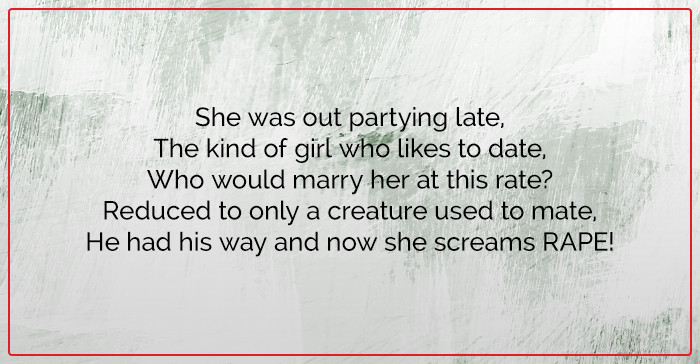
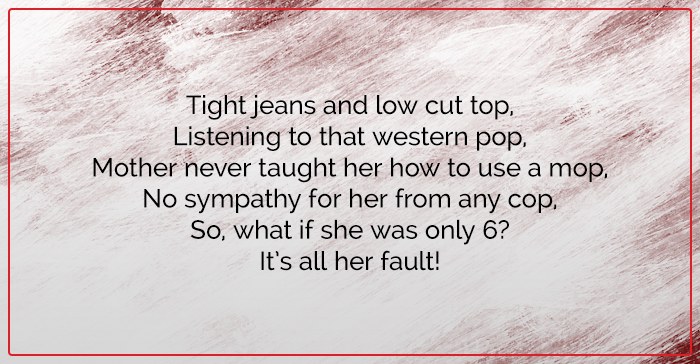
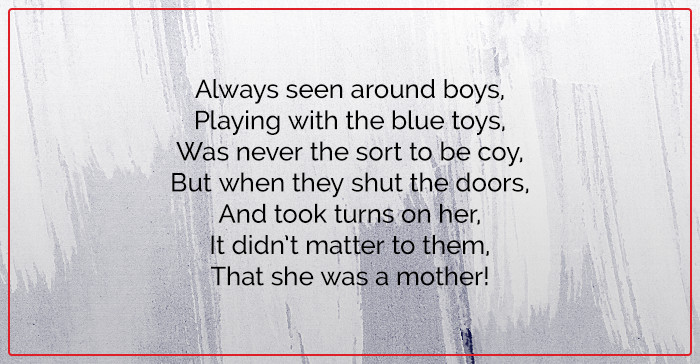
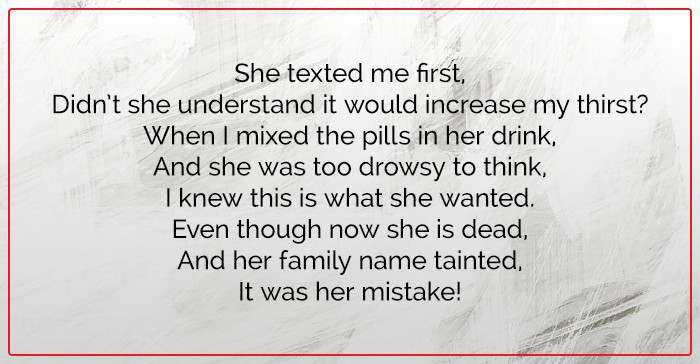
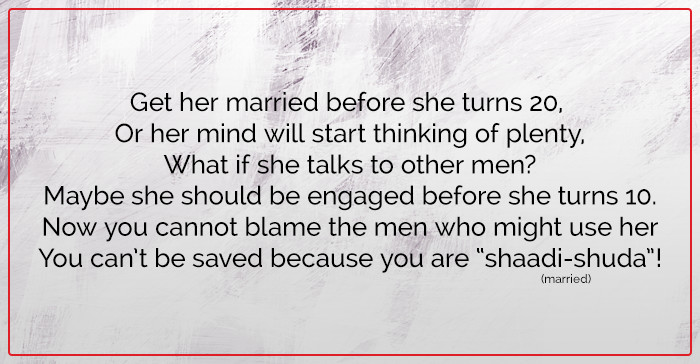
India has been dubbed the rape capital of the world. Whose fault is it when someone is raped? Is it the aggressor who couldn’t hold his urges and decided to destroy someone’s life or the victim/survivor? How is it fair to blame someone to be out at a particular time or wearing particular clothes? Or what about when a man is raped? This is a whole new story where the man is considered weak and laughed at.
It’s the hypocrisy that we all indulge in which needs to stop. We all have a responsibility to keep each other safe and make sure that justice is delivered to the culprit and not to an innocent person.
Write to us with your views and opinions to jaagorein@gmail.com or tweet to us @JaagoRe with the hashtag #whosefaultisit.
Share this story on
.jpg" /></p>
<p class="art-para-power">
If you were walking on the road and suddenly a dog or a pack of dogs...)
Reacting V/S Responding - Why do we regress when it comes to Rape?
"Rape is nobody's fault but one has to dress desirably"
Why is this statement wrong?
Arguably, there are two very wrong claims in this comment - one that rape is "nobody's fault", and that one has to "dress desirably" so that nothing such as rape happens.
Every time an incidence of rape hits the news, we see people and the media telling us how the victim was at the wrong place, at a wrong time, and how very stupid it was to do so. Why do we prefer to blame the victim and not the perpetrator of crime?
To know more about this issue, we conducted a twitter chat on ‘Victim Blaming-Society's reaction to rape' with experts Rashi Vidyasagar (NGO Programmes officer), Paras Sharma (Coordinator at iCall a psychosocial helpline), and Vidyut (Socio-political blogger). Here are a few interesting points raised in the chat:
Questioning the media
Reaction to news reports
Lack of reaction
There have been more than 68,000 rapes cases from 2009-2011, but only 16,000 people were convicted. India has been battling the rape menace, but it seems like it's a losing war. Citizens who are supposed to be safeguarding the rights of the victim have turned against them.
How do you think we can stop indulging in what has now become a "spectator sport," and actually help to prevent further assaults?
Write to us with your views to jaagorein@gmail.com or tweet to us @JaagoRe. You can also reply to the questions we asked during the chat.
Disclaimer:
Views expressed here are of the author alone and do not necessarily represent that of the brand.
About the authors



Share this story on

Why are we ashamed of Menstruation?
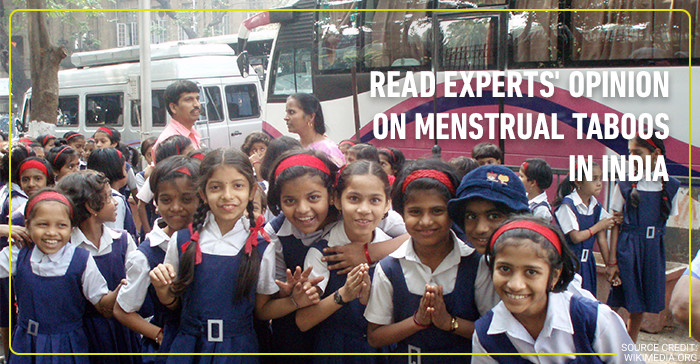
Menstruating women are impure and so they should not go to temples during their periods - As absurd as this seems, it is a common belief in our country. Many such myths lead to taboos, which in turn result in discrimination against women. Hence, menstruation is associated with shame and people avoid discussing it.
What are these taboos and how do they affect us? To know more about, we conducted a Twitter chat today with experts - Nishtha Gautam, Goonj (NJPC - Not Just A Piece of Cloth), Menstrupedia and Feminism in India . Here are a few snippets from the conversation:
What are Menstrual Taboos
Menstrual Taboos in India
Nature of the issue
Effects of taboos
Gender discrimination
Why do taboos still exist
How to overcome taboos
Final thoughts:
We’re at the end of 2015. Do you think these menstrual taboos are still relevant in the world we live today? How best can we as society help people everywhere overcome stigma against menstruation? Share your thoughts with us in the comments section below and continue tweeting to us on Twitter. You can also write to us at jaagorein@gmail.com and on our Facebook page.
Disclaimer:
Views expressed here are of the author alone and do not necessarily represent that of the brand.
About the Author:




Share this story on

8 reactions to ridiculous headlines
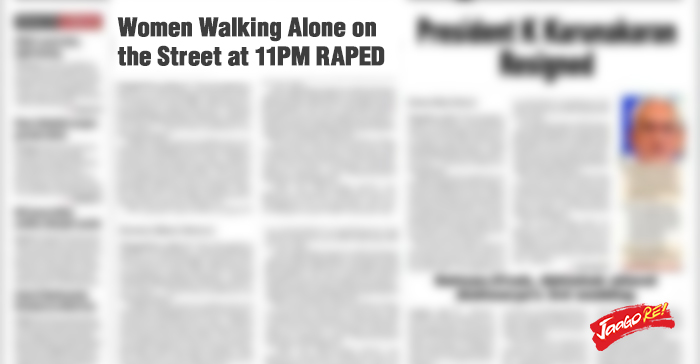
Many times in a newspaper, we've come across headlines that put victims of sexual crimes in a very poor, judgemental light by the media. Its precedence is set in such a way that it seems like the victim was at fault for provoking the perpetrator of the crime, even though they are not. We at Jaago Re, wanted to question, assess and identify how this would be perceived amongst the general public. Would people realise that the media's portrayal is also the perception of society itself? Would people question the sexual crimes taking place? Who would they hold responsible, the victim and her parents? The perpetrator and his education? Or would they question themselves and their mind-set? JR went out to the streets of Bangalore with a news headline – “Woman Walking Alone At 11 PM on the road Raped” and gathered insights from the responses elicited by the general public. Read on further to see the highlights.
Who cares why you stepped out, it's your fault you got raped
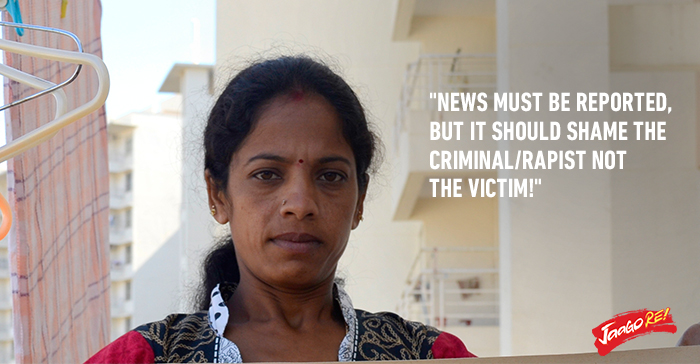
"Coming from a community that has never taken women's needs seriously, I feel such news headlines are unfair towards us. Do they want us to lock ourselves up at home and never step out? How am I supposed to feed my children and pay for the daily expenses if I as an individual cannot step out without having support from my community? News must be reported, but it should shame the criminal/rapist not the victim!"
Doesn't matter who commits the crime, a woman must be restrained!
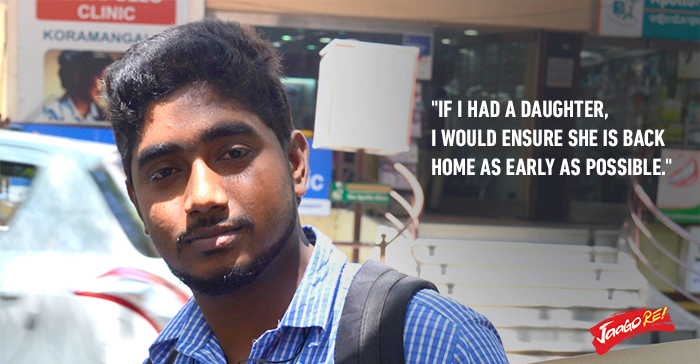
"To a large extent, women are solely responsible for communal safety. Right from the way they dress, to the way they behave and the things they say in public to other people - they make unknowingly provoke people to do harmful things. I don't mean to say that women shouldn't be out late in the nights, but with an unsafe environment in our streets, why take risks? Even men aren't safe, they have high chances of being attacked. Sometimes I have to travel long distances on my bike to deliver goods to a customer, I as a man do not feel safe! Coming to these news headlines, I strongly believe things like this should be published by the media. Women must know that they are unsafe at nights, expecting society to change for an entire population of women is quite difficult.. it will take time. If I had a daughter, I would ensure she is back home as early as possible. Not because I want to restrict her, but to protect her."
Even if a woman goes to the moon, she is unsafe!
.jpg)
"Coming to the subject of women being out late in the night, we refuse to believe that this society is capable of protecting women at any given hour. Day or night, how does it matter? Gruesome crimes have occurred in broad daylight - what do people have to say about that? Such prejudiced opinions give us a look deeper into what society and we ourselves perceive of our safety. Women are still viewed as frail objects, we are still looked down upon. It does not matter if we have a woman President, chief minister or even fly ourselves to the moon. What good is a country that cannot protect its citizens? Aren't women citizens? There are no helpful laws, our government and courts have shown no progress in fast tracking cases."
One bad apple can spoil the whole bunch
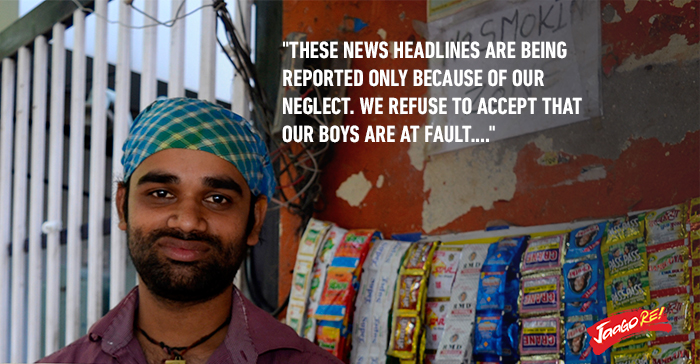
"In my opinion, it does not matter if boys are brought up well by their parents and their school teachers. The driving factor for all boys to turn into criminals is the company they keep. What can anybody do if a "well brought up" or "good" boy falls into the company of evil minded people? These are questions we as adults must ask ourselves. These news headlines are being reported only because of our neglect. We refuse to accept that our boys are at fault, we are of the opinion that they learn as they grow older. If a boy is not taught what is wrong, he will continue to be a nuisance to society. As a result, his wife, children, the people around him will suffer."
Everyone else is at fault, except me!
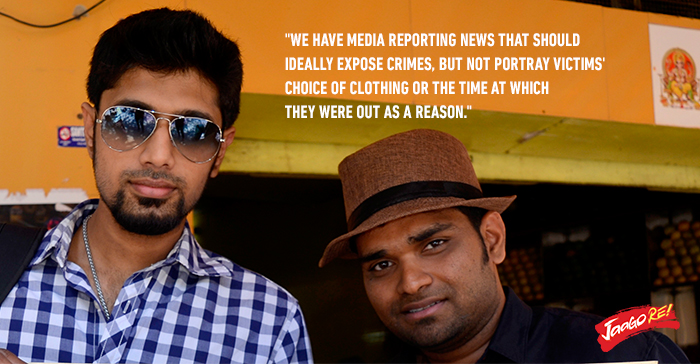
"As men, we feel that we have a crucial role to play. In order to help establish a sense of equality in our society, it must begin with us men. It's not enough if we send women out to be educated or out to work, people think that's what equality is all about. We aren't being sensitive to women's issues. Employment and education barely scratch the surface. To top it all off, we have media reporting news that should ideally expose crimes, but not portray victims' choice of clothing or the time at which they were out as a reason."
The length of my clothes is directly proportional to my safety
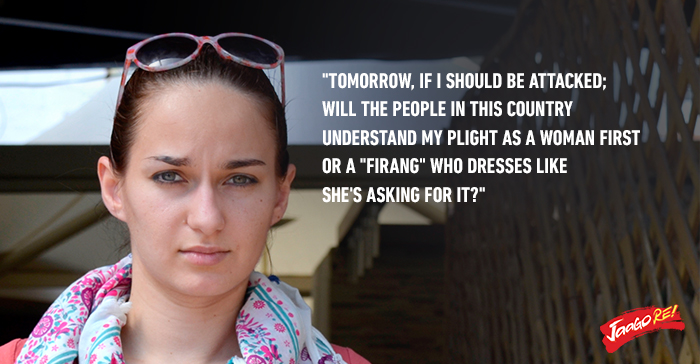
"I feel very uncomfortable when I see such headlines. I have been living in India for the last 2 years, travelling throughout the country and I always question my safety. Tomorrow, if I should be attacked; will the people in this country understand my plight as a woman first or a "firang" who dresses like she's asking for it? Irrespective of my colour, my clothes and the time that I am out. Safety for me as a woman is something I will constantly demand from the government, whether I am in Hungary or India. These news headlines are not just a problem in India, but even in many other countries where I have travelled. The world's outlook of women is very unsettling, many people still think it is always the victim's fault."
This social experiment was carried out over a span of two days – and around 42 people from the streets of Bangalore were involved in making it possible. The age group ranged from 18-60+ years. Can we put an end to how rape culture character assassinates its victims? Will we start asking the right questions?#PowerOf49 #JaagoRe #WhoseFaultIsItAnyway
Share this story on

Highlights of the year 2015 in India
The Republic Day Parade
This year’s Republic Day parade saw the US President, Barack Obama gracing the function as our country’s first ever international chief guest. This event also saw an all-women contingent march down Rajpath, making it the first time ever that we saw women from armed forces partake in Indian history.
The Agni-5 Test
Agni-5 is an intercontinental ballistic missile developed by the Defence Research and Development Organisation (DRDO) of India. On January 31st, India had successfully launched Agni-5, its longest range ballistic missile, for the third time off the Odisha coast. The missile was launched from a canister from Wheeler Island, giving it higher road mobility.
Union Budget 2015
The 2015-2016 budget was presented by Finance Minister Arun Jaitley on February 28th. It saw the abolishment of wealth tax, service tax was raised from 12.36% to 14% and the education sectors saw rise in new schemes, institutions and scholarships.
National Electoral Roll Purification and Authentication Programme
The National Electoral Roll Purification and Authentication Programme (NERPAP) is voter registration project of the Election Commission of India. It will link the elector's Photo Identity Card with the Aadhar number of the registered voter. It is aimed to create an error-free voter identification system in India, especially by removing duplications. The project was launched on March 3rd.
Beyond Visual Range missile, Astra
India's Beyond Visual Range (BVR) air-to-air missile Astra was successfully test fired from a Sukhoi-30 fighter aircraft on March 19th. The missile, which was fired off Odisha coast near the Integrated Test Range at Chandipur, Balasore, has been indigenously designed and developed by the Defence Research and Development Organisation (DRDO).
Section 66(A) declared unconstitutional by SC
The Supreme Court declared Section 66(A) of the Information Technology Act on March 24th, terming it "vague" and "unconstitutional". The law has been used in a number of instances to crack down on those who posted critical or divergent political views.
The purpose of Section 66(A), according to the annotations of the law, reads, "Punishment for sending offensive messages through communication service, etc”. Many activists, freedom of speech and internet freedom campaigners expressed their opinions that the act was being aimed solely at quietening differences of opinion on the internet.
Operation Raahat: India Rescue Mission in Yemen
Operation Raahat was an operation of the Indian Armed Forces to evacuate Indian citizens and other foreign nationals from Yemen during the 2015 military intervention by Saudi Arabia and its allies in that country during the Yemeni Crisis.
The evacuation by sea started on 1 April 2015 from Aden port. The air evacuation started by Indian Air Force and Air India on 3 April 2015 from Sanaa. More than 4640 Indian citizens in Yemen were evacuated along with 960 foreign nationals of 41 countries. The air evacuation ended on 9 April 2015 while the evacuation by sea ended on 11 April 2015.
“Give up LPG Subsidy” scheme
On April 5th, the Petroleum and Gas minister, Dharmendra Pradhan launched a scheme that urged rich Indian citizens to give up their Liquified Petroleum Gas subsidies, which will in turn help low income bracket citizens to be able to afford it.
First International Yoga Day
The First International Yoga Day was commemorated by the United Nations General Assembly on 21st June, a lot of groups in India held all day yoga camps. The event gathered a lot of international attention and India got its due credit for its long held ties with yoga.
Digital India launch
Digital India is an initiative by the Government of India to ensure that Government services are made available to citizens electronically by improving online infrastructure and by increasing Internet connectivity. It was launched on 1st July, by Prime Minister Narendra Modi. The initiative includes plans to connect rural areas with high-speed internet networks.
Launch of Astrosat
Astrosat is India's first dedicated multi-wavelength space observatory. It was launched on a PSLV-XL on 28th September.
Its scientific purpose is simultaneous multi-wavelength monitoring of intensity variations in a broad range of cosmic sources, monitoring the X-ray sky for new transients, sky surveys in the hard X-ray and UV bands, broadband spectroscopic studies of X-ray binaries, AGN, SNRs, clusters of galaxies, and stellar coronae studies of periodic and non-periodic variability of X-ray sources.
India's Intended Nationally Determined Contributions
In contribution to the United Nations Framework Convention on Climate Change, Indian environment minister Prakash Javadekar announced that India would reduce its emission intensity by 33-35% by 2030.
Uber rapist gets life imprisonment
The Delhi Uber rape case finally saw a verdict being given out 11 months after the incident, the rapist is to serve life imprisonment.
Induction of women as combat pilots
On 24th October, the Ministry of Defence approved its induction of women as combat pilots in the Indian Air Force.
Juvenile rapist in Nirbhaya case released
Amidst a lot of protests on 20th December, the juvenile rapist in the Nirbhaya case was released and given rehabilitation by the government.
India gets its own navigation system
Indian Space Research Organisation (ISRO) has developed what will now be known as India’s very own navigation satellite. It will provide two types of services - standard positioning service and restricted service.
Women in private sector to get maternity leave up to 26 weeks
In a recent report, the central government has decided to raise the maternity leave private sector employees from 12 weeks to 26 weeks.
Do you think we are prepared to see the year 2016 in a much more positive light? Let us know your thoughts in the comments below, you can also reach out to us on our Facebook page, or tweet to us @JaagoRe and even write a mail to jaagorein@gmail.com
In the months leading up to the election, Jaago Re released a 10-point Powerof49 Manifesto, and presented it to the leading political parties. Can we check to see if any of those demands have been met? If not, how do we, as citizens of the world's largest democracy assert our rights?
Can we take inspiration from movements around the world, where the youth, both men and women have gone up to every extent imaginable to ensure their rights are met with – or can they serve as an example for us to shake off our apathy and to introspect, question, organise and gather together to demand what's ours. Click to here to read the list of demands of the Powerof49 Manifesto.
Share this story on

How Bangalore is tackling gender bias, one school at a time
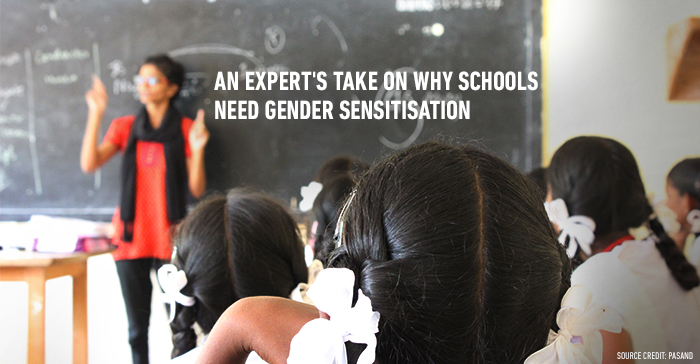
“Girls shouldn’t wear short skirts and boys shouldn’t be weak.”
What do you think is wrong with this statement? Or do you think there is nothing wrong at all?
We have come to a stage where two year old girls are being raped and more than 42% girls are abused before they turn 19.* It’s not only girls who are facing these unfortunate and horrific cases; one in two boys in India is a victim of sexual abuse.* We are clearly failing to protect our children, to educate them about how to stay safe. Moreover, it should not be the responsibility of victims to prevent abuse, but rather of the communities to stop it from happening. Many schools have realised this problem, and to help combat it, they have introduced gender sensitization workshops with the help of different organizations that help bring awareness of body safety rules and abuse in age appropriate levels.
We spoke to Sharmada Shastry who works for one such social enterprise based in Bangalore, Pasand, and conducts regular workshops for schools, and here’s what she shared with us:
Why do you think Gender Sensitisation is important?
We aren’t told about some very important things from a young age. For example: your mother would tell you not to go out or you will get raped, but she will never tell you what rape really is. Parents will ask where their daughters are going but not think to question their sons. This leads to many children not understanding the gravity of something like abuse, or rape. Children are curious and if they are shamed by adults for their questions, they look it up on the internet, making them even more vulnerable. It’s important for someone with proper knowledge and an approachable attitude to inform children about their rights, body changes, and how to stay safe. This is where Gender Sensitization workshops step in to help.
What reactions do you usually get from the children?
Reactions vary from school to school, especially depending on the socio-economic background of the children. At first, the children giggle, and are shy or uncomfortable. However, once we get into the session their curiosity takes over any shyness. They ask many questions and understand that it is a serious topic for their own benefit. No one has ever spoken to them about sex or anything related to it before, whatever they know is usually from the media or internet. When children learn that their body changes are normal and natural, but that everybody is different, their reaction is a big sigh of relief and a smile.
Since it’s a sensitive topic how do you make children feel more comfortable?
To make them feel comfortable we use ice-breakers, as well as personal stories and humour from the facilitators. In one ice-breaker we integrate gender norms and ask children to pick a classmate with “good qualities.” You will be surprised that girls choose other girls who are shy or fair and don’t speak much, whereas the boys are picked because they are strong and intelligent. It’s easy to see how harmful gender biases start from a young age.
How do you approach schools and what feedback do you get from them?
Sometimes schools approach us and sometimes we go to them. We start by explaining the need for the programme given the rate of abuse as well as the fear and shame students experience going through puberty. For example 90-95% of our female students do not have much knowledge about their private parts.
60% of our male students do not know boys can be victims of sexual abuse. When we share our own research, schools understand that it’s important to empower kids to make choices for their own health and safety. Most schools agree but some ask us to change or omit some information. Sometimes we oblige, but most of the time we take them through the curriculum, with detailed examples of what happens when certain things are left out, and explain why it’s important. In spite of disagreements on what can be taught and what cannot, we always receive good feedback. More and more schools have started taking up the programme including government schools.
What is the kind of feedback you have received from parents and students?
We have seen a great response from students. We also conduct a pre and post survey to track how much they have learnt. Apart from thanking us, they tell us that they have found more clarity on a particular topic. Just to give you an example: When we start off, girls don’t know much about menstruation so once we tell them about the different taboos and give them information, they understand that it is not shameful but a normal process of their body. With the boys we tell them how much pain their mother went through while giving birth, this in-turn leads them to respect women and see them as equals. One of our 8th standard boys, Praveen told us that “the programme taught [him] that both boys and girls should get education and both should work, before and after marriage.” We use games and activities to get students to make their own conclusions and discoveries including the fact that gender equality is good for both men and women. Making a change in attitudes and information is the first step towards behaviour change.
Reactions from parents is more of a mixed bag. Recently, a mother came up to me and told me that we had gone too much in detail about rape by giving students the legal definition. We explained to her that we cannot teach about rape to the older students without giving an accurate (and legal) definition. This isn’t done to scare students but rather to empower them with their legal rights. Most topics on sexual health and assault awareness are inter-related, and our program makes sure to build slowly to more intense topics. After talking with the parents we often realize they themselves are lacking critical information. Engaging parents (esp. mothers) more effectively is part of the latest program we are piloting in two communities in Bangalore.
Gender Sensitization is a small but necessary step to the gradual eradication of gender biases and to reduce the abuse and harassment across the country (while increasing reporting). Through collective efforts of people, organizations, and with the cooperation of schools and parents, we can hope to keep our children safe by keeping them informed.
What are your views on the same? Write to us at jaagorein@gmail.com or tweet to us at JaagoRe.
Power of 49 Manifesto
The Power of 49 Manifesto points out the need for gender sensitization to be made compulsory for boys and girls from Std. V to XII in order to counter eve-teasing. But there are a many objections for implementing the same. Comment with your views below.
Push the pin
Push the pin on gender issues that you think affect issues related to gender sensitization.
Sources:
UNICEF
The New Indian Express
More about the Experts:

Share this story on

What is the story behind menstrual myths?
Shock and shame – this is how most women in south Asia remember the onset of their menstrual cycle, and it changes their world entirely. The greatest irony is that menstruation is absolutely essential for survival and perpetuation of humankind, but most societies don’t want to deal with the fact that women bleed every month.
It wasn’t until the mid-18th century that menstruation was known to be related to ovulation. Scientific experiments to test the factor of “impurity” in menstrual blood were not undertaken until 1920s. It is then understandable that some of the myths our ancestors lived by came to be because of the lack of information regarding what exactly was going on inside our bodies.
But, despite having known that menstrual fluid is nothing but a harmless mixture of blood, tissues and small amounts of hormones for about a century now, the culture of silence around the subject keeps menstrual myths unquestioned and inviolable.
Origin of Menstrual Myths
We aren’t supposed to talk about it in the open, nor are we supposed to question the restrictions and rules that follow this natural, not to mention essential, biological process. The clouds of myth and superstition that surround menstruation are affecting millions of women every day and more importantly, shaping how young girls and women look at themselves, their bodies and their roles in our society. Where did this cycle of internalized shame and ignorance begin?
.jpg)
Popular Myths that lead to menstrual taboo
Now that we know how menstrual myths originated, let’s look at some of the most popular myths believed to be true in a lot of communities, especially in South Asia, along with logical/scientific explanations debunking these myths.
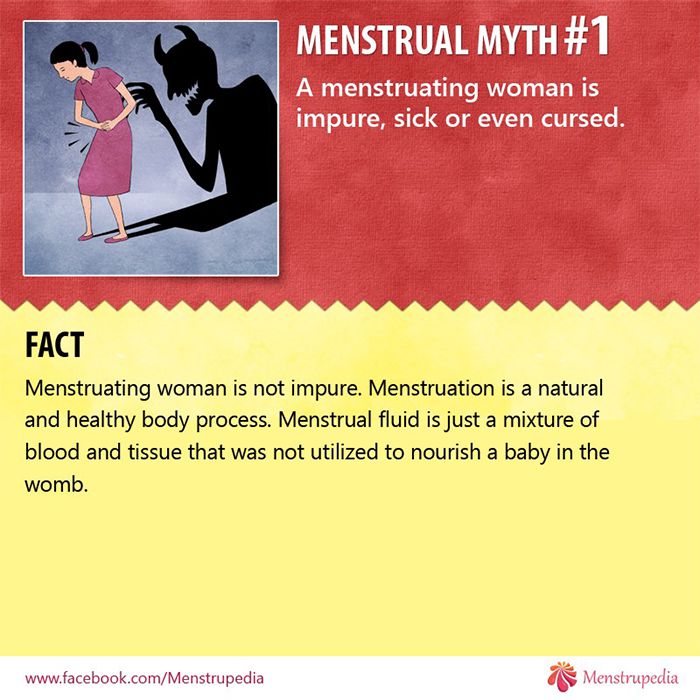
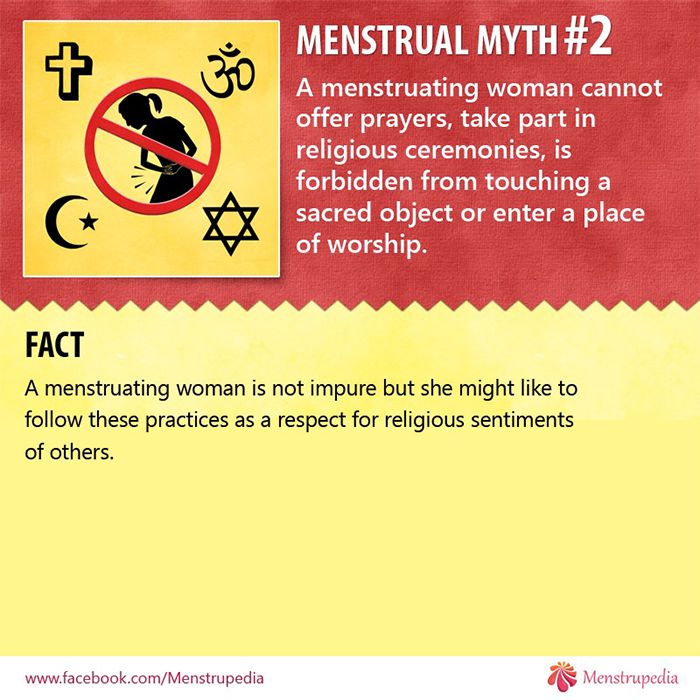
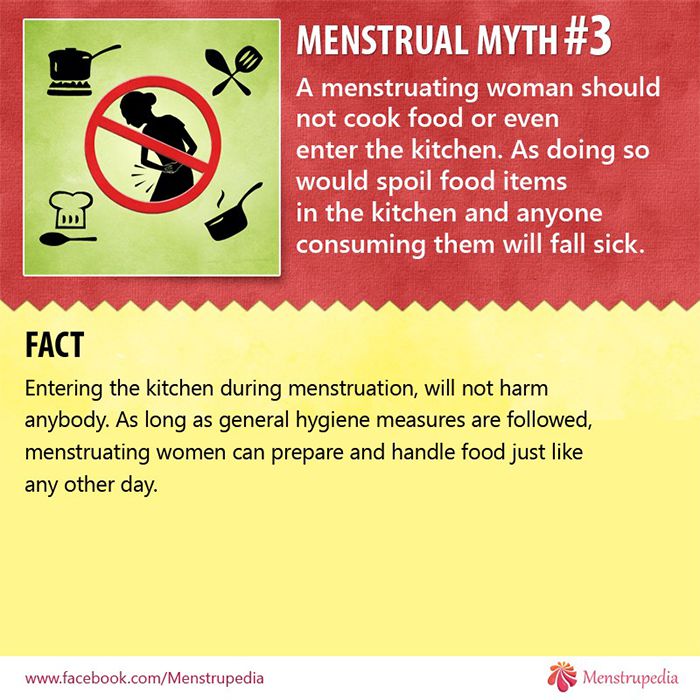
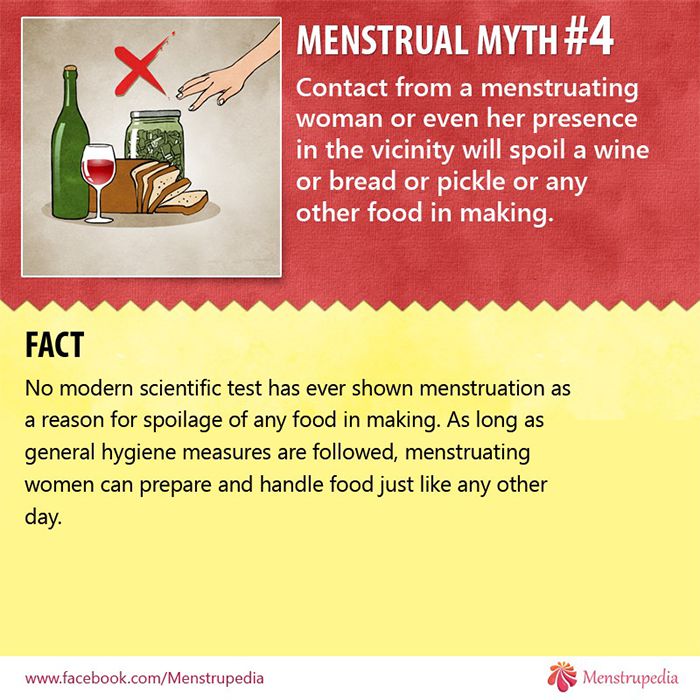
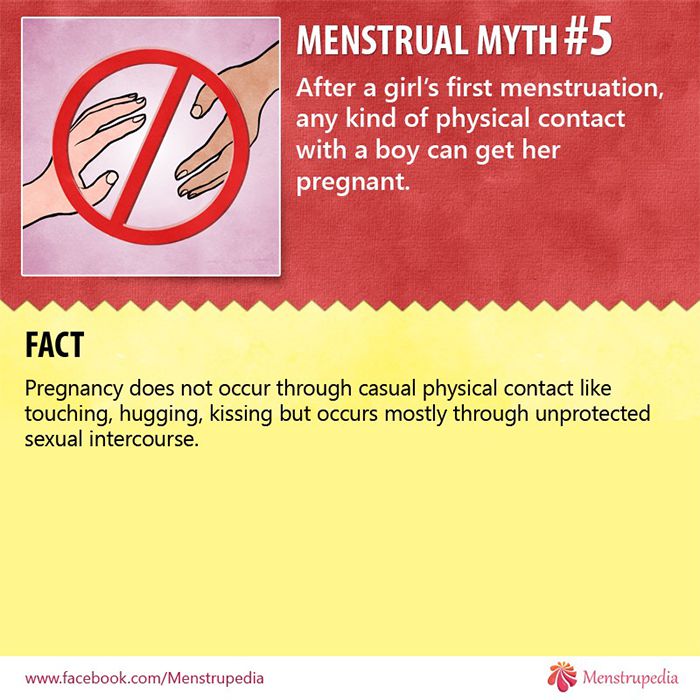
Menstrual myths have a long history rooted in our lack of understanding of the human body and our habit of deductive reasoning based on symptoms. But our beliefs and practices must change with time and with scientific advancement. It's also important to know the context in which some practices were suggested once upon a time, so as to debunk myths with a logical and nuanced explanation. It is a long road ahead for emancipation of women from the stigma of menstruation, but like any other hundred foot journey, this too needs to begin with the small step of our breaking free from the taboo and shame and encouraging others to do the same by using the power of reason.
Disclaimer:
Views expressed here are of the author alone and do not necessarily represent that of the brand.
About the Author:

Share this story on

Fight Dowry, not 498A
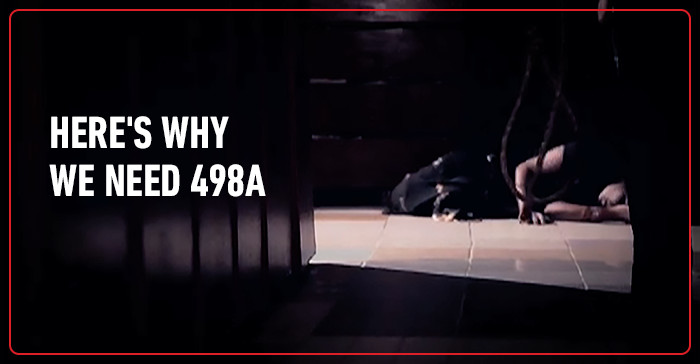
One woman dies every hour due to dowry harassment in India. *
The anti-dowry harassment law (498A) has helped women gain confidence to come and report domestic abuse, but there has been an increasing anger towards it. As the debate continues on the use and misuse of it, we decided to ask Namita Bhandare, a journalist and gender editor at Mint, a few questions about the way society has changed in terms of perceiving gender violence like harassment for dowry, and how this law grants or denies justice. Here’s what she said:
1. We have been seeing a backlash of 498A due to its misuse. How can this be prevented?
I am frequently amazed at the vigilantism against 498A. If only we were equally vigilant about all the other laws being misused.
To answer your question, is 498A misused? Yes. Undeniably. It is misused just as every other law is misused. Taxation laws are misused. Criminal laws are flouted. Our anti-terror laws frequently err in arresting innocent people for years. Yet, I don’t hear anyone suggest that we scrap our anti-terror laws.
2. The government has proposed to amend the law (498A). Do you think this will help?
Continuing with my earlier response, I think we need to understand who is misusing 498A and why.
(i) Litigants have no idea about legal provisions. It is lawyers who frequently advise clients to file cases under 498A. They do this for a variety of reasons, but most often they do this because they believe that 498A will give women their only leverage in cases of maintenance and custody. So any talk of reforming the law or changing it, must take into account reform in the maintenance and custody procedures too, making these fairer and more transparent for women.
(ii) Any talk of reforming or amending this section, must also make the process of divorce easier and simpler, particularly in cases of mutual consent. Yes, courts can play a mediatory role but ultimately they need to understand that when two adults no longer wish to continue with the marriage, they should not attempt to prolong or protract it in any way.
(iii) The constituency that misuses 498A is the constituency that is liable to misuse most laws anyway. But the majority of women in this country do not have access to courts and lawyers. They suffer domestic violence and dowry harassment in silence. By removing or watering down 498A, you will be removing the only protection they have in law, even if it is a protection they do not or cannot avail of.
(iv) Today we have forgotten the horror of dowry deaths that were dismissed as ‘kitchen accidents’ that played out prominently in media through the 1980s. Yet, dowry deaths and harassment as per NCRB data is up.
(v) We need to once again bring back anti-dowry campaigns. We should have done away with dowry altogether by now, yet marriages have become more ostentatious, with the brides’ family still paying huge amounts of dowry. We have an existing Beti Bachao Beti Padhao campaign: why not use this campaign to send out an anti-dowry message?
(vi) Finally, there are provisions in our statute books against the filing of false complaints that lead to arrests. If men’s rights groups are concerned about false cases, then they must invoke these sections and seek the protections they already have under the law.
3. Some people believe that the 498A and anti-rape law are against men? What are your views on this?
Against men, no. Against criminals, yes. If the perpetrators of rape and dowry harassment are men, then these laws are against them. But I don’t see how they are against men as a group. Let’s not forget that we have many, many men who are supporters and enablers of women’s aspirations. Why tar them with the same brush as men who commit crimes?
4. What differences do you see in the laws for women in India and other countries?
I am not a lawyer or even a legal expert so I am not really qualified to answer this question. But as a journalist I do see a fair amount of progressive legislation in our country.
while on one hand the anti-dowry harassment law (498A) has provided justice to many women who were victims of domestic violence, on the other, many women have misused the law. Do you think this warrants for it to amended or scrapped? Write to us with your views and opinions to jaagorein@gmail.com or tweet to us at @JaagoRe.
Disclaimer:
Views expressed here are of the author alone and do not necessarily represent that of the brand.
Namita Bhandare is gender editor, Mint. The views expressed here are her own and do not necessarily reflect those of her newspaper.
About the author:

Sources
*The Telegraph
Share this story on

Is the fate of the girl child in India changing?
In a country where, child sex ratio has declined from 945 in 1991 to 914 in 2011, the significance of the National Girl Child Day, observed and commemorated on 24th of January every year, cannot be overemphasised. Subsequently, the observance of this day, earmarked for raising awareness about the inequalities and injustices perpetuated against the girl child, and also for educating people about the rights of a girl child, was extended to a weeklong (24th-30th January) commemoration in the form of National Girl Child week.
This National Girl Child week, let’s look back at six events of 2015 that have made a positive impact for the Indian girl child:
Mhonbeni Ezung, an eight year old girl from Nagaland, became the youngest National Bravery award recipient in 2015, for rescuing her drowning grandmother. Her 78 year old grandmother had taken her fishing and had fallen into the river after suffering from sudden cramps, followed by a stroke. Little Mhonbeni ran all the way to a village 4-5 kms away, all alone and brought help in time, to rescue her drowning grandmother.
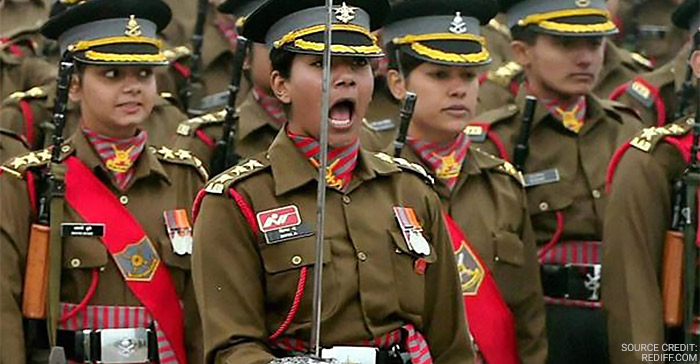
Captain Divya Ajith Kumar led the first all women’s contingent of the Indian Army for the Republic Day parade on January 26th, 2015. Twenty-five year old Captain Divya Ajith is also the first woman cadet in the history of Indian army, to have been awarded the prestigious ‘Sword of Honour’ in 2010.
Government of India launched the ‘Beti Bachao Beti Padhao’ campaign in January 2015, with the aim of creating awareness and to ensure survival, protection and empowerment of the girl child.

Indian tennis player Sania Mirza, became the first Indian woman to be World no.1 in women’s doubles. She, along with her partner, Martina Hingis, won 9 titles including the Wimbledon, US Open, and the year-ending WTA finals. They continued their winning stint in 2016, and broke a 22 year old world record by winning 29 matches in a row. In many interviews, following her victories, Sania Mirza has spoken about her desire to inspire girls in the sub-continent to take up sports, especially tennis.
2015 saw Indian women receive global appreciation with 7 of them making it to the BBC’s list of 100 most aspirational women. These extraordinary seven women -farmer Rimmppi Kumari, entrepreneurs Smriti Nagpal and Kanika Tekriwal, campaigner Mumtaz Sheikh, singer Asha Bhonsle, Tennis star Sania Mirza, and veteran actress Kamini Kaushal - have made their distinctive mark in their chosen fields.

In April 2015, the Malik twins – 23 year olds Nungshi and Tashi Malik – completed the Explorers’ Grand Slam by skiing to the North Pole. The sisters join the rare club of 44 achievers to have completed the Explorers’ Grand Slam, which is a challenge to reach the North Pole, the South Pole, and to climb the highest peak of each continent – the Seven Summits. In 2014, they had already achieved the distinction of being the first ever siblings to scale the seven tallest peaks in seven continents, which they had dedicated to the cause of Indian Girl Child.
These are some of the achievers who serve as inspiration for the Indian girl child and as a lesson for the society which considers her existence as a burden. But, in a country where children, especially girls, are deprived of the right to live, to basic education and nutrition, all the girls who survive, make it school, and strive each day are achievers in their own right.
What are your views on the article? Write to us on our Facebook and Twitter pages, or email us at jaagorein@gmail.com.
Disclaimer:
The views expressed in the article belong to the author alone, and do not necessarily represent that of the brand.
More about the Author:

Share this story on
