All you need to know before filing Income Tax Returns

Dear Taxpayers,
Every year, by the 31st of July, we see taxpayers running from pillar to post in order to file their tax returns and often get caught in the complex web of tax laws which are meant in order to help the taxpayers. To make things simpler, we will run a series on how to file your Income Tax returns, fast & easy, with an aim to help you file your tax returns without any hassle.
Before we start, I believe you know that the last day to file your tax returns for the last financial year has been extended to 31st August, unlike 31st July every year, but I would strongly suggest you file your tax returns at the earliest, and not wait for the last day to start collating all the details.
Let us understand few important parameters and address a few questions before you go about filing your tax returns:-
1. What is the meaning of filing tax returns?
A. Return of Income i.e. Tax Filing is a process, wherein a person reports/declares to the government about all their income and taxes as paid by them. It is like an NOC from your college library, which you have to take before leaving your college even though you had never visited the library. It establishes the fact that you do not have outstanding obligation, or if at all there were any dues, they had been cleared.
2. Who needs to file Income tax Return?
A. A person is required to file his or her “Return of Income”, if their taxable income exceeds INR 2.50 lakhs in a particular financial year; so, anyone earning more than basic exemption limit needs to file his or her tax return by the due date as prescribed by the government.
3. I have a permanent account number (PAN). Do I still need to file IT Return?
A. Just having a PAN number does not mean that you need not file your tax return. As mentioned above, you are required to file a “Return of Income”, if your taxable income exceeds INR 2.50 lakhs in a particular financial year. However, you need to have a PAN in order to file tax returns. It’s like how having a driving license does not mean that you have to compulsory drive but if you want to drive then you must have a driving license.
4. What are the benefits of filling income tax returns (ITR)?
A. Filing returns or not has never been a choice, as it is a legal obligation and must be fulfilled by everyone who falls under the prescribed category as mentioned above. Though apart from a legal obligation, filing tax return is always helpful in the following situations:-
For availing loan facility like home, or personal.
For visa and immigration processing
You can use it as an income proof/ Net worth certificate
For claiming excess tax paid via refund
Applying for a higher insurance cover
And last and most important is your peace of mind!
5. My tax is already deducted at source by my employer and paid to the government, then why do I need to file income tax return?
A. Although tax has been deducted and there is no further liability to pay tax, you have to compulsorily file your income tax return if your income exceeds the basic exemption limit.
6. I have not been able to submit my Investment details for e.g. life insurance premium etc. to my employer and excess tax has been deducted. So can I still declare & claim the benefit?
A. Yes, you can claim these benefits while filing Income Tax returns and can submit your refund claim.
7. What are the different sources of Income?
A. Before you start your tax filing, you need to first determine sources of your total income. Does your income comprise of only salary and interest on savings bank account or you also earn rental income, capital gains or income from any other source?
Let’s see different heads and “Sources of Income” as per Income Tax Act as follows:-
Salary
Rental income from House Property
Profit & gains from Business or Profession
Capital gains on sale of shares or mutual funds or capital assets
Other sources like bank interests etc.
So, you need to add income under each “Head” and then compute your taxes. Don’t forget to include income received by your minor kid. A minor is not required to file a separate return of income but income arising on account of let’s say interest on Fixed Deposits in the name of your minor kid needs to be clubbed in parents’ income.
8. What are the documents required before filing income tax return?
Form No.16: Issued by your employer summarizing your income from salary and tax deducted at source.
Form no 16A: Issued by all the payers who have deducted tax while making payment to you during the year. For example Banks where you have FDs.
A/C statements: All your operating accounts during the year for arriving at interest income earned during the year.
Property details: If you have bought any property or put up existing property on rent then details for the rent received and receipts of municipal taxes paid during the year would be required. If the same is purchased through a loan then copy of loan certificates for interest & principal.
Contract Notes: For sale & purchase of shares during the year for calculating capital gains.
Tax Challans: Details of tax payments made during the year in case you have made advance tax or self-assessment payments.
Others: Any other documents for a financial transaction involving tax implications for computing your taxes.
Important Point: You don’t need to submit any of these copies to the I-T department during the process of filing income tax returns, and even originals are also not required to be given to your CA, if you are taking professional help. These documents are required to help you prepare your tax computation and you do need to keep these copies ready in your file/records in case if IT department asks you to furnish the same at a later stage.
I hope, the above information will help you in setting your tax figures right. Next, I will share a detailed article on how to file income tax returns and the latest changes in the tax forms/rules and processes. Happy filing.
More about the Author:

Disclaimer:
Views expressed here are of the author alone and do not necessarily represent that of the brand.
Share this story on


8 Awesome Comebacks to Sexism And Harassment
Many women face verbal and sexual harassment: at school, colleges, in the workplace, while using public transport, or even from their trusted friends or family members.
It is often unsafe to respond especially to harassment. If you are alone it is advisable to ascertain the situation and decide if it's safe to respond.
Here are some incredible responses that have shut people up. Take a look at these amazing comebacks to sexism and harassment . So the next time next someone makes a sexist insult, you know you can make a comeback and you don't need to tolerate it!

Comebacks from some famous women:
Rihanna
What are you looking for in the next man?
"I’m not looking for a man. Let’s start there."
Emma Stone
Reporter: You look beautiful, as always
Emma Stone: Oh thankyou, that’s all that matters!!!??
Keira Knightley
Reporter: How do you balance your career and personal life?
Keira Knightly: Are you going to ask all the men that?
Megan Fox
Interviewer: The fact that there aren’t many superhero films with super heroines with female leads. What’s your take on that? Do you feel like it’s time? It’s a matter of time? Before we see more of those?
Megan Fox: Do you think that I would answer anything but yes to that question? Do you think I’d say “No it’s not time for women to be in movies, let’s take it back 50 years.
Lauren Conrad
Interviewer: What’s your favourite position?
Lauren Conrad: CEO
Comebacks from some lesser known women:
When I get harassed…
I always pretend I didn't hear and say "what?" The more they have to repeat the sillier they sound.
Man: "I bet u don't know how to play this video game."
Woman: "I actually created it."
Or Simply
That was sexist. And it's unacceptable.
Share this story on
How women make women the weaker sex

The long-drawn movement for women's rights has been fighting to bring women and men on an equal footing in society.
However, the perception that women are oppressed and exploited by men alone is not true. Patriarchy is so seeped into the system that often, some women vehemently act as espousers of patriarchy and misogyny. The ideology of patriarchy has been so deep-rooted that every part of the system works together to maintain this power structure. There are women who can’t break out of it. On the other hand, there are women who have ingrained patriarchy upto a dangerous extent that they will do anything, in extreme cases, kill another –just to uphold self-righteous 'principles' (read: honour killing).
How gender sensitive are our women?
In a recent quiz posted by Jaago Re on gender sensitisation, around 31% women have scored a "negative" result in the quiz. Some true/false options in the quiz were:
Girls are more prim and proper than boys
A woman's primary role is that of a homemaker and a mother
The portrayal of women in soap operas is a reflection of a woman's characteristics
Women need to put the needs of her husband and children before hers
The answers to all the statements above are obviously NO, breaking away from the traditional perception that stereotype women and force unreal expectations on her.
Around 4,500 answers by women have been incorrect – placing them in the category that is in need of gender sensitisation.
Women should be allies of each other – and work together towards uplifting the so-called "weaker sex". That cannot happen if we have women continuing to perpetuate the oppression of women.
Here are some severe ways in which women contribute to their own suffering:
Forced by another woman, a woman aborts a girl child
This is common knowledge in India. The number of instances where not just men, but women who make the daughter/daughter-in-law in their family abort a girl child is unusually high. The innate bias towards a girl child only breeds the prejudice and misogyny towards women in India, and it's worse when women are the perpetrators.
Killing your child to save the "honour"
The recent case of honour killing of a young woman in Delhi by her parents for marrying a man outside her community shocked the country. However, it's certainly not an isolated case. These so-called 'values' are so deep-rooted that even children are not spared. Participating in such crimes further reveals our twisted sense of 'values and honour' that is inbred in our society.
Women guilty of torturing, or killing women for 'dahej' or dowry
According to an IBN report one woman dies every hour due to dowry-related reasons. Over 8,000 women were killed in India in 2012 for dowry.
Even in the 'modern age', at a time when dowry is illegal, such cases refuse to die down. We are following this tradition at the cost of abuse of thousands of women, and even murders of many more. Women have also been guilty of subscribing to these demeaning traditions. Instead of recognising these inhuman practices and banishing them, we still have thousands of families, including women staunchly espousing them.
Everyday instances where women make women the weaker sex
Many of us shrug and think of such extreme cases as the ones we read about in the news, not as something that would happen to "us". Yet the fact is these crimes are an inseparable part of our culture – they are born out of our culture.
You will notice everyday instances where women are allowing abuse, subjugation and offence; as subtle as it may seem.
"You're a girl, you don't need to work, you should be at home": Mother
When a society tries to shut out opportunities for you, because of your gender it sure is discrimination. When your own mother ascribes to the bias and proclaims it as "tradition", where does the girl go? We have to let a woman learn to be financially independent, instead of readying her simply for her "marriage". We cannot deprive her of her freedom to step out of the house and imprison her life and dreams – so she stays in her parents or her husband’s house.
Character assassination
Often, set roles are laid down by society of what a "good woman" should be like. Demure, soft-spoken, adorned in salwar kameez, home before dark etc. are some traits of the "good woman". Anybody who breaks out of this stereotype is usually looked at with disdain. Men and women often indulge in defaming such a woman – be it relatives, neighbours or the ‘society’ at large. It's time we learn not to scorn when women make independent choices for themselves.
Ofcourse, the media plays a big role in perpetuating this norm. The "good woman" is the sari-clad, super chef, self-sacrificial mother at home, and the "evil woman" is the outspoken skirt sporting siren. They haven't even masked this ridiculous stereotype and the audiences have willfully accepted it as real life models to go by.
Many over-the-top cases of moral policing we see today, also stem from such attitudes.
Tolerating objectification of women and idolising it
Our media may be guilty of this, but impressionable girls and women are also guilty of placing such women on a pedestal. Even when we have amazing role models like Mary Kom, Kalpana Chawla or Arundhati Roy, the idea of "beauty" is only limited to those who have an itsy bitsy waist, clear and flawless skin and an idealistic anatomy. Who decides what is "beauty"? Why are supermodels used to sell products that have no connection with them? Why are we (both, men and women) falling prey to such unrealistic standards of beauty?
Men and women, both have to learn that a woman is more than her skin, her figure or her looks. Women can start taking the onus, and men should embrace it.
Tolerating sexism and rape 'jokes'; not calling it out
'Rape culture' is being talked about widely. Often we are silent when offensive "jokes" are passed around. When a woman stands up for herself, she is also standing up for other women. Only when we call it out and draw the line between humour and sexism, is when the rape culture will start to recede.
Women should be allies, and not competitors
It’s high time women recognize each other as allies, support each other and embrace the power of their feminity. Several women (and men) have been fighting to make gender equality a reality for all women in India. Instead of supporting them, when we project misogynistic attitudes, it only puts their work ten steps behind. Identifying the root of patriarchy in day-to-day life is a start. At a time when crimes against women are at an all-time high, we need to transform our society in every way so that we give way for a country that is safer, more gender neutral and respectful to all genders.
Are you Gender Sensitive? Play the Game and Find out Now!
Do you display sexist attitudes in your daily life or are you gender sensitive? Click on the game and play now to know your score on gender sensitivity.
Before the elections started in 2014, Jaago Re launched a crowd-sourced 10-point manifesto about serious issues affecting women in India. We presented it to leading political parties and asked them to pay attention to our concerns.
Are they being followed through with sincerity by our leaders? Is India catching up with any of the points listed in the manifesto? See the manifesto for yourself here
If you see instances of harassment against women, don't stay mute. Push the Pin here.
Share this story on

5 ridiculous myths about Menstruation
Using sand, paper and ash – women in India do not have it easy when it comes to their monthly menstrual cycle. A taboo topic, most girls hide themselves out of fear or embarrassment on their way to a medical store. Majority cannot afford hygienic sanitary pads, and a woman’s menstrual cycle remains a serious concern for half the population of India.
Aditi Gupta and her husband, Tuhin Paul, a young couple and both graduates of Ahmedabad’s National Institute of Design, set up a website called Menstrupedia. An light and entertaining one-stop-centre for everything related to periods, they are winning worldwide acclaim in their creative endeavours to break the menstrual taboo. Menstrupedia helps us bust five ridiculous myths related to menstruation.
1. A menstruating woman is impure, dirty or cursed
A menstruating woman is going through a natural and healthy biological process. She is shedding the egg that can result in the conception of a new life in her womb. It is a sign of a mature woman capable of reproduction.
Calling her dirty or cursed is bigoted and superstitious. All women go through their monthly cycles and there is no need for name-calling. A healthy society will accept it as a natural process and respect a woman experiencing menstruation.
2. A menstruating woman should not enter the temple
A menstruating woman will not "anger God" if she enters the temple. In olden days, when science had still not understood reproduction and the menstrual process, many myths and superstitions came about. They don’t hold any place today - menstruating woman is not “impure” - she is simply going through a normal bodily function.
3. A menstruating woman should not enter the kitchen
She can enter the kitchen on any given day, anything she touches will not "go bad" or rot. She can maintain hygiene and go about her day just like she does on any other day. Prohibiting her from the kitchen is discriminatory and actually in bad taste.
4. Nobody should touch a menstruating woman
This is again a discriminatory attitude. Touching a menstruating woman cannot harm you at all. Going through a natural hormonal cycle is not a negative thing. You cannot treat a woman, or a young girl like that – she and her bodily functions must be respected.
5. Virgins should not use tampons
There is a lot of preaching around the subject of virgins, without the understanding of what a 'virgin' really means. A virgin is someone who has not had sexual intercourse. The hymen of a woman could break even with sports or other activities, and the presence of a hymen is not a measure of a "virgin". Using a tampon is not related to virginity at all.

Share this story on
Will the Uniform Civil Code bring Order?

What is the Uniform Civil Code (UCC)?
The term civil code is used to cover the entire body of laws governing rights relating to property and matters like marriage, divorce, maintenance, adoption and inheritance.
Currently, there are different laws governing these aspects for different communities in India. The laws governing inheritance or divorce among Hindus would be different from those pertaining to Muslims or Christians and so on.
Ruling party's pledge for UCC
In their mainfesto, the ruling party had pledged to draft the UCC.
This is what their manifesto said with regards to UCC -
"The party believes that there cannot be gender equality till such time India adopts a uniform civil code, which protects the rights of all women, and the party reiterates its stand to draft a uniform civil code, drawing upon the best traditions and harmonizing them with the modern times."
What is the current stand on UCC?
The new ruling party is in favour to discuss the controversial UCC. In the next few months, the developments on UCC might roll out and if it does, the entire country's laws will come under one uniform system.
*Source - TOI and The Guardian
Share this story on

5 unique individuals bringing freedom back to India
It is the eve of the 67th Independence Day in India. Over six decades have gone by since our forefathers laid down their lives for an Independent India. Yet there has been a nagging sense of disillusionment. Many times we ask ourselves where is the freedom we once fought for so passionately? Corruption, pollution, social inequality, gender violence, poverty, child abuse etc. are some serious problems plaguing India today.
Many young people have taken note. And they have risen up to the challenge already. These true role models of the new India can certainly teach us a thing or two about winning freedom back.
Jaago Re pays a tribute to five such young freedom fighters of the new India.
1) Mathew Jose- Freedom of environmental sustainability

Reduce, re-use, recycle: a message we have learnt from our childhood. In India, however, only 20% of waste is recycled. In a country that is constantly at risk from pollution and scarcity, freedom of resources is hugely important.
Inspired by rag-pickers in Indian slums, who survive off selling waste items, 26-year-old Matthew Jose set up the NGO, Paperman. The charity works with over 120 schools in Chennai alone, setting up recycling units, selling waste items to raise money, and spreading awareness.
His efforts have had three main impacts. Waste has been reduced; rag pickers in Chennai have benefited from increased business; are saved from excessive exploitation and are finally earning some respect and recognition.
Funds have also been generated for other important causes. In a year-and-a-half, Jose says, they "managed to raise enough to fund a year of school education for 100 girls across India" while schools in Chennai, such as Church Park School also help institutions such as old age homes, giving freedom to the elderly.
Paperman is so successful because it funds itself, using the economic incentive to create sustainability and free India from the problems created by excessive consumption and waste. Inculcating these ideas right when kids are young; initiatives like this can bring freedom from waste and pollution, and dignity for manual labour in India, which is long over-due.
2) Pooja Taparia- Freedom from child abuse

In 2004, Pooja Taparia watched a moving play about a child trapped in the bondage of sexual abuse. In a space of the last 10 years, she has set up an NGO which directly helps 70,000 and indirectly reaches 200,000 people, freeing children and their families of the psychological problems created by abuse.
According to a recent study, around 50% of India's children suffer or have suffered from sexual abuse, yet most people have no knowledge about this crime. Pooja's NGO, Arpan- Making Little Difference, aims to free India of this taboo and in the long-term change the country's attitude.
The charity provides trauma counselling for families, awareness sessions for police officers, and guidance for teachers, students and several other NGOs. Pooja's belief is that in order to free India of this recurring pattern of exploitation, "the society at large has to come together".
When she started her campaign, there were only 26 people listening, but now her voice has been heard, and the result has been incredible.
3) Dhruv Lakhra – Empowerment and Freedom of the disabled through employment

Dhruva Lakhra is the perfect example of a social entrepreneur, who has used his Oxford education and business background to free a highly disadvantaged group from the daily struggles they faced. Lakhra set up a courier business in Mumbai that delivers packages to well-known clients. The one defining factor of Miracle Couriers: all 64 employees are deaf.
In India there are nearly 10 million deaf people and around a third fail to find any employment. Those that do, gain little or no sympathy owing to ‘invisible’ nature of this disability: there is no way of knowing if someone is deaf. Lakhra himself was inspired after a bus journey, when he asked the person sitting next to him a question and received no response. It is this simple communication gap that makes it hard for deaf people in India to attain real economic freedom.
Lakhra chose the courier industry because it relies on sharp visual skills, such as map reading and building recognition, but does not need good verbal communication. Delivering over 65,000 items every month, Miracle Couriers has gained global esteem and has won awards such as the Helen Keller Award and the 2010 National Award for the Empowerment of People with Disabilities.
Lakhra's organisation has therefore been extremely important in raising awareness for the problems faced by disabled people in India and in freeing them from the societal judgement they face daily.
4) Saloni Malhotra- Freedom from the rural brain drain

Saloni Malhotra set up a high-quality IT BPO firm in rural areas of Tamil Nadu and Karnataka. The firm taps into the talent of over three hundred untrained and unqualified young people from the villages in these states, helping to create a generation free from geographical constraints for education and employment.
The BPO provides back office services and computer analysis for organisations from over 15 different industries, in the process giving its employees, mainly women, life skills for computer and IT services. Freedom of employment is so important for the youth of these communities, because they are no longer being forced to commute or migrate large distances to find economic stability.
The organisation has three main objectives: 'to bridge urban rural gap through employment'; 'to plug the rural brain drain' and 'to improve local economic growth'.
As Malhotra discovered, in India over 60% of BPO employees are from relatively rural areas. Therefore, diversification into the countryside is hugely important for the freedom of both rural and urban areas.
5) Anand Shah- Freedom of clean and accessible water

Anand Shah's NGO, Sarvajal, has brought clean and cheap water to thousands of communities across NorthWest India, freeing them of daily struggles caused by lack of access to water. His method? Water ATMs.
Each solar powered tank serves water to around 50 households in decentralised communities and operates through the use of a smart card. Water is delivered at a certain time daily and people are free to choose their own collection time. "The reason the ATM idea is so critical for us", Shah says, "is because it allows us to sell clean water that's not in a bottle. You come to it and you hit a button and water comes out, like the machines at grocery stores in the U.S."
Shah's groundbreaking idea is now also operational in slums in Mumbai and Delhi. The main reason it is so successful is that all machines are manufactured locally. “Instead of buying from a large company, you’re really buying from a neighbor” he says. In addition, machines are controlled through a device that is simply composed of mobile phone technology. So if there is a problem in the system, the solution is a phone call away, rather than a cross country trek.
This new technology promises to free millions of people from water-borne diseases in India and will also significantly change the way the world thinks about water accessibility.
Share this story on
An Open Letter To All Indian Women
You are a resident of India. You pay your taxes. You work. You have a beautiful home and you take great pains in maintaining it.
You give great thought to your wardrobe, ensure that all deadlines are met at work, spend time with your family and meet friends and relatives as and when time permits. You attend to every little detail and ensure that nothing goes unnoticed.
Well, almost.
Some details have gone unnoticed. You forget that before anything else, you are a powerful woman. What does that mean? You have the power to decide who gets to make your life easier in this country.
Like you, 49% of women in India have the same power too. YOU, and the rest of them. A big group of women with one power – to VOTE for a government that is attentive of their issues. And why shouldn’t that be so? You almost form half the base that elects the government. Isn’t that something? Now imagine if the lot of you decide to use the power, and use it wisely. Go vote, and encourage every woman you know to vote.
You may have a perfect home, a great professional career, may be the friend everyone wants to have – but before everything else, you must be the one thing that you are not right now – be fair to yourself. Use Your Vote. Make the system aware of the 49% that YOU belong to.Don’t start a movement. Just join the one you already are a part of - #PowerOf49!
Share this story on
So You Want Women’s Safety In Delhi?
Going by the saturated coverage it has received, the whole country as one is horrified and infuriated by the gang rape of the Delhi woman that took place in a chartered bus earlier this week. Opinions on TV, radio and the internet are flying thick and fast and now everyone has a point of view on women; their duties, their dress code, their demeanour, their situation and their safety. Some vote in favour of the death penalty or castration as the answer to rapists; others speak of the commodification of women and some cite globalisation as the cause for such happenings.
In all this, the one steady leitmotif has been the lack of police performance and the degree of police response to crimes against women. Contempt and bitter condemnation is being heaped upon their heads under the full glare of prime-time news coverage, which forced them to act quickly to nab some of the perpetrators. But this has also brought into sharp focus their everyday failures, attitudes and responses.
Delhi has not earned its reputation for being the rape capital of the country for nothing. There were 572 rapes in 2011. More rapes are reported from Delhi than from Mumbai, Kolkata, Chennai, Bangalore and Hyderabad combined. Thisis just the starting chapter of the whole story. It is well known that only a fraction of all rapes ever get reported. The everyday violence against women that takes place in their homes and the sexual harassment women face at the workplace is all too well hidden. Reasons for these incidents being hushed up range from the general subordinated status of women within our societies to the ‘shame’ and family dishonour associated with taking matters to the law. But one of the strongest factors for the continuation of this miserable state of affairs is women’s lack of trust and belief in the ability of the police to protect them and assist them in their suffering, assault and the discrimination against women.
A 2010 safety audit by Jagori, a respected women’s group, shows that public transport especially buses are seen as unsafe and are cited by the majority of women as a common site for harassment. The levels of sexual harassment have not been measured, but suffice it to say that, if men faced similar levels of harassment and violence it would be cause enough for a national emergency. Sexual harassment and violence that goes unpunished has an economic impact as much as a social one. Families don’t allow young women after a certain age to continue school, college is out of the question for many, work options get limited and because of the absence of women from the workforce the country loses millions in possible GDP.
With all the evidence before us, if after 65 years, for a democracy based on the rule of law to say it cannot protect its women or prevent crimes against women is unacceptable. The police may say that it is not them alone who are responsible for this state of affairs, but posing as victims of ‘the system’ hardly enhances confidence in their abilities to protect and serve.
In terms of the heinous Delhi rape, it isn’t that the police have not reacted to the situation. Across the country, police are teaming up to create community based contact programs, Delhi police have teamed up with local NGOs to hold gender sensitisation classes. Standard operating procedures for rape and other violence are being developed. But patch-work solutions across the country have not gone far enough nor been fast enough to change the situation on the street. Nor are they sufficiently bold, consistent and backed by the political will of the leadership to change the sub-culture that sees violence against women as being acceptable or because its ‘her fault’.
Foundations for change have to be built on strong pillars of performance evaluation and accountability within the police and the response to crimes against women must be factored in as a prime component of that. Attention to this will pave the way for further changes and will speed up the process.
The better protection of women is a piece within the better protection of all. It can’t improve unless the whole system of policing changes to respond to the public and not just to one segment. The question for us is… what is our vision of policing for the future and how can we contribute to make it happen?
-Navaz Kotwal, CHRI
Share this story on
Society & Stereotyping of Women
Gender is the way a society differentiates between men and women and their roles or place in the society. Stereotype is a fixed idea or image that many people associate to a particular type of person or thing, which is often not true in reality. Gender stereotypes are assumptions about characteristics, differences or roles based on gender. By making assumptions based on gender and generalizing these assumptions, we perpetuate gender stereotype.
The age old practice of looking at differences, rather than similarities have resulted in assigning certain roles to men and women as their salient duty, and are now being seen as compulsive criteria to get approval from the society. The process of gendering begins as soon as a child is born, as can be seen from the way parents accessorize room for the baby. If it's a boy, the colour will be blue, toys will be guns and cars and if it's a girl, the colour will be pink and she would get dolls and tiny kitchen sets. The gender roles in our society has been strengthened with the patriarchal system.
In a marriage, even educated urban families assume a woman to be the house manager and take care of kids. The husband has to be the breadwinner and the head of the family. When situation demands that either one of the spouses need to sacrifice the job, by default it has to be the woman. Even women back up this notion because "women are naturally better at managing a house" and so should quit working if need arises. Individual choices apart, there are ambitious women who do not wish to give up their professional lives and are pressurized with balancing work, household chores and kids. This apart, a woman is supposed to be subservient, submissive and quiet. To be safe, she is advised not to go out and to cover herself up. Has generations of practicing this made our society safer for women? Assault on women has been happening and will keep happening. It's not women, but the society that needs to change.
Locking up a woman in the house is not the solution, the solution lies in creating respect for women in the society, among men and among women themselves. This respect has to come from within us and the first step is to stop stereotyping, stop telling our men and women how they are meant to be because they are a "man" or a "woman", teach them to respect the other gender and see them as equals. This is a big change, a change in habits formed over generations, but every change has a small start. Let's make that small start now.
Share this story on
5 Reasons why women in Odisha do not work after marriage
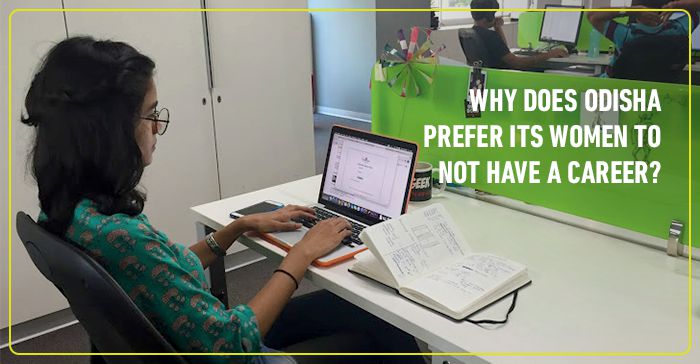
How does a society become instrumental in encouraging its women to pursue their career aspirations? While this question is vital anywhere, it is especially significant to be asked and addressed in the case of Odisha.
Odisha is one of the most unfavourable places for women's development, as is evident from the participation of women in workforce (27.16%)*, and from existing regressive practices like dowry, child marriage and high girl child dropout rates.** How is it possible for women to feel encouraged to be independent and have a successful career in such a society?
We asked a few people in Odisha about the way their society looked at women having a career and economic independence. They made some very strong points about expectations from women in the society and within a family, and they also pointed out that these problems are not exclusive to Odisha. Here’s are a few views shared by them:
1. A woman may work, but not at the cost of household and familial responsibilities
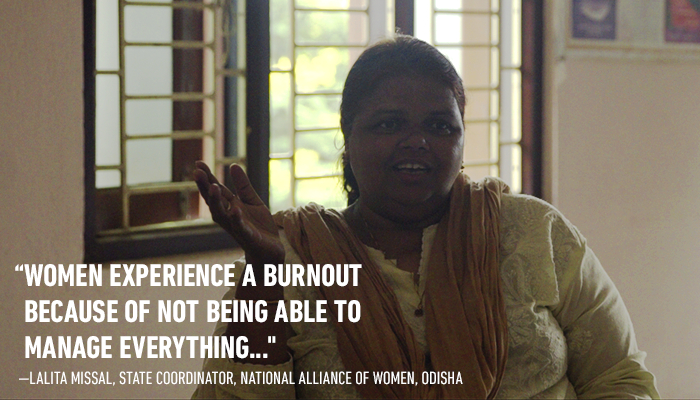
"The expectations (from a working woman) are more. You have to always juggle between being a good daughter-in-law and being a good professional. Women experience a burnout because of not being able to manage everything, and thereby carry a sense of guilt. We have to make sure we cook in the morning, send everyone off to office / school, take our own tiffin, make sure everything is ready for dinner, then go to office and work there, then while coming back we have to collect children, groceries, household supplies, etcetera, and then get home to cook. I don't think most men do that at all.They just go their office and come home where they may or may not participate in the household responsibilities."
2. A woman must ensure that she performs well as a bahu (daughter-in-law), even though she does not perform well professionally.
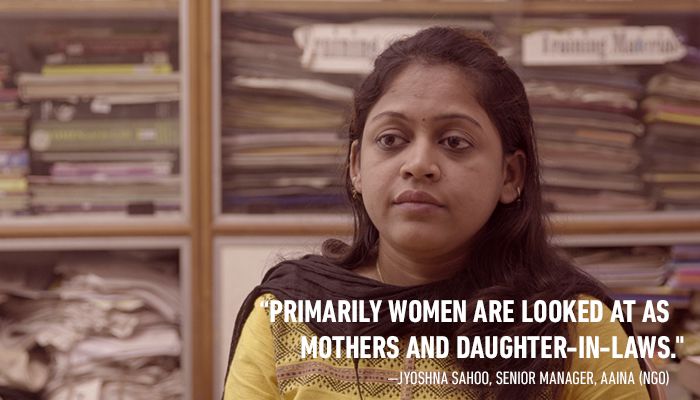
“Bias against women is not specific to Odisha. Everywhere we see that women are primarily looked at as mothers and daughter-in-laws. For a woman it does not matter if she does well at work, but it is very important that she does well as a family woman. Nowadays men do help with housework but it is expected from women to take care of family members, guests, etc., whereas a man doesn’t have to do that.”
3. A woman’s profession and her colleagues need to be approved by family members before allowing a woman to work
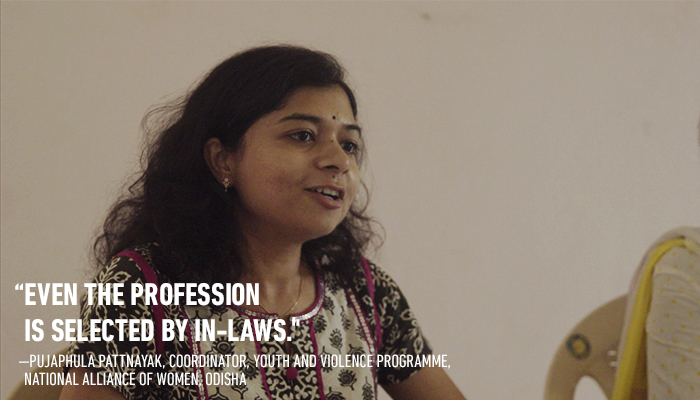
"The perceptions of in-laws have changed to an extent that they will allow the daughters-in-law to work but they have to perform their main role of cooking and caring for the family. They say - 'you go to office, but come back earlier, before your husband comes. Also, you should not sit beside your male colleagues.' Even the profession is selected by in-laws. While looking for a girl they prefer someone in professions like teaching where there are holidays and a pre-set work timing. Women like us in other professions struggle. To make up for the time we spend in office, we have to work extra hard at home to convince them that we are good daughters-in-law."
4. A man helping a woman in household chores is not appreciated
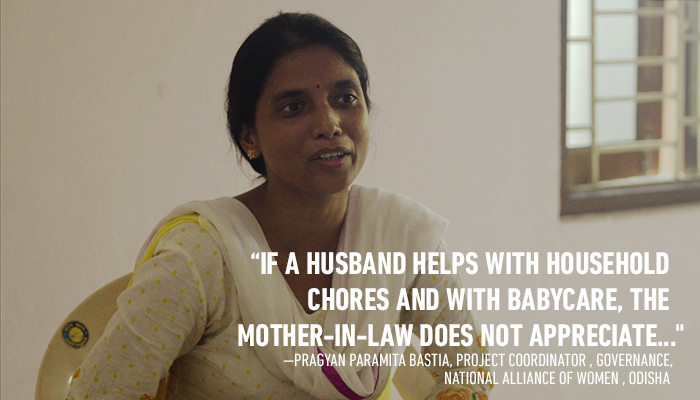
“If a husband helps with household chores and with babycare, the mother-in-law does not appreciate it because she thinks it is a woman’s responsibility - it doesn’t matter whether she has a job or doesn’t. You just have to continue as an ideal an ideal wife.”
"Even bringing up a child is entirely a woman's responsibility. It doesn't matter that there are other family members staying with the child while the mother goes to work, the mother has to ensure that even the clothes a child has to wear after school is kept ready. While at work she, she is expected to enquire if the child has eaten or is well. The father is not expected to fulfil any of these responsibilities."
5. Women do not have economic independence, even if they earn
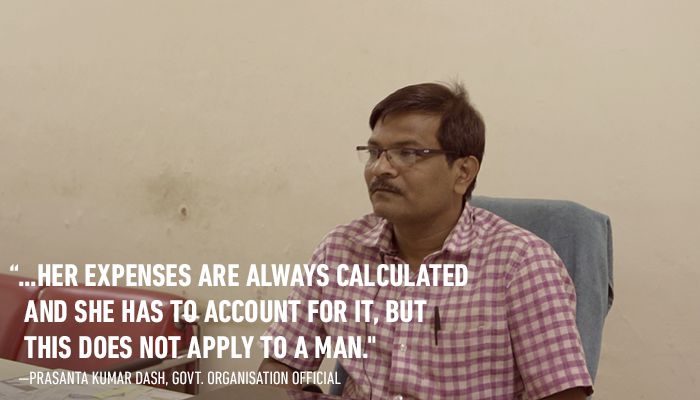
"Even if a woman has money, her expenses are always calculated and she has to account for it, but this does not apply to a man. He can spend his money as he wishes. This gives men a sense of belief that their decision is right, and the wives should agree with them. There is no concept of mutual decision. When it comes to equality, people think about biological differences and say equality does not make sense. They never understand that gender equality is about equal respect and opportunities."
Being a career woman in Odisha (and in many other places) has been a matter of constant struggle against the society. Going out into the world does not replace the conventional role that the society expects its women to already play, and this added pressure further discourages women from working.
People in Odisha believe that the conditions of women are changing, albeit slowly, and they have pointed out specific steps like gender sensitisation, facilitating education for girls, and greater employment options for women, to tackle women's issues in the state. Read more about the condition of women in India here
How do you think can Odisha, and India can overcome gender bias in society? Have you experienced or come across any such challenges working women face? Write to us at jaagorein@gmail.com or tweet to us with @JaagoRe. You can also share your views on our Facebook page - JaagoRe
Sources
*Ministry of Statistics and Programme Implementation
**New Indian Express
Child Marriage in India - An analysis of available data, UNICEF
Share this story on
