7 reactions to our video on Gender Sensitization
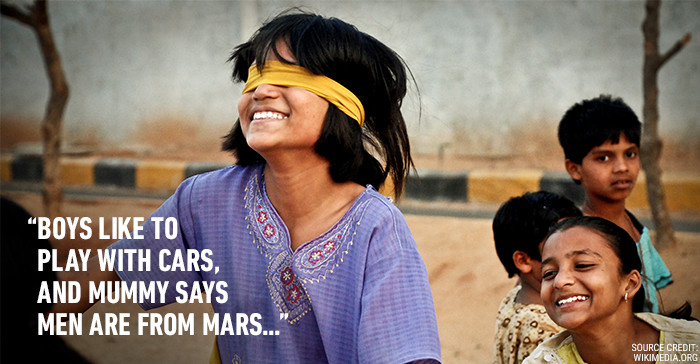
"Gender sensitization is an effort to show how gender shapes the roles of women and men in society, including their role in development, and how it affects relations between them." - Bhowmick Soma.
Boys like to play with cars,
And mummy says men are from Mars.
Girls like to play with dolls,
And also to shop at malls.
Daddy says boys shouldn't cry,
And girls should learn how to make a good potato fry.
Isn't our work supposed to be 50-50 in the house?
But the wife is considered the weaker spouse.
Even though Meera can run any race faster,
My teacher says her husband will be her master.
But what if I am a girl and I want to be an electrician?
Or if I am a boy who wants to be a fashion designer?
Men cannot cook and women cannot drive they say,
They think our thoughts can be moulded like it were clay.
To highlight the need to remove beliefs pertaining to gender bias and help understand the need for gender equality through gender sensitization we interviewed teachers, parents and students about their thoughts on the issue. The interviews compiled into a video which was featured on our facebook page, website and even on The Logical Indian has received some interesting comments. Here are a few of them:
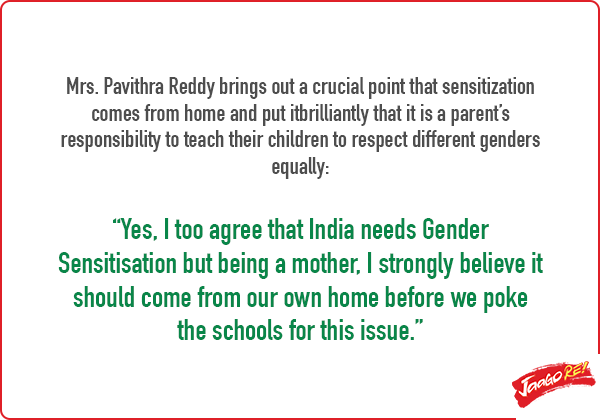
Mrs. Pavithra Reddy brings out a crucial point that sensitization comes from home and put its brilliantly that it is the responsibility to teach their children to respect different genders equally:
"yes i too agree India Needs Gender Sensitisation .. But being a mother i strongly believe it should come from our own home before we poke the schools for this issue"
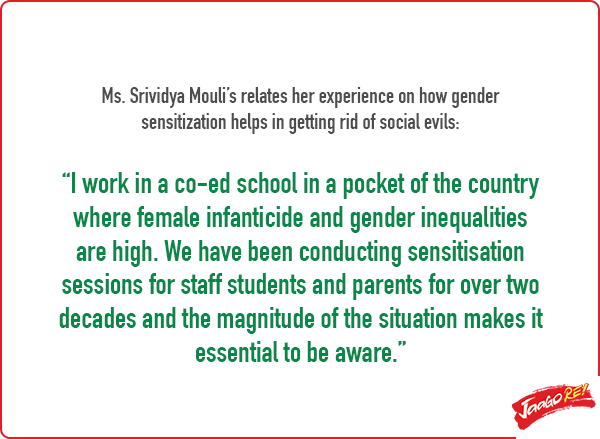
Ms. Srividya Mouli’s experience speaks for itself on how gender sensitization helps in getting rid of social evils:
"I work in a co ed school in a pocket of the country where female infanticide and gender inequalities are high. We have been conducting sensitisation sessions for staff students and parents for over two decades and the magnitude of the situation makes it essential to be aware."
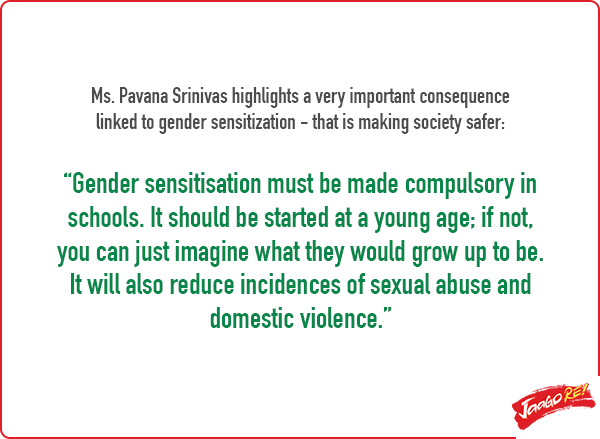
Ms. Pavana Srinivas highlights a very important issue linked to gender sensitization-that of making society safer:
"Gender sensitisation must b made compulsory in schools....it shud b started at young age,...if not u can just imagine what they would grow up as...it will also reduce incidences of sexual abuse and domestic violence...."
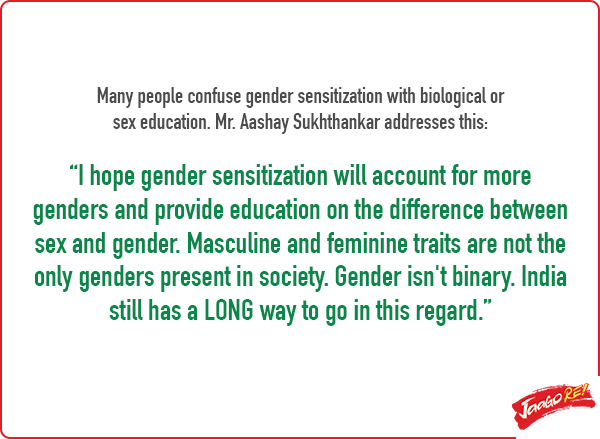
Many people confuse gender sensitization with biological factors that are biological as Mr. Aashay Sukhthankar explains this:
"I hope gender sensitization will account for more genders and provide education on the difference between sex and gender. Masculine and feminine traits are not the only genders present in society. Gender isn't binary. India still has a LONG way to go in this regard."
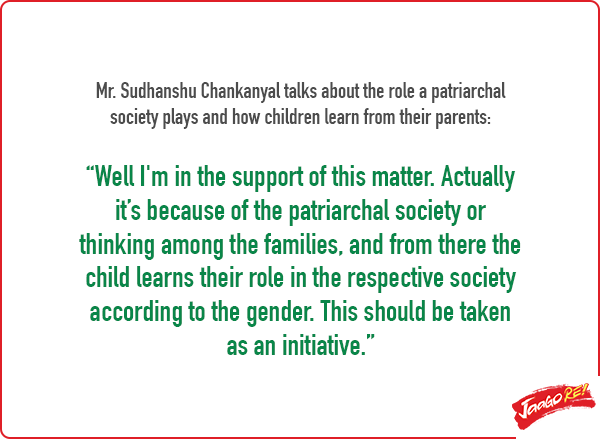
Mr. Sudhanshu Chankanyal talks about the patriarchal society's role in the issue and how children learn from their parents:
"Well I'm in the support of this matter. Actually its because of the patriarchal society or thinking among the families and from there the child learns their role in the respective society according to the gender.. unsure emoticon this should be taken as initiative.."
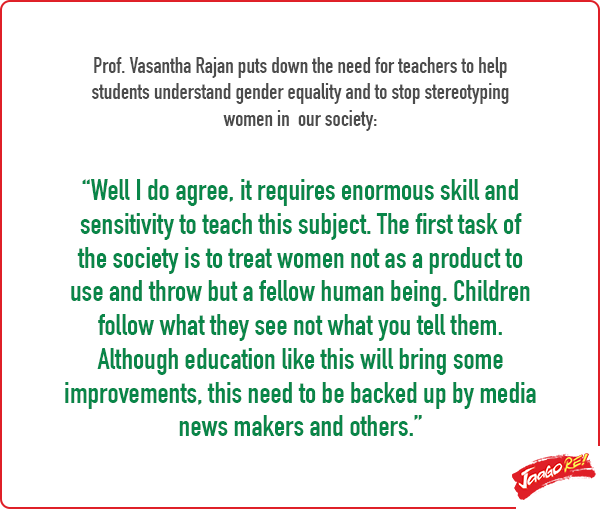
Prof. Vasantha Rajan puts down the need for teachers to help students understand gender equality and to stop stereotyping women in our society:
"Well I do agree,it requires enormous skill and sensitive to teach this subject.the first task of the society to treat women not a product to use and throw but a fellow human beings.we need lots of opinion leaders and top successful professional s who keep preaching and practicing gender equality not the way most of our politicians and even other leaders treat women.children follow what they see not what you tell them.therefore all though education like this will bring some improvements,but this need to backed up by media news makers and others.ours is patriarchal society and the mind set is always to treat women as subordinate class.to bring about a change among younger generation is a Himalayan task.unless all cooperate backed by this type of teaching the change may not be total."
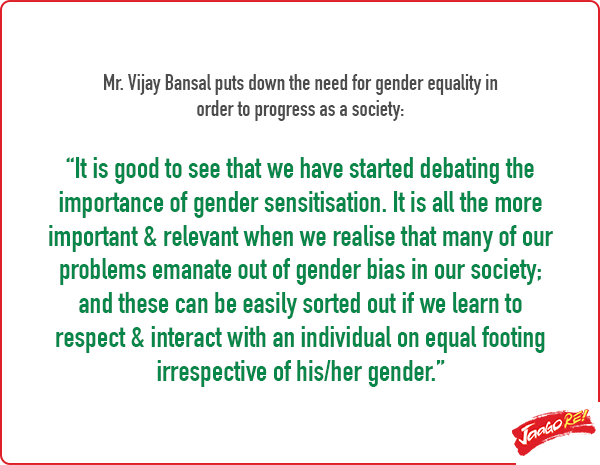
Mr. Vijay Bansal puts down the need for gender equality in order to progress as a society:
"It is good to see that we have started debating the importance of gender sensitisation. It is all the more important & relevant when we realise that many of our problems emanate out of gender bias in our society; and these can be easily sorted out if we learn to respect & interact with an individual on equal footing irrespective of his/her gender. Rather, we have to learn to respect the individuality of a person irrespective of gender/cast or creed/religion/race, etc. etc., and then only we will truly be an evolved, educated, progressive, & independent society ."
Biases deny equal opportunities for everyone and stop us from progressing. Schools need to equip themselves to teach children that gender roles are interchangeable and that children are free to choose what they want to become or do depending on their likes rather than their biological make-up. We would love to hear your views or experiences on gender issues. Please write to us at jaagorein@gmail.com or tweet to us @jaagoRe. You can also comment on our facebook page - JaagoRe.
You can watch the video here
Share this story on


Meet Four Female Sports Talent that India Lost
World Cup 2014 just went by and the entire country collectively cheered and booed at every goal scored, and every goal missed. They cheered for many sports players that are perhaps oceans apart.
Recently an international tennis star was belittled for being unaware of a celebrated Indian cricketer.
Yet how do we justify our own ignorance and insensitivity to scores of other prodigious sports talent in India? The Government, sports authorities, the media and the society can all share the blame.
In the last decade, we have done a great disservice to the country’s sports players by letting such glorious talent waste and slowly wither away. Women sports players have it tougher than the grind. The lives of many sports persons have ended on a miserable note in India.
We present to you four such exceptional sportswomen that India lost.
Sita Sahu

15-year-old Double Special Olympics medalist now sells paanipuri to make ends meet for her family in Madhya Pradesh
A 15-year-old wonder did India proud and won two bronze medals in a 200 and 1600 meter race at the 2011 Athens Special Olympic.
And how did her country repay her back?
This bronze Olympian now sells paani puri along with her family back in her village in Madhya Pradesh.
After her father fell sick, Sita discontinued going to school and started working full time to sustain her family.
The State Government had announced a cash prize of Rs 1 lakh for gold, Rs 75,000 for silver and Rs 50,000 for bronze winners.
Sahu won two bronze medals and was entitled to receive a cash prize of Rs. 1 lakh. However, she didn't receive a penny.
After news reports highlighting her plight started doing the rounds, the State Government sanctioned Rs 1 lakh for Sita Sahu in mid-2013.
It didn't go a long way in helping her. She still helps her family in making paani puri/papdi chat in her one-room house. Her brother sells them on a hand-cart under a street light. The entire family earns around 150 Rs. a day.
The Olympian's mother laments she cannot even afford milk or fruits to feed her children.
Such is the abject poverty that this ace player now lives in.
Nisha Rani Dutta

Former archery champ forced to sell her bow to fix her house after it collapsed in the rains. She quit archery due to extreme poverty
This young former archery champ is living in dire circumstances. She’s represented India abroad and won many accolades: a silver medal at the 2008 South Asian Federation Championship in Jharkhand, a bronze medal at the 2006 Bangkok Grand Prix, and the Best Player Award in the 2007 Asian Grand Prix in Taiwan.
After such an illustrious career, tragedy struck when she was forced to sell her archery bow for Rs. 50,000. A heavy spell of rains caused her house to collapse.
Her trainer had gifted her the bow which was worth about Rs. 4 lakh.
She failed even to get a bank loan to pursue sports education. Her family members didn’t have enough land, besides she didn't have a guarantor to show for applying for a loan.
"When I participated in events for the country, nobody recognised me. I felt disappointed, and I decided to sell my bow as I had no options left."
Eventually, the Government announced a financial assistance of Rs. 5 lakh for her.
Things had to get to such a grim stage until help reached this fallen player.
Rashmita Patra

Acclaimed Oriya footballer now runs a betelnut shop in her village.
This Oriya footballer won acclaim several times in her short-lived but illustrious career.
She was born to a daily wage labourer's family. She represented India in the Asian Football Confederation (AFC) for under-16 women's qualifier at Kuala Lumpur in Malaysia in 2008.
Two years later, she helped Odisha win the national women's football for under-19 in Cuttack.
In 2011, she again played for India in senior AFC qualifying round at Dhaka and helped the country win an invitational series in the Gulf country, Bahrain.
However, poverty forced her to quit her career.
She married a traditional fisherman and now lives to fend for her baby by running a betelnut shop.
On the eve of Fifa World Cup 2014, she says that football players elsewhere are taken care of well, but it's a different case altogether in Orissa.
Nauri Mundu

Ex hockey champ now a teacher and farmer in a village in Jharkhand
She quit hockey five years ago. This ex-hockey player from Jharkhand also won many awards. She has represented the National team 19 times. She was awarded the best hockey player ward by former Chief Minister of Bihar. She won bronze in Nehru Girls Hockey Tournament and National Women's Games, among several other accolades.
She now teaches at Mahil, a private school run by an NGO. Besides teaching, she also has to engage in farming because she earns merely Rs. 5,000 from her teacher's job, which is not sustainable for her family.
"I have put my best foot forward, but I soon realised that without adequate funds I won't be able to support my family," she said, "I would have continued if I had been helped by the government, much like it does with cricket players. I moved pillar to post but without any respite."
India's Talent or India's Shame?
Throughout the football or cricket tournaments, we all gear up excitedly to watch our favourite sports stars. However, these inspirational players as shown here are now not even able to afford a square meal. It's time our country shifts the attention to lesser known sports and sports players, both men and women.
There are many women from relatively rural backgrounds that belong not just "in the kitchen". They can be remembered in history for their contribution to India.
As grim as reality looks today, we must take ownership and rise up to change. Let's ensure to respect these players, and let's demand our leaders to develop sports and education facilities for our women.
Push the Pin on education and employment here!
In another story, 18 young girls have represented India at US Football Cup. Click here to know more
*Source – India Today
Share this story on
Why this Indian village accepts live-in relationships
Naniya Garasia, aged 70, from Rajasthan married his 60-year-old live-in partner Kaali in the presence of his grandchildren. His three sons also married their live-in partners on the very same day.
All the four men had been living with their partners for years and their children had all been born out of wedlock, something that India may find hard to come terms with.

Living-in a tradition for 1000s of years in this part of India
Living-in couples in urban cities have been frowned upon severely. Many have also been victims of moral policing, which sometimes take extreme turns.
Many debates on living-in vs. arranged marriage have flared up of late in our country.
"Indian culture does not allow a man and a woman to live together out of wedlock" – that is the supposed notion
Meet the tribe from Rajasthan that has defied this stringent tradition – and how.
The indigenous Garasia tribe from Rajasthan has been practicing a different tradition from thousands of years. According to social scientists who have been studying the tribal practices, the Garasia people’s livelihood depends on farming and labour. Couples live-in together and only marry their partners when they have a fair amount of money.
Yet money happens to come at a much later point in their lives. Until then, they continue to live together and have children out of wedlock, minus the societal ostracisation.
Choose your partner and then 'elope'
Another unusual practice in the Garasia community is letting their teenaged children befriend partners of their choice at a two-day 'courtship fair' held in parts of Rajasthan and Gujarat. Reportedly, they then "elope" and return to live together, without necessarily having to marrying each other.
Rare incidents of dowry death and rapes
Experts have pointed to the low incidents of dowry deaths and rapes in the community. Without the concept of marriage, there’s no question of dowry deaths. This is a matrilineal tribe where women have an equal status, or even a higher status.
It is also a bit of a rare occurrence in rural India, where teenaged boys and girls have the freedom to choose her partner.
And when the "eloped" couple does return, it is the boy’s family in this case that pays a sum to the bride’s family before the couple start living-in together.

Why is the culture different among Garasias?
Social scientists such as Rajiv Gupta who has studied the tribe says their culture believes in the "the right to choose and the right to reject".
"They do not find the modern society’s marriage system worthy, as it brings with it several impositions, especially on women," says Gupta.
The Garasia community finally giving in to 'modern' ways
One of the spokesperson in the village mentioned that this practice is now changing. Verbal agreements between the couples are being recorded on paper. However, it’s a slow and gradual change.
What, really, is 'Indian culture'?
Our country has often prided on our "culture and traditions".
Does the culture of the Garasia tribe, which incidentally has a low rate of rape and dowry, has something to teach our country currently suffering beyond words from repeated and ghastly crimes against women?
What are your thoughts? Do share them in the comment box.
* Source – Al Jazeera
Share this story on
13 things you must know to tackle sexual harassment at the workplace
.jpg)
With every occurrence of gender-based violence in India, India's legislation is scrutinised yet again. While it is true that we are far from recognising sexual violence against men or marital rape as criminal offences, the legislative atmosphere is changing.
Post Nirbhaya's tragedy, the legal structure of the country has seen some significant changes with the enactment of the Sexual Harassment of Women at Workplace (Prevention, Prohibition and Redressal) Act, 2013, ('the Sexual Harassment Act') which addresses sexual harassment of women in the context and course of employment and provides civil remedies. The Criminal Law (Amendment) Act of 2013, ('the Criminal Amendment Act'), on the other hand, treats the sexual harassment of a woman by a man as a punishable offence
The enactment of these legislative provisions is widely seen as a progressive move. On the other hand, the extensive legal mechanism provided by the Sexual Harassment law has led to perceptions of it being an anti-male law as almost every organization in the private sector that undergoes various processes to ensure compliance with this law struggles to address fears of misuse of the law by female employees for career advancements. In boardrooms, this law is seen to be a newer cousin of the dowry-death provisions of the Indian Penal Code, 1860.
The only effective manner to address such barriers of perception and belief is to be well-versed with the letter and the spirit of the law. It is also essential to remember that laws are rarely exclusively 'good' or 'bad'. Laws are tools that have the ability to deliver outcomes based on how well they are wielded. Therefore, the best way to ensure a positive outcome in the application of a law is to understand it in its entirety.
What's the basis of the Sexual Harassment law?
In 1997, the Supreme Court laid down definitive guidelines to protect women from sexual harassment in the course of employment in Vishakha v. State of Rajasthan. Till 2013, these guidelines were the only legal framework in the country to recognise the problem of sexual harassment and provide some recourse against it.
In a developing economy like India, it is necessary to ensure a safe working environment for a growing female workforce. The participation rate of women in India's workforce has actually reduced from 37% in 2005-2005 to 29% in 2009 -2010. Another study reveals that almost 79% of the surveyed victims who report some form of sexual harassment are women.
So what is the Sexual Harassment Act about?
The Sexual Harassment Act makes it the duty of every employer to treat sexual harassment of women that may occur in its workplace as misconduct and punish it.
Every employer that employs more than ten people must constitute an Internal Complaints Committee ('ICC'), provide training to members of the ICC to investigate into complaints of sexual harassment and also, abide by the orders of the ICC.
Failure to constitute an ICC can cost the employer up to Rupees Fifty Thousand for the first offence and subsequently, the loss of license to carry out business for a repeat offence.
This law protects all women from sexual harassment at all workplaces, irrespective of their ages and their employment status. In fact, even women visiting a workplace – such as customers in banks – are entitled to protection from sexual harassment under the provisions of this law.
It allows an aggrieved woman to file a criminal complaint (if the action amounts to the crime of sexual harassment) while simultaneously seeking redress before the civil mechanism of the workplace. Therefore, sexual harassment can be complained against before a workplace's ICC, and is also a crime that is punishable with upto three years of imprisonment as well as a fine.
The protection against sexual harassment also extends to domestic servants in the unorganised sector. It is the duty of the government to constitute a Local Complaints Committee ('LCC') at the district level to hear complaints against incidents of sexual harassment that may occur in the course of such employment of domestic servants.
If an incident of sexual harassment occurs at a workplace that does not have an ICC or has failed to constitute an ICC, then a complaint against such sexual harassment can be lodged before the relevant LCC. Similarly, if the complaint is against the employer itself, then the complaint against such sexual harassment can be filed before the appropriate LCC.
Penalties for sexual harassment under the Sexual Harassment Act can vary from reprimanding the perpetrator to termination of service, depending on the gravity of the incident.
On the other hand, the punishment of sexual harassment under the Criminal Amendment Act ranges from one to three years of imprisonment.
Importantly, making a false complaint of sexual harassment (knowing that the complaint is false at the time of making it) or giving false evidence in a complaint against sexual harassment, is punishable with the same penalties that are prescribed for sexual harassment itself.
Every ICC and LCC needs to be well trained to investigate complaints of sexual harassment. The law does not provide these committees the power to dismiss complaints without investigating them. In the event that upon investigation, a committee finds that while the complaint was made in good faith, the incident reported does not amount to sexual harassment, it can close the investigation and recommend that no action be taken against the person complained against.
An order of an ICC or an LCC can be appealed against before the appropriate authority as designated under the Industrial Employment (Standing Orders) Act, 1949.
This law applies to all educational institutions (and provides protection to students and staff therein), hospitals, government departments and authorities, and even sports stadia.
Concerns
No law can operate by itself and therefore, to be successfully implemented, this legislation too, requires a robust legal structure. One of the greatest challenges facing victims of sexual harassment is retaliation and victim-shaming that follows such incidents. While the law itself is silent on detailed anti-retaliatory mechanisms, employers need to ensure a safe reporting process and a series of checks and balances to ensure that people who speak out against sexual harassment do not suffer from unwarranted backlash. Inquiries into complaints against sexual harassment must ensure complete confidentiality of identity of the victims. Further, investigating committees need to take the lead on providing a productive environment, conducive to employment, even when complaints are being investigated.
Every business values its reputation and being known as a responsible corporate entity is a value addition in today's global market place. A clean and safe working environment is no longer a privilege to be enjoyed at the discretion of the employer, but a legal right to be exercised by every member of society.
Useful Resources:
1. The Sexual Harassment of Women at Workplace (Prevention, Prohibition and Redressal) Act, 2013 at http://wcd.nic.in/wcdact/womenactsex.pdf
2. The Sexual Harassment of Women at Workplace (Prevention, Prohibition and Redressal) Rules, 2013, at http://www.lawyerscollective.org/wp-content/uploads/2013/12/Sexual-Harassment-at-Workplace-Rules.pdf
3. The Criminal Law (Amendment) Act, 2013, at http://indiacode.nic.in/acts-in-pdf/132013.pdf
*Sources-
International Labour Organization, Global Employment Trends 2013: Recovering From a Second Jobs Dip (2013), the full report is available at ILO and AWARE
More about the Author:

Disclaimer:
Views expressed here are of the author alone and do not necessarily represent that of the brand.
Share this story on
.jpg" /></p>
<p class="art-para-power">
With every occurrence of gender-based violence in...)
Caught in the Net - A serial child molestor
One of the biggest manhunts Mumbai Police has seen in recent years just acquired success.
A serial sex offender hurting minors was caught in a chase that would give Hollywood thriller film makers a run for their money.

The last picture on the right is the final sketch of the man that has sexually assaulted several children in Mumbai, and given Mumbai Police sleepless nights. Ayyaz Mohasmmed Ali Ansari has now been booked in 25 sexual assault cases, including two of rape.
26 officials were in relentless pursuit of this serial child molestor and rapist.
This move comes as a great victory for India, and for the fight against the abuse of women and children. The rest of the country must follow in the Mumbai police team's footsteps and passionately work to end such crimes forever.

How Mumbai Police Nabbed the Offender
- The capture meant putting together pieces of a complex jigsaw puzzle. It involved careful co-ordination among 12 police stations in Mumbai. Women police officers had to be patient and understanding with the survivors of abuse who were minors.
- The Indian Express report says – "Each police station was asked to revisit their respective cases, including the victims involved. Officials revisited the crime scenes to look for any camera that may have picked up the assault from any angle."
- The offender also had a history of stealing mobile phones. He wasn't a first time offender. He had also been caught previously assaulting a minor, and was beaten up by a mob in the neighbourhood.
- With time, the police officials zeroed in using all the clues related to similar and frequent child molestation cases. Night patrol officers were put on high alert.
- Peering over CCTV footage, the few confirmed videos of the culprit were shown continuously to many police officials.
Little by little, the pieces of the jigsaw came together. As seen in the first picture, three different versions of the accused criminal’s face have been designed. The third and final sketch gave the police a valuable clue. As fate would have it, with the help of informers, the accused was finally captured getting off an autorickshaw at a busy signal intersection, and put behind bars.
No remorse for hurting innocents
With no hint of remorse or fear, this pathological criminal was quoted telling his capturer, at Carter Road Police Station in Bandra, "'I used to see couples kissing inside locked cars at Chowpatty beach. I wanted the same but didn’t want to pay for the sex."
The huge difference between consensual sex, prostitution and sex with minors is completely lost on him. Can we blame the society, wrong parenting or his sick criminal mind for the monster he turned out to be?
Perhaps all the factors are to blame, but most of all his own personal choices now decide his fate.
Many abusers still out on the loose
This is one sole case of a criminal behind bars. However, so many such criminals are walking free amongst us.
Some reality check:
National Crime Record Bureau CRB figures for India
- In 2013, one in two missing kids was lost forever.
- 65,038 missing children were reported in India in 2012.
- India is now a destination and a place of origin for human trafficking.
The future of our country is in the hands of our children. A large population of our country is young. Let's ensure their childhood is protected.
Push the Pin if you are suffering, or know others who are suffering, help raise awareness about a noise about women’s safety, domestic violence, street harassment or others here
*Source - Indian Express
Share this story on
Why Indians want Schools to have Gender Sensitisation
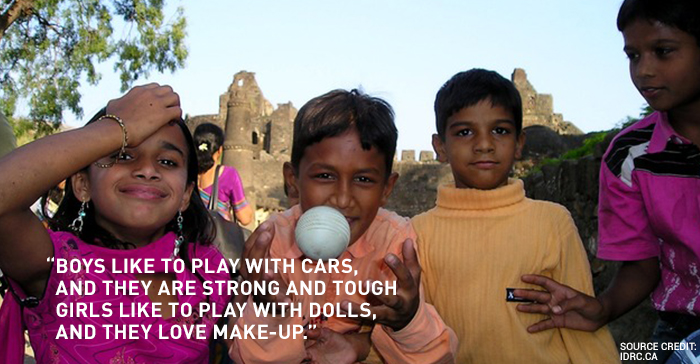
“Boys like to play with cars,
And they are strong and tough
Girls like to play with dolls,
And they love make-up.
Daddy says boys shouldn’t cry,
Mummy says girls should be shy.
I thought we all should share housework
But Mummy is just the housewife, and Daddy the breadwinner.
Meera can run any race the fastest,
Mohit can cook food that’s the tastiest;
I am a girl and I want to be an electrician.
I am a boy who wants to be a beautician.
As kids we learn what boys and girls can or can’t do
From grown-ups who say things without proof.
As kids we learn biases that seal our fate,
And we grow up to be adults, realising everything a second too late.“
Women and men are often restricted to particular roles in society depending on their gender. Under our Power of 49 manifesto, we had brought out the need for Gender Sensitization to tackle such beliefs which pertain to gender bias.
To help understand the need for gender equality through gender sensitization, we interviewed teachers, parents and students about their thoughts on the issue.The interviews were compiled into a video which was published on our facebook page and website. The Logical Indian also republished our video, and we have received some very interesting comments on all our platforms.
Take a look at a few of the most interesting comments:
Schools are an integral part of a child’s life where their mindsets and attitudes are learnt and shaped. Implementing curriculums on gender sensitization would enable children to learn that gender roles are interchangeable and that they are free to choose what they want to become or do depending on their likes rather than their biological make-up.
We would love to hear your views or experiences on gender issues. If you know about a school that conducts gender sensitisation workshops for the children, or has incorporated it into their syllabus, do let us know!
Please write to us at jaagorein@gmail.com or tweet to us @JaagoRe. You can also comment on our facebook page - JaagoRe
Share this story on

Hetal Dave: Wrestling gender stereotypes

When you hear the words ‘Sumo Wrestling’ you tend to associate it with ‘burly men wrestling’. However, did you know that Indian women are gradually picking up this Japanese sport? Women’s participation in sports may not be widely acknowledged in India, leave alone women taking up wrestling as a sport.
We spoke to Hetal Dave, India’s first female sumo wrestler who proves that with determination and perseverance, there is nothing that cannot be achieved.
How did you get into Sumo wrestling?
I started with judo when I was young and at that time there were some boys who used to train for sumo wrestling as well. When I realised that I was good at it (I defeated some of the guys as well), I decided to try it out.
Tell us about your first big competition
My name was cleared for the World Championship in 2008 which was held in Estonia. I did not have the money and no sponsor was willing to fund me for the travel or the stay. However, someone came forward and helped me get to the championship, where I ranked 5th.
What is the reaction from different countries when they see an Indian woman representing us?
They are very happy to see that our country’s women are participating and the reception abroad is definitely better than at home.
How can we get Indian women to participate more in sports such as wrestling and sumo wrestling?
We have to create an awareness among people. The more people participate, the more they are encouraged. It’s almost like we have to keep repeating the importance of sports again and again for our society to understand and take notice of it.
What is the biggest drawback of Indian women in sports?
The biggest drawback is exposure - people do not know that there are women in sports or that there so many different sports for women to participate in. I don’t think there is much of a problem of a woman in a man’s world, people just need to know that it can be done.
Was your family always supportive of your decisions with regards to Sumo Wrestling?
Yes, even though I come from a conservative Rajasthani family, my parents and my brother have been very supportive. They are the reason I am where I am.
What message would you like to give parents whose daughters want to get into sports?
Let your daughter do whatever she wishes to do. Girls are taught to mainly sacrifice - but girls have a power, an inner strength. They just need your support to realise this. Don’t stop them from doing anything. We girls get the most satisfaction from pursuing our dreams. Don’t stop your daughter and you will see her excel.
What message would you like to give to girls out there who are in sports or want to get into sports?
As girls we think a lot about our communities and families, but you must also not forget to think about yourself. You have to respect family, no doubt about it, but don’t stop for anyone. If your family does not come with you, in time they will surely stand behind you and support you.
Hetal Dave is also a judo trainer in Mumbai and an inspiration to girls in our country as she proves nothing is beyond their grasp. You can follow her facebook page here.
If you have comments about the article please write to us at jaagorein@gmail.com or tweet to us @jaagoRe.
Share this story on

7 ways the Internet can help victims of domestic abuse
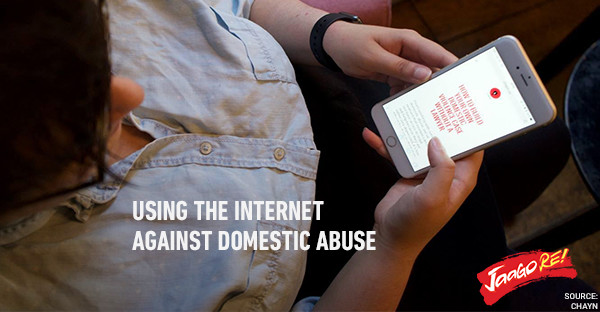
About once every five minutes, domestic violence is reported by a woman in India - one of the highest incidence rates in the world. Contrary to popular belief, domestic violence does not only occur in “poor” families or in minority communities – it happens all around us. However, thanks to the prevalence of the internet, smartphones and tablets, modern Indian women can connect to the outside world and escape the hardships their mothers endured. Here are seven ways the internet is helping female victims of domestic abuse:
1. To find out if they are being abused
In a country where marital rape is legal, most women do not realise that the cruelty they are experiencing is actually abuse. By accessing websites, blogs, and forums dedicated to domestic violence and reading stories by other women, they will come to recognise the signs and symptoms of abuse.
2. To make sense of what is happening to them
The effects of domestic violence extend beyond physical attacks; mental health issues such as depression and Posttraumatic Stress Disorder are common among survivors. In a different vein, many women think something is wrong with them if they still have feelings of love and affection for their abuser – this is a symptom of Stockholm Syndrome and is totally normal.
3. To ensure the well-being and happiness of their children
One of the most common questions asked by women facing domestic violence online is whether the violence and abuse at home will affect their children. Now, with the use of technology, not only can women find the information they need to ensure their children are safe, they can also talk with other mothers in the same situation.
4. To become informed about the options available to them
Whether you choose to stay or leave, it is important to know your options and the risks they present. Information on everything from nearby shelters to educational opportunities to job prospects are easily available through the web, and can empower a woman to leave an abusive situation.
5. To learn how to stay safe, whether they are still at home or after they have left their abuser
Safety is of utmost importance for the survivor of an abusive relationship as severe injuries or even death are a possibility for them. Women can learn how to cover their tracks online and offline from security experts to ensure their abuser cannot find them after they have left.
6. To access tools that will help them build a case against their abuser and get justice
Information on Indian divorce laws, domestic violence acts, and women's rights laws is often difficult to understand and time-consuming to look through. Chayn’s How To Build Your Own Domestic Violence Case Without A Lawyer will help and guide you on how to report a case about abuse if you do not have enough resources for legal counselling.
This means that the abusers are punished as per the law, and the victim is granted a divorce, child custody or asylum.
7. To access and partake in a support system
Technology allows women to connect with other women who have experienced domestic violence in the same ways that they have. They learn that they are not alone, and platforms such as Facebook create safe, nurturing groups for women to discuss what they are going through and support each other.
***
Click here to find out about Chayn India
***
About the Author:

Disclaimer:
Views expressed here are of the author alone and do not necessarily represent that of the brand.
Share this story on

Rape culture is as Real as Rape

India is a heady mix of contradictions, traditions, science, religion and culture. Almost everything is found here in different permutations and combinations and there are very few things that aren't normal. Even rape has become almost normal. Just think about the number of times you have told your girlfriend, friend, sister or any woman in your life to "get home safe", not to walk on a certain street or to not wear something while going to a certain place because she is at risk of being abused.
If she 'bares' it, she has to ' bear' it
Though we have moved about 5 years past blaming "western clothes"- wearing miniskirts or a T-shirt still warrants unwanted attention and if a girl unfortunately happens to be abused whilst wearing such clothes, then she has to bear the rape because she did not take the needed precaution of not dressing in "decent clothes". The amount of skin that she covers is proportional to her values and her "asking for it."
TRP's- The Rape Programming
The media today, is more bothered about getting their TRP's (Television Rating Point) or readership numbers to increase. Though showing rape on media is a good thing and it creates awareness, how this rape is portrayed is where the real issue lies. Rape victim's stories are paraded around in the most sensationalized way that people no longer raise their voices to help the victims but rather tell their daughters to stay at home.
The glass ceilings might be shattering but the bottle is still taboo for the woman
Alcohol gives men an invitation to do whatever they want to a woman.
If a woman drinks then she has "no morals or values and is used". If she is already "used", then she will have no problem if she's raped.
She has male friends so she definitely is a "slut"
When we picture "rape culture" the only images that come to our mind are politicians, old men in khap panchayats, aunties who glare at girls when they talk to boys and uncles who stare at girls lecherously. But this is where we are wrong! How many times have you called someone a "slut" because you thought the girl had male friends? Though, it might not seem a big deal, even small comments reveal mindsets that contribute to "rape culture." There tends to be less sympathy for girls termed as "sluts" when they are abused or raped.
I am only singing it not living it
Switch on the radio and you will hear everything about how hot a girl is or what the singer would like to do to them. It's not the just the male tones but even lyrics sung by female artists objectify women. Switch on the TV and most songs will show women gyrating around men. It's almost like popular music is promoting the rape culture. By letting people know that they can call women whatever they want and they have to take it as a compliment.
Eve teasing doesn't make you a bold 'aadami'
No one bats an eye lid anymore when it comes to street harassment. If you are a girl/woman then you have braced yourself to being teased when you step out and if you see someone being eve teased you leave it to the norm as it's just "harmless." But what most of us don't understand is that this leads to perpetrators thinking they can get away with anything and girls think twice before they leave their homes.
Rape isn't just Rape; its ostracisation
A recent video showed people in India telling the interviewer that they would not want a rape victim marrying their son or they wouldn't marry a rape victim because if a woman has been raped she has lost all purity and has probably done something to deserve it. Rather than seeing her as a survivor who stands as an example that our society needs to change she is seen as the contaminator of everything innocent.
The word-Rape
Rape is not just used to describe what it really stands for anymore. We use rape to describe sports, the crazy night we had or if two friends had a nasty argument. Rape is not serious anymore. It is a colloquial word that we can use without realizing the gravity of its meaning. The more lightly we take 'rape' the heavier its consequences get.
Voices of those who have been campaigning for a safe society for women are getting hoarse. People are tired of hearing another rape story. Whether it is a 2-year-old child or a 30-year-old woman, it's a story that's been "done to death". We are living everyday trying to pretend it is a mythical, fire breathing dragon living in a far off castle but in fact rape has got so serious that it is being called a "culture." It's time we stopped avoiding rape and started preventing it.
We are hosting a record from India on all the issues that citizens, particularly women face. Push the Pin here to report issues of women's safety in your city.
Share this story on

Gender sensitization a Taboo?

No one knows if fire was discovered by a cave man or woman. Neither does anyone know which gender invented the wheel. So, it is completely baseless to attribute certain distinctions or qualities to a person depending on their gender.
We have grown up listening to things like that stereotype men and women into categories. “Women are supposed to cook” or “boys are tougher”. In today’s day and age where issues regarding safety for women are the norm, it’s important to understand the need to teach our children to respect each gender equally. This is where gender sensitization plays a crucial role. But many aren’t aware of what it means. Hence, to find what gender sensitization is all about and why it’s required, we conducted a Twitter chat to discuss ‘Beginning Gender Sensitisation at a young age ’ with Sunder Ramu who has started the 365 meal dates initiative and Rajani R Menon who is a Programme Coordinator at the Gender Training Institute.
There were some very interesting insights discussed revolving around literature, education and parenting. Here are some snippets from the same :-
Gender Sensitization?
Stories and Gender bias
Gender bias a threat?
The discussion helped us open a door to this controversial topic which is often considered taboo. There is a dire need for awareness and the chat exposed some issues that arise out of gender biases and how we can tackle them. It also dealt with a few simple steps that we all could proactively undertake. What we say and do in front of our children puts an impression on how they react to situations; hence it is essential that we make a conscious effort to put an end to gender biases once and for all.
If you have any opinions on the issue, feel free to comment below.
The Power Of 49 Manifesto points out the need for gender sensitization to be made compulsory for boys and girls from Std. V to XII in order to counter eve-teasing. But there are a many objections for implementing the same. Comment with your views below.
Push the pin on gender issues.
More about the Experts:


Disclaimer:
Views expressed here are of the author alone and do not necessarily represent that of the brand.
Share this story on
