Are big cities in India prepared for natural disasters?

After the earthquake that has shattered parts of India and Nepal, concerns on disaster and safety are echoing across the sub-continent.
How prepared is India if a disaster of the same magnitude were to strike us? Let's take a look at some of the major cities in India and their mechanisms in place to defend ourselves against natural calamities:
Bangalore
The garden city with a rapidly growing population of 10,839,725 is relatively less disaster prone. According to research it is in seismic zone 2 (least active) but is slowly moving into zone 3 (moderate activity) owing to 'land use pattern' and increase in population. Though, 80% of Karnataka is drought prone, Bangalore enjoys a good water supply because of the Cauvery River and the year round rainfall.
Apart from NDMA (National Disaster Management Authority) there is KSDMA (Karnataka State Disaster Management Authority) and KSNDMC (Karnataka State Natural Disaster Monitoring Centre).
The KSDMA under the Chief Minister
- Assess the vulnerabilities of each area in the state and help provide possible measures.
- Generate awareness on the hazards among various institutions.
- Provide 'forecasting, early warning, advisories and preparedness in management of natural disasters.'
Chennai
The Southernmost Metropolitan City with its population of 9,121,477 is in seismic zone 3 (moderate activity). The city has already witnessed a devastating Tsunami in 2006, post which the state set up the Tsunami Rehabilitation Programme. Chennai is also constantly threatened by Cyclones. What is the government doing to safeguard the coastal city?
It has the CDMM (Centre for Disaster Mitigation Management) managed by Anna University in collaboration with state government, apart from which there is a local branch of the NDMA. Though there is the Tamil Nadu State Disaster Management Authority, the plan which was formulated way back in 2003.
The CDMM researches on the various impending natural disasters whereas the NDMA helps the state in policy, planning and capacity building.

Delhi
The capital city with a population of 18,248,290 houses the headquarters of NDMA. Delhi being in seismic zone 4 (high activity) is one of India's most vulnerable cities when it comes to earthquakes. Being in such a volatile location, the city also has the DDMA (Delhi Disaster Management Authority) which makes sure the city has no imminent threat.
The responsibilities of the are DDMA are to
- Equip each locality to use funds allocated for disaster management activities
- Train search and rescue, police and fire personnel in case of any disasters
- Chalk out plans to prepare against disasters.
Hyderabad
Two years back, a newspaper article had criticised the city with its population of 11, 48,741 for lacking a CDMP (City Disaster Management Plan). While the city is in seismic zone 2(least activity) it is prone to floods and cyclones having recently seen a spate of the same.
Apart from the local chapter of NDMA, Hyderabad still lacks a proper city disaster plan.
Kolkata
The Eastern city lies in seismic zone 3 (moderate activity). With a population of 44, 86,679 the city houses the West Bengal Disaster Management Department. Though the city has no plan in place, WBMD has laid out plans for the entire state to prevent and provide relief against and during any natural disasters which compensate for it.
The role of the WBDMD include-
- Arranges for crisis management during natural calamities
- Prepares disaster management plans for all tiers in the State
Mumbai
The island city with its 12,772,094 population sees its share of flooding due to poor infrastructure and heavy rainfall every year. Falling in seismic zone 3 (moderate activity) the city is at high risk owing to the haphazard city plan. Though the city has a disaster wing under the Municipal Corporation of greater Mumbai the city's haphazard planning proves to be a major threat during any disaster.
The Greater Mumbai Disaster Management Action Plan formulated in 2007 lays out-
- Different areas and their vulnerabilities in Mumbai
- The various mitigation and preparedness strategies
- Responsibilities of different forces during any calamity
Before the elections started in 2014, Jaago Re launched a crowd-sourced 10-point manifesto about serious issues affecting women in India. We presented it to leading political parties and asked them to pay attention to our concerns.
Are they being followed through with sincerity by our leaders? Is India catching up with any of the points listed in the manifesto? See the manifesto for yourself here
Sources
Share this story on


Remembering four powerful sibling stories on Raksha Bandhan

Sister donates 65% of her liver to save brother
In late 2013, Nisha Bhaisade from Mumbai didn’t think twice before donating 65% of her liver to her brother Nilesh Bhaisade. The surgery took place on the day of Raksha Bandhan.
Excessive alcohol had damaged her brother’s liver. According to the doctors, Nilesh’s degraded liver was removed and a part of his sister’s liver was transplanted in his body. Liver has a tendency to grow wholly in a span of three weeks in both the donor and recipient’s body.
The surgery was just in time; for her brother had barely three weeks to live. Unable to find an immediate relative of the same blood group, Nisha herself turned up to make a donation for her brother. “I am extremely lucky to have a loving sister who saved my life while putting her’s in danger,” Nilesh reportedly stated.
Playing with their lives to save their brother
In a village in Bihar in mid-2012, three teenaged sisters lost their lives while fighting to save their three-year-old brother and another toddler from drowning. The girls were washing their clothes on the river bank when they saw their brother Shivam and another child Vikas struggling in deep water. The girls plunged in to rescue the young boys. The three of them reached the toddler boys who clung on their sisters tightly, preventing them to swim freely.
The two boys reached to safety. The villagers also heard their cries and pulled them to the shore. However, the three girls could not be saved and they lost their lives in the bargain.
Brother's stem cell transplant gave new life to sister
India’s first successful stem cell transplant that gave a new life to a young girl. One and a half year old boy Pugazhendi’s umbilical cord blood stem cell cured his sister Thamira of a fatal blood disorder she had for seven years.
The disorder can destroy blood cells and cause severe anemia that occurs within months following birth.
Today, their parents are heaving a sigh of relief since their daughter’s misery has ended.
My brother's cord blood saved me or I knew I wouldn't have been alive for long. I love my brother," says Thamira.
Fighting the fury of nature to save her younger brother
In the monstrous floods of Uttarakhand in 2013, eight-year-old Mahika Gupta saved her younger brother’s life. After spending three days without food, water and clothes at Uttarakhand, they reached Delhi safely.
She was awarded the National Bravery Award 2013 by the Prime Minister in January 2014 on Republic Day.
This is her story in her words: “In this summer vacation I went to Kedarnath Temple on June 16th with my family. We were praying in the temple and suddenly there was a great thundering sound. Everyone was frightened. Before we could understand anything, muddy water with huge stones entered the temple with great pressure all around us. The pressure was so high that we got separated from each other. I found myself alone in the water. Suddenly, I heard someone crying and it sounded like my brother’s voice. Quickly looking towards the sound I saw his legs were pressed down under a big stone. The horrible darkness of the muddy water made me helpless. The water began to enter my nose, my ears and my mouth. I did not know what to do and I could not swim. But to save my brother’s life I began to move my hands towards him. Luckily my hand touched a little finger. I pushed myself with my whole strength and succeeded in finding him. I held his hand tightly and closed his nose with the other hand. Water flowed around but I did not lose my grip. We were both lost in the water. After some time I was able to see a little light. I waved my hand for help. Like an angel a person appeared and took us to a safe place”.
Share this story on

नदी की महिलाएं

क्या एक अकेली औरत बहाव बदल सकती है... पूरी तरह से?
जब उत्तराखंड में कोसी नदी के पानी का स्तर कम होना शुरू हुआ, तो नदी पर निर्भर ग्रामीणों ने इसका सीधा खामियाजा भुगता। समस्या घातक हो गई होती यदि एक महिला – बसंती ने अथक प्रयास न किया होता।
बसंती ने 2003 में पढ़ा था कि कैसे कोसी क्षेत्र में वनों की कटाई इसे 2010 तक सूखी नदी बना सकता है। उसने और अधिक शोध किया और पाया कि जंगल की आग और पेड़ों की कटाई नदी के पारिस्थितिकी तंत्र के संतुलन प्रभावित कर रहे थे। इस चेतावनीपरक खोज ने ही उसे कार्रवाई करने के लिए प्रेरित किया था। उसने लकड़ी काटने के लिए जंगल में नीचे जाने वाली ग्रामीण महिलाओं से मिलना शुरू किया, उन्हें अंधाधुंध लकड़ी कटाई के बारे में लेख दिखाए और बात करने की कोशिश की।
आखिरकार, नदी के संरक्षण के लिए वह वन संरक्षण के महत्व के बारे में महिलाओं को शिक्षित करने में सफल रही। उसने उनसे छोटे समूह बनाने और और जंगल की निगरानी करने का अनुरोध किया। वह महिलाओं को यह समझाने में भी सफल रही कि हरे पेड़ों विशेषकर ओक की लकड़ी को काटने से बचें। उसने और महिलाओं के समूहों ने प्रारंभिक चरणों में अन्य ग्रामीणों का कुछ विरोध भी झेला, आखिरकार, प्रक्रिया इस हद तक सुव्यवस्थित हुई कि वन अधिकारियों ने भी उनका साथ देने का फैसला लिया क्योंकि दोनों पक्ष एक ही मकसद के लिए लड़ रहे थे।
बसंती के मार्गदर्शन में, ग्रामीण जंगल को आग से बचाने और हरे पेड़ काटना छोड़कर जंगल की रक्षा करने में सहायता करने में जुट रहे थे। उसके प्रयासों के परिणामस्वरूप, वन में गुणकारी देवदार के पेड़ उगने शुरू हो गए और ऐसे नए सोते फूटने शुरू हो गए, जो पानी के एक स्थायी स्रोत का काम करते हैं।
एक महिला ने अन्य महिलाओं को जोड़ने और नदी को बचाने के लिए मना लिया। एक महिला ने जिम्मेदारी ली, और कुछ ही समय में, अन्य महिलाएं उसके नक्शेकदम पर चलने लग गई थीं। यह प्रेरक कहानी केवल यह सिद्ध करती है कि संख्या में अपार शक्ति है, कि एक साथ मिलकर महिलाएं पहाड़ों को हिला सकती हैं या इस मामले में, बहाव बदल सकती हैं!
यदि एक महिला नदी के बहाव को फिर से शुरू कर सकती है, तो इस देश को बदलने के लिए महिलाओं को क्या रोक रहा है जो मतदान समूह का 49% हिस्सा हैं। # 49 की शक्ति
Share this story on

What Do Women Want?

There are questions and then there is THE question – ‘What do women want?’
Stereotypical notions have been attached to this question; that women DON’T KNOW what they want. That they are confused because they perennially changing their minds. That they might think that they know what they want, but in reality, they don’t.
Multiple methods have been tried to arrive at the answer. Women have been quizzed, surveys have been conducted, psychologists have been summoned, books have been written, debates have been held, movies made – the list is endless.
But one method to discover what she REALLY wants seems to have slipped through the cracks; no one has ever tried hard enough to get her to VOTE.
Surprising, you may say? Think about it.
Ask a woman what she really needs. She will respond by first telling you that she can find a job, buy a car or own a home all by herself, she knows how. But working in an office that has no Sexual Harassment Cell makes her vulnerable. Driving that car that she owns puts her at risk if it’s late at night on a deserted stretch. Getting permits to own that home means doing under the table deals. So what she really needs is a system and a government that is accountable to and works in the best interest of her.
When you’re done asking a woman the big question, lead her to the answer, if she hasn’t arrived at it herself. Then ask if she wants to continue as though these are matters that need not be discussed. Ask her how much she really cares, as a woman, about the other women in her life… her mother, daughter, sister, friend, female colleague or even her house-hold help.
Ask every woman you know and then ask them to vote.
Because when all the women who constitute 49% of the vote bank in India go out and exercise that right, the question will be answered and all of us will know exactly what women really want.
Share this story on

Waging a WARR

How many times have you been eve-teased, subjected to lewd name calling or been groped in trains or railway stations? How many times have you just stood there helpless and ashamed? WARR (War Against Railway Rowdies), a crowd-sourced initiative in Mumbai, is now coming to the rescue of distressed female commuters.
Who is WARR
A small group of about six young people from Mumbai initiated a crowd sourced movement and called it ‘War Against Railway Rowdies’. Dipesh Tank, a young media professional and one of the WARR founders, says that this is a movement by common people.
The WARR is on
Operating with hidden cameras and co-ordinating with Railway Police authorities, WARR volunteers are bringing ‘Railway Romeos’ in Mumbai back on the ‘decent’ track by catching them red-handed and detaining them.
Tank echoes our concerns: “Every time we catch a sexual offender, we’re catching a potential rapist.”
WARR capture the culprits yet avoid public shaming. They sent letters to senior railway officials about the gangs they encountered. Fortunately, Andheri railway police reassured them that an alert had been issued against rowdies.
Survey shows Sleaze in Mumbai Rails

In the very week the Shakti Mills gangrape of a photojournalist rocked Mumbai, WARR volunteers held a survey amongst 481 women at Malad, a busy railway station in the western suburbs. The results were shocking to say the least.
The "lifeline of Mumbai", ferrying over 72 lakh commuters to and fro daily - the Mumbai railways are a nightmare for women, going by the survey results. Over 84% women have admitted to encountering eve-teasing/sexual harassment at Malad railway station every single day. Consequently, over 82% women fear harassment at railway platforms.
WARR Speaks Out
“The worry isn’t that there are sexual offenders in the trains. The worry is when the rest of us choose to keep quiet. The journey of WARR hasn’t been easy. We have borrowed laptops, cameras etc. to help the Railway Police gather evidence in nabbing the culprits. We want to unite people who feel helpless but want to change the situation,” says Tank.
A small group of young people in Mumbai are keeping a strict check on sexual misbehaviour in the railway stations. If such a small group can make waves in the lifeline of Mumbai, imagine what the Power of 49 can achieve. Get together. Get aware. Make an informed choice.
Push the Pin on Unsafe Public Transport

WARR is planning to extend their drives to other railway stations in Mumbai. Help WARR identify unsafe spots in Mumbai. Push the Pin on unsafe public transport here
WARR is currently in need of volunteers. Help them make public transport in Mumbai safer. Connect with them on https://www.facebook.com/waragainstrailwayrowdies
You can share your opinions and help create a better movement. Fill up their survey here: http://bit.ly/1faP6Sy
Lesson Learnt in Time

A WARR volunteer along with a railway commuter caught this young man harassing railway commuters, specifically women from Malad to Bandra. At Bandra, he was confronted and then handed over to Dadar GRP police. Even you can catch train hooligans by calling GRP on 98-33-331111
| SOS number on Mumbai Local Trains. | |
| GRP: | 9833331111 |
| RPF Western Railway: | 1276 |
| RPF Central Railway: | 1275 |
Share this story on

From Farmer to CEO: A Mother's Tale
An agricultural labourer from Warangal is today the CEO of a multi-million dollar software company in the US. Jyothi Reddy recounts her inspiring journey

A painful and short-lived childhood
Jyothi lost her mother at a young age. Thereafter her father lost his job in the military during the Emergency, and placed her in an orphanage.
Owing to her poor background, her family got her married early. By the tender age of 18, she was a mother to two daughters. From 1986 – 1989, she worked as a labourer in the fields for 5 Rs. a day.
A young mother’s struggle for her daughters
Incidentally the opening of a night school ended her labourer’s hardship. Since she was the only educated woman in her village, she was hired as an educational trainer for 150 Rs. a month.
"At that time 150 Rs. meant a lot to me. I could buy milk and fruits for my kids," Reddy says.
Working in the education sector, she realized the importance of education and went on to pursue graduation and post-graduation. With a B.ED degree, she started working as a government teacher, much to the disapproval of her husband.
After working laboriously on many odd jobs, a chance meeting with a cousin from US stirred up dreams in her for her children. She worked hard to save up money for a passport and visa, and learnt how to use computers. After six rejected attempts, she finally procured a visiting visa and flew out to the US in 2000.
.jpg)
Jyothi Reddy in the Red Saree - back in 1990, when she was earning about 150 Rs. a month.
Turning her life around – United States
Working alone in an alien country, after years of juggling between jobs and saving every penny, she managed to get her US visa sorted. Eventually she started her own IT company despite the challenges and the turnover of her company reportedly stands at $5 million today.
Her daughters are engineering graduates and both are married and settled in the US.
.jpg)
1986 with Fear and Confusion...2012 with Courage and Confidence.
Giving back ten-fold to her homeland
Perhaps through philanthropy she found a way to give back to her homeland. She is not just an inspiration to the people back in her village, she is their guardian angel.
Reddy has given much more to the society than what they could give her. Sponsoring orphanages, old age homes, homes for the mentally challenged, supporting education of children in downtrodden villages and also sponsoring many weddings among the poor have fast turned her into the people's saviour.

Revisiting her elders - singing and rejoicing with those that taught her how to work in the fields in Mailaram, Andhra Pradesh.
100 birthdays with Reddy
"I have dedicated my birthday for the orphan girl child in India. Every year I celebrate almost a 100 kids' birthdays on my birthday – and buy new clothes and cakes to each individual in my village".

Offering Solace to Women
The hard life a woman endures in India may be close to her heart. Perhaps that is the reason she has worked closely with women and enabled them to stand on their own feet. "I have travelled across rural areas in Andhra Pradesh and worked with women's groups on education and employment. I want to enable women to face problems from society and want to show them how to live independently."
She worries that many women in rural villages are dependent on their parents or husbands. She is currently formulating an intensive programme that will train women between the ages of 18-35 years on various employable skills that will provide an opportunity for them to work.
Women should Vote!
On a closing note, she stresses that women should take part in elections by casting their votes. She says: "Politics affects us, be it any sphere of our lives. Women are treated as secondary in society and many problems arise. We can change that slowly – we have to recognise that as women, it is very important to take an active role in elections."
Share this story on
An interview with Mrs.Deshmuk

It is not uncommon in the least to spot a fellow citizen question the workings of a local municipal body or complain about some kind of inconvenience faced due to a glitch in the ‘system’. Although it is in our right to voice a concern or point out something negative, we often forget that it is also in our capacity to initiate the improvement that we want to see.
Is your immediate thought, ‘easier said than done?’
Mrs Kanika Deshmuk* has been a resident of Nagpur for the past 24 years. She is a go-getter and believes that waiting around for someone to take charge is not an option, at least, not for her. Having noticed that several women in her neighborhood faced an inconvenience in paying electricity bills because of the lengthy queues and the elaborate procedures, she proposed an idea and saw it through.
In conversation with Mrs. Kanika Deshmuk.
Mrs. Deshmuk, how long have you been a resident of Nagpur?
I am quite proud to say that I have lived here for the past 24 years.
I am sure that as a homemaker, you have a tremendous amount of responsibilities. How packed would you say is your average day is?
I'm a housewife, so my schedule is very packed. I juggle quite a few things but I do seek help as and when I require it.
I understand that you are quite social. How many women do you interact with frequently?
I do have some very well-deserved social engagements when I can make time for the same. There are around 80 women in my neighborhood and it’s safe to say that we are all well acquainted.
Do you feel like you influence these women?
I would not say I am the ring leader but when a bunch of housewives come together, we have common issues that we have to deal with. More than often there is a unanimous decision or a solution to a particular problem we are facing.
Would you say that these women are satisfied with the services that the concerned municipal authorities in your area provide them with?
There can never be a macro solution to how the municipality helps a woman in doing her chores. Of course, some amenities like garbage disposal are the municipality's responsibility, so if your question is, ‘Is the municipality is up to the mark? Then, yes.’ But of course, there can instances where it overlooks certain needs but as responsible citizens, it is our right to point it out and amend the same.
I understand that you, along with a couple of women in your neighborhood faced some issues with paying the electricity bill. How often did you have to wait in queue to pay bills?
Yes, we did find it quite tiresome to stand in queue to pay our bills. We also found the process to be quite elaborate and faced some difficulty in getting this done.
Was there any particular reason you decided to approach your local office?
It was actually in a meeting of friends that on one of us joked that we should hire a guy to collect the money and do the same.
How many women in your locality were on board to see this through?
A housewife doesn’t need to leave her busy routine to go and pay a bill? Who wouldn’t want that?
When did you first approach the department?
We initially hired one of our house maid's husbands to collect the money and pay the same at the offices. They initially thought that he was a dalal i.e. a point man, like at the RTO. But soon found out that it was our initiative. They offered the same services within 3 months. Of course, we insisted that our man be given the job. Though now he earns a fixed amount instead of 50 Rupees for each household.
Are you pleased with their current services?
Yes, it was quite reassuring to see that they understood our problem, even though it was small, and did their part to resolve this inconvenience. We were quite pleased to see that they are quite approachable.
Does the man who was appointed by the office come regularly?
Yes, he is quite efficient and dependable.
Are you currently facing any issues that you would like to see resolved?
In fact, we are trying to resolve an issue that we are facing with the street lights outside our homes. We have already approached the concerned authorities and I am sure we will find a way to amend it.
Are you someone that believes that you can make positive changes in your civic environment if you take initiative?
Of course I am a believer, but even if it’s the government's duty to provide you with something, it’s the citizen's responsibility to ask for it and we have managed to build a very good rapport with our local municipality. We have faith that they take a genuine interest in meeting our needs.
Lastly, Mrs. Deshmuk, do you vote?
Yes, quite regularly I must say.
Do you think your vote matters?
It matters, but personally, I think that we need to make informed decisions. We need to understand who does what and how. I strongly feel like we need to be well aware of every decision being made and be quick in our response as well, to any change that our local government bodies prescribe. I speak for all of us when I say that my fellow neighbors are extremely involved and take responsibility in seeing that our government performs responsibly towards us.
Mrs. Deshmuk and her group of enthusiastic friends are just one example of how a collective and conscious effort can resolve an issue that can be neglected or brushed off as irrelevant. Her ability to realize that she has the potential to initiate a small and relevant change is a sheer example of the much ignored Power Of 49!
*Kanika Deshmuk is the alias being used for the lady in question as per her request.
She lives in Jaytala PO, Nagpur, Mahrashtra.
Share this story on

Everything you need to know about the withdrawal of ₹500 and ₹1000 as legal tender notes
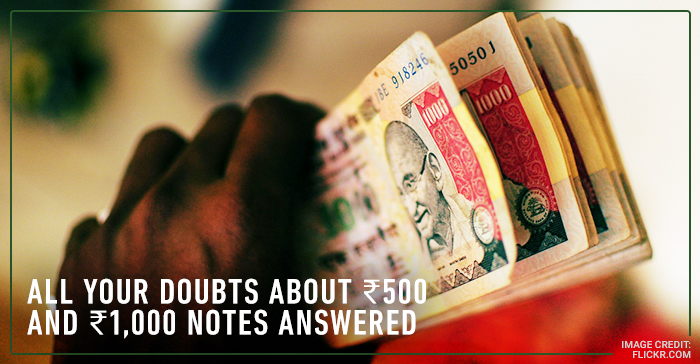
In a landmark move to curb black money, corruption and counterfeit currency, Prime Minister Narendra Modi made an unexpected announcement of the withdrawal of ₹500 and ₹1000 notes as legal tender, effective 8th November 2016. While many have welcomed this move, many other are apprehensive about the outcome of the decision.
Here's what you need to know about the scheme and how to go about exchanging the existing currency notes:
You still have 50 days to exchange/deposit for the same value at any of the 19 offices of the Reserve Bank of India or at any of the bank branches or at any Head Post Office or Sub-Post Office till the 30th of December.
For your immediate needs, you can go to any bank, the head post office or sub-post office, show your identity proof (could be your Aadhaar Card, Driving License, Voter ID Card, Pass Port, NREGA Card, PAN Card or any Identity Card Issued by Government Department), and exchange your old five hundred or thousand rupee notes for new notes. The limit for such exchanges has been set to ₹4000 till 24th November, but the limit will be increased in the future. Anything over and above ₹4000 will be receivable by way of credit to a bank account.
If you are unable to exchange your notes by December 30, you can declare them with the Reserve Bank of India till March 31.
Withdrawing from ATMs can take a while to be possible as the banks are still recalibrating their old systems. Once functional, you will be allowed to withdraw up to a maximum of ₹2,000 per card per day up to 18th November. The limit will be raised to ₹4000 per day per card from 19th November onwards.
You are allowed to withdraw cash against withdrawal slip or cheque with a limit of ₹10,000/- in a day within an overall limit of ₹20,000/- in a week (including withdrawals from ATMs) till 24th November.
₹500 and ₹1,000 notes will be accepted for an additional 72 hours in places of importance such as hospitals, railway ticket booking counters, government bus stands, and airports until 11 November midnight.
If you are currently not in India, you may choose to enable another person in India to deposit the notes on your behalf in writing. The person so authorised has to come to the bank branch with the notes, the authority letter provided by you and a valid identity proof.
If you are a foreign tourist, you can purchase foreign exchange equivalent to ₹5000 using the ₹500 and ₹1,000 notes at airport exchange counters within 72 hours after the notification, provided you present proof of purchasing the notes.
New notes of ₹2,000 and ₹500 will soon start circulating from November 10.
If you still have doubts, you may approach the control room of RBI by email. You can mail to publicquery@rbi.org.in or call 022 22602201 / 022 22602944.
Furthermore, to get a clearer understanding of the situation, we spoke to financial expert CA Rishabh Parakh who explained that unless the cash at your disposal was generated out of unlawful means and illegal transactions, you have nothing to worry about.
Here are a few tips he outlined that we can take to handle the situation:
Know your Cash Position/Prepare Cash flow summary: Update your book of accounts immediately to know your cash position to track how much amount of cash balance out of your capital account has been generated. Though most businessmen would understand this, but a salaried employee is usually unaware about this and most probably haven't prepared their Balance sheet for that matter.
The time has come to prepare your 'Cash Flow Statement' over the last few years. Apart from using your past income tax returns data, you will also need to look at your cash withdrawals from ATMs or your Bank account to create the statement. This exercise will help you in justifying the cash available to you.
No need to worry about your Cash Deposit: There are various reports stating that you shouldn't deposit more than ₹2.50L in one go or ₹10L lakh in a year (01/04/2016 to 31/03/2017) in your savings bank account as it may attract income tax notice. Any unexplained or unmatched deposits of over above Rs 2.5 lakh during this 50-day window could attract income tax along with a 200% penalty in case of any income mismatch. So, yes, a person with unaccounted black money will have a reason to worry.
But, for those whose money is well accounted for, there's nothing to worry about. The same has been declared in your tax returns as cash income and taxes have already been paid on the same. In this case, an even higher amount of deposits will not be an issue. However, you may have to justify your deposits by submitting an evidence in case of an enquiry.
You can refer to Rishabh's last column on income tax notices and how to handle the same.
File your Tax returns: File them as soon as possible, if the same are not filed for the last two financial years as beyond that you cannot file them. Your income tax return will be matched to see the cash you are depositing and in case you haven’t filed your tax returns, then chances of you getting a notice or an intimation are very likely. Be on the right side of the law and comply with taxation rules with immediate effect.
Using your account for others: Don’t use your account for depositing money for someone else as it will be extremely difficult to justify in case of any enquiry. Your simple act of support to someone will land you in a big soup.
Wallets payments: Use e-wallets, net banking facilities and debit & credit cards in case of any urgent transactions.
Don’t reshuffle your existing investments: Do not shuffle any of your legitimate investments to bank deposits. Let the mutual funds, equity and other financial instruments that you have invested in be stationery. Let the chaos pass.
A permanent measure is likely to cause some temporary pain but in the long run, its implications are expected to be only looked at as profit. Let us all welcome this move which has the potential to change our lives for better and bring forward a corruption free society.
If you have any queries about these new policies, write to us jaagorein@gmail.com or comment on our Facebook and Twitter pages.
Special thanks to Rishabh for helping us out with his expertise in this field. A Chartered Accountant by profession, he is also the founder Director cum Chief Gardener of Money Plant Consulting, a leading tax and investment service provider. He also writes for several leading publications in India.
Share this story on
Curbing Violence In India By Gender-Sensitising Kids From An Early Age: Enfold

Enfold has worked with over a lakh children on gender, safety and self-empowerment. Their involvement with children brought forward several biases and prejudices that young children in our country live with, and they’ve uncovered several cases of abuse among both boys and girls. They shared a few of their insights with Jaago Re, explaining the gravity of the situation in India, and how gender sensitisation can play a crucial role in freeing our children from these biases.
Challenging power equations
The idea of power equations emerges from one’s own idea of gender. For example, here’s what a boy witnesses throughout his formative years – a working father who brings home the money and therefore assumes the role of power over the entire family, whereas, the mother is subservient to the rest of the family and the father - thereby making her look weaker and submissive.
When this boys grows up and sees this gender dynamic being threatened, he tries to challenge it. Many a times, it’s challenged through aggression, violence, bullying, or even blackmail. Of late, the most gruesome assault cases we have seen are all about one gender enforcing power over the other.
How does gender bias affect the upbringing of young boys?
It is a common misconception that only girls face identity problems when growing up. Today, young boys are being exposed to ideas such as “it’s okay for a man to cry”, “It's okay for a man to be a stay-at-home dad”, etc. These ideas challenge age-old gender notions. Boys are also going through a hoard of hormonal changes, conflicts about their identity, etc., which are often left unaddressed. Therefore, it is imperative to counsel young boys on gender sensitization along with girls.
On shifting rigid beliefs and attitudes through gender sensitisation
We held a before-and-after quiz among the kids, asking them a set of questions relating to gender and behaviour. Some of the questions asked were:
“Would you cook or ask your sister to cook?”
“Is a girl a family's responsibility or is she a burden until she's married?”
We noticed a clear shift in attitudes post training sessions because of the positive responses we received. It only proves that if we start young, we can create a healthier, safer, and a more respectful society for everyone. Gender sensitisation is the understated need of the hour.
On gender biases that lead to abuse & crime
All kinds of abuse starts from gender bias and gender disparity. The immediate need is to implement gender sensitisation so as to help curb violence and abuse. Therefore, it is important to remove all forms of gender discrimination, gender bias. We teach kids to acknowledge and respect the differences between both genders and that feelings, qualities, emotions, and intelligence are not gender specific. We emphasize that both boys and girls have a right to cry or do things that one usually associates with just one gender. Without gender sensitisation, our children will not be able to cope with the changing gender dynamics, and this will probably lead to more instances of gender violence.
The clock is ticking. Are you ready to be a part of the solution? Join our movement to make gender sensitisation accessible to all school children in India:
Be a part of Tata Tea’s initiative and sign the petition today! Visit Alternatively, you can also dial 7815966666 toll free.
Alarm Bajne Se Pehle Jaago Re!
More on the Expert:
Share this story on
How Schools can change the future of Sports in India

Where do children play?
Everyone seems to agree that children should play, and that more children should play as often as possible. However, the problem is not “Why should children play?” The real problem is “Where?”
With increasing urbanization, open spaces are disappearing in cities as well as smaller towns. Also, with increasing traffic congestion, the commute time for parents and children is a hassle. Children spend an hour travelling to-and-from the sports venue. In addition, the parent must arrange transport or drive the child and wait around while the child plays. Most parents do not have such a luxury of time or resources.
Therefore, due to a combination of disappearing open spaces/playgrounds near our homes and the hassles involved in commute, children are not playing as much as they used to a generation ago. This has contributed to significant increase in obesity levels, mental disorders and lack of social skills amongst children.
However, there is a clear solution. Schools present the scalable and sustainable solution for getting children to play. Schools can solve these problems by making sports an integral part of education.
Aggregation of children:
Every class has 25-50 children of a similar age, height and weight category and they show up every day, throughout the year. No separate transport logistics need to be managed or ongoing marketing needs to be in place to ensure children show up. There is a Physical Education timetable that runs round the year.
Synchronization of children:
Physical Education (PE) & Sports is mandatory in all schools (though it is often followed merely in letter than in spirit). So, all the children in a class come out at the same time during their PE/Sports period.
Space:
Most schools do have some space for children to play. Programs can be structured and designed to make effective use of limited time and space.
Fees:
Sports and PE is an integral part of Education. Parents pay fees and the fees cover PE and Sports for all children, along with other studies. Parents expect their child to be taught Physical Education and Sports with the same structure, rigour, individual assessment, daily lesson plans and by a trained teacher – just as they would for Math or Science. The budgets have to keep these factors in mind.
Not only budgets, but also space and time has to be aligned based on the number of students in school. With all the resources at hand, it is only sensible for schools to make sports compulsory and run it efficiently.
Lack of Space:
Lack of space in schools is often touted as a reason for not conducting the in-school PE/Sports program. However, most PE/Sports programs for children can be covered in a basketball court-sized space.
Adults make a common mistake of confusing sports with match play and visualise large grounds when they think of sport. However, if you analyse a professional sports team’s practice calendar, you will find that they spend time on three aspects: fitness, skills and match play. They spend 80% of their time on developing fitness and skills required to play the game better. For this, they use a small corner of the ground, never the whole field. If professional teams can work with small spaces, why can’t we get our children to play in schools?
A structured sports education program ensures the best use of the limited space and time available in a school. As parents and responsible citizens, we need to demand more from our children’s in-school Physical Education & Sports Program so that children get the benefit of the fees paid to the schools.
Sports need to be made compulsory in schools, just like Mathematics or Science. Sports is Education.
Join us in our quest to build a culture of sports in India.Visit or call 7815966666 (toll free) to sign the petition to the HRD Ministry, to work with the sports ministry and implement sports as a compulsory subject in schools, and advise state governments to implement this across all educational institutions.
More on the Expert:
Share this story on